Teff
Ethiopia/Eritrea
History meets tasting
Historical and cultural context
FAO places teff’s origin in Ethiopia and highlights cultivation in Ethiopia and Eritrea.
Sensory guide
In injera, fermentation creates variable acidity and a supple, porous texture.
Skill to observe
Compare grain, flour and flatbread: fermentation changes the sensory profile.
Indicative sensory descriptions: variety, fermentation, cooking and accompaniments change the result. Catalogue illustrations, not a shared botanical scale.
FAO · International Year of Millets FAO · Traditional fermented food and beveragesUnderstanding : Teff
INTRODUCTION
Teff (Eragrostis tef) is now establishing itself as an African “super-grain,” celebrated for its gastronomic versatility, agricultural resilience, nutritional richness, and deep cultural roots. Originating from Ethiopia and Eritrea, this tiny grain, to which the longevity and vigor of the peoples of the Horn of Africa are attributed, symbolizes the link between man, land, spirituality, and community. While its name has become global thanks to “gluten-free” and “superfood” dietary trends, teff has been much more than a simple food for millennia: it forms the very identity of Abyssinian cuisine, structures the social and religious calendar, nourishes families, accompanies rituals, and testifies to the agronomic ingenuity of African societies. This text offers an exhaustive description of teff: botany, agricultural cycle and practices, culinary heritage, processing techniques, social and symbolic dimensions, nutritional value, place in modern Africa and the diaspora, challenges, and future prospects.
Where to find it
Look for the exact food-grade form required by the recipe at markets and specialist shops. Check the product name, ingredients, condition and storage instructions.
Explore further: Cooking tips · Food hygiene and safety advice.
Search Amazon.fr — affiliate link →
Check availability and delivery on Amazon.fr. Compare ingredients, packaging and sellers.
As an Amazon Associate I earn from qualifying purchases.
History and uses
1. ORIGIN, BOTANY, AND DOMESTICATION OF TEFF
1.1. African Roots Teff is an annual grass of the genus Eragrostis, native to the Ethiopian plateau and domesticated over 6000 years ago. Its cultivation remains almost exclusive to Ethiopia and Eritrea today, although its growth is now reaching North America, Europe, and Australia, driven by the “gluten-free” trend. Cultivated in the Blue Nile Valley, the Shewa region, Tigray, Amhara, Oromia, it is also found on mountainous highlands up to 3000m, in fertile humid or semi-arid pockets. 1.2. Grain Morphology Teff is distinguished by the smallness of its grains: it is the smallest cultivated cereal in the world (approximately 0.8 to 1.0 mm in diameter, 150 times smaller than a grain of wheat). There are different colors of teff: white (netch teff), red (kay teff), brown/black (tikur teff), each having its flavor, reputation, and market value. 1.3. Robustness and Agricultural Cycle A low water-consuming plant (adapted to drought), teff resists diseases, soil leaching, quickly recovers after a drought, and thrives on poor to gravelly soils, while also being able to adapt to sandy, silty, or acidic terrains. The agricultural cycle lasts 3 to 5 months, from sowing to harvest; harvesting is manual, threshing traditional or mechanical depending on the region.
2. HISTORY AND SOCIAL ANTHROPOLOGY
2.1. Historical and Symbolic Role Teff has nourished Ethiopia since time immemorial, traversing all periods of peace, famine, migration, prosperity, or hardship. Unlike wheat (often imported), corn, or barley, it is seen as “the grain of blood, life, and Ethiopian identity.” Teff cultivation structures villages, agricultural calendars, the cycle of Orthodox and Muslim religious holidays, and local exchange systems. 2.2. Identity Link “No teff, no injera (a spongy, fermented flatbread); no injera, no Ethiopia”: the proverb summarizes the patrimonial centrality of the grain. Owning a teff field is a sign of respectability, stability, connection to ancestral land, and the ability to feed one's family and welcome the community.
3. AGRICULTURAL CYCLE, VARIETIES, VALUE CHAINS
3.1. Peasant Practices and Know-how • Sowing: broadcast “by hand” in plowed fields, sometimes associated with rotation with legumes, barley, or beans. • Few chemical inputs, fertilization based on manure or compost, manual harvesting (scythe, sickle), threshing on a beaten earth floor, winnowing in the wind. • Peasant diversity: traditional seeds frequently exchanged during festivals, weddings, or offered to the next generation. 3.2. Sector, Economy, and Governance • Teff structures a key sector in Ethiopia: nearly 30% of cereal areas, more than 50 million people involved (producers, collectors, millers, bakers). • Price often higher than wheat or corn, due to high demand (weddings, festivals, export, premium injera), but also its arduous harvesting. 3.3. New Frontiers • Innovations: introduction of improved lodging-resistant varieties, trials in Eritrea, Sudan, South Africa, Kenya, then America and Europe (Oregon, Netherlands, Spain) thanks to the diaspora and “superfood” entrepreneurs.
4. PROCESSING AND PLACE IN AFRICAN CUISINE
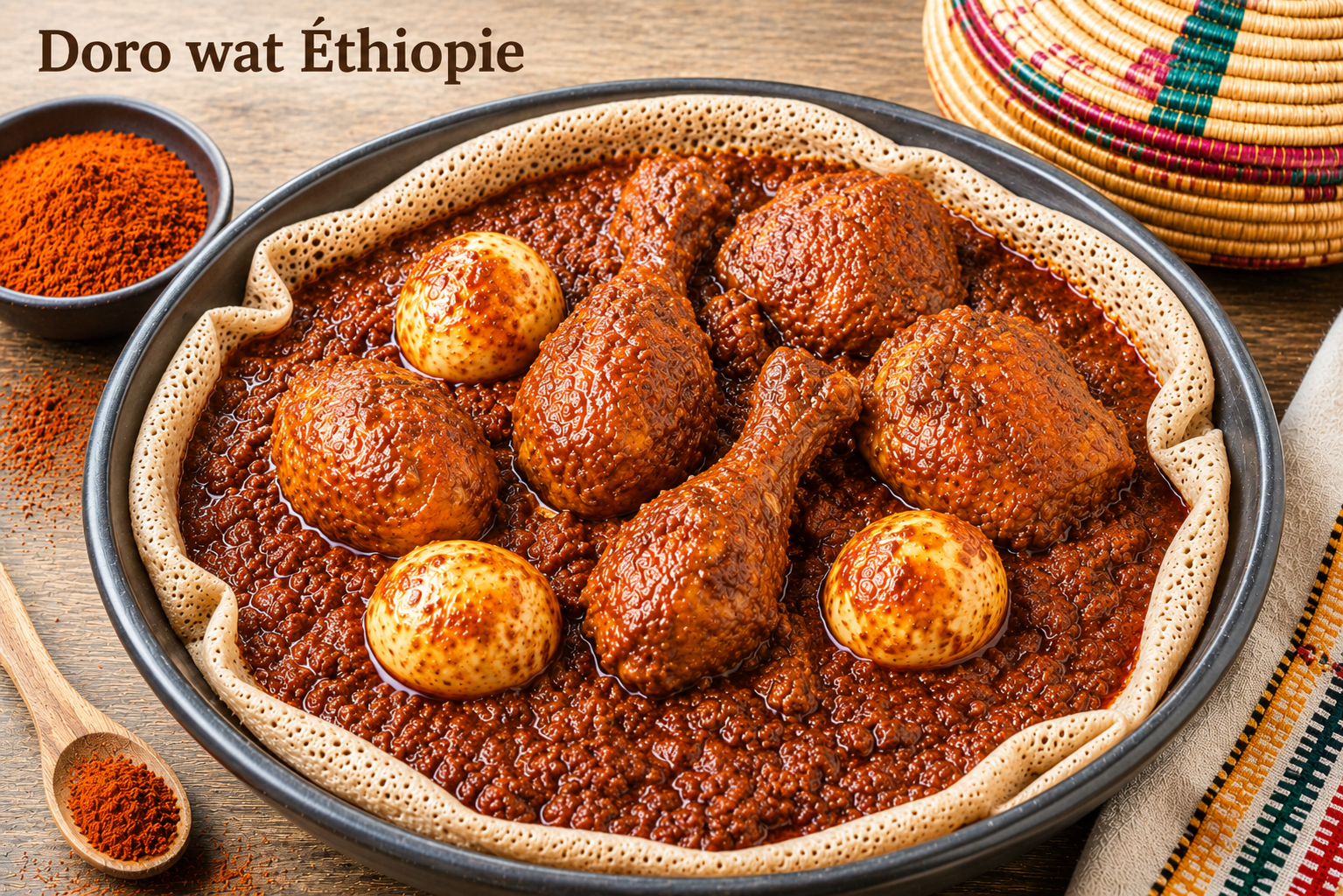
4.1. Fermentation Star: Injera The main use of teff is the making of injera (a spongy, fermented flatbread), the famous fermented pancake that serves as bread, plate, and cutlery. Process: • Teff ground into flour (traditionally on a stone mill, today also industrially). • Mixed with water, sometimes a starter (“ersho,” a sourdough starter), and left to ferment for 36 to 72 hours. • Once the dough is fermented (bubbles, tangy taste), poured onto a large clay or cast iron griddle (mitad), partially steamed to obtain a soft, porous texture (yeqwan). Injera is shared at every meal: all wot (stews), salads, vegetables, meats are placed on it, and it is torn by hand to pick up each bite. 4.2. Other Uses • Thin porridge (atmit, genfo): for infants, athletes, the elderly. • Thick porridge, breakfast creams, baked bread, fritters, flatbreads, biscuits, sweet snacks. • Tella (a traditional Ethiopian beer): traditional fermented beer popular in rural areas, a basis for fermentation and socialization. • Modern biscuits, energy bars, teff couscous in urban cuisine. • Modern addition: in Western breads (gluten-free mix), pancakes, muffins, organic pasta, granolas. • Leaves and stems: used as fodder for livestock. 4.3. Diasporic and Afro-fusion Cuisines • Teff travels thanks to the diaspora in America, Canada, Europe: Ethiopian/Eritrean restaurants, food trucks, African brunches. • Revisited recipes: teff pancakes, savory granola, burgers, wraps, African sushi, healthy crackers. • Valued in organic markets, Afro stores, vegan grocery stores, by nutritionists and gourmets.
In my books

Continue exploring the continent’s cuisines with Africa at the Table — 54 countries, 54 iconic dishes, by Alioune FALL. This book is in English.
Explore further
5. SOCIAL, SYMBOLIC, AND RITUAL DIMENSIONS
5.1. Ritual, Celebration, Hospitality • Injera is the support for wedding meals, baptisms, Orthodox and Muslim religious ceremonies, funerals, returns from migration, “meskel” (cross) festivals. • The fertilization of a teff field, the first harvest, are celebrated collectively (songs, dances, gifts). • Offering teff, sharing injera, means forging kinship, solidarity, inviting peace. 5.2. Work, Gender, Transmission • Women are queens of transformation: know-how of fermentation, “just right” cooking, art of cutting, presentation of the dish. • Mother-daughter transmission, village mutual aid, informal learning, and respect for elders. • Field, mill, and market artisans are valued: “living” memory of teff culture.
6. NUTRITIONAL VALUE AND HEALTH BENEFITS
6.1. Nutritional Assets • Rich in protein: 12-16%, essential amino acids (lysine rare in cereals). • Iron, calcium, magnesium: unparalleled content by other cereals. • Soluble and insoluble fiber: digestive support, satiating effect, glycemic regulation. • Gluten-free, low glycemic index, well tolerated. • Source of vitamins (B1, B2, B3) and antioxidants. • Dough fermentation: better assimilation of minerals (reduction of phytates), prebiotic effect. 6.2. Health Benefits • Prevention of anemia, diabetes, recommended for children, athletes, pregnant women. • Recommended in clinical nutrition, celiac diets, 21st-century diets.
7. MODERNITY, EXPORT, ISSUES, AND CHALLENGES
7.1. Internationalization and Organic Market • Teff has become a star in Western and North American organic markets (bread, bars, granolas, crackers), its price has exploded, creating tensions between local production and export demand. • Agri-food boom in Ethiopia (7% of agricultural GDP), new sectors, but a need to protect heritage, local consumption, popular accessibility. 7.2. Food Security, Rural Innovation • Potential for rural revitalization, fight against erosion, soil degradation, rural poverty through the valorization of peasant seeds, women's cooperatives, integration into public nutrition and school programs. 7.3. Challenges • Threat of monoculture, risk of patents on varieties (“biopiracy”), speculation on agricultural markets. • Fragility of knowledge transmission in the face of urbanization. • Need for equitable sharing of gains among producers, processors, exporters, support for local markets.
CONCLUSION Teff symbolizes the strength, stability, creativity, and memory of African cuisine. An ancestral grain from the Abyssinian plateau, it links terroir, identity, innovation, and health. From the Ethiopian village to trendy world food tables, from ritual injera to new energy bars, it shows the power of traditional agriculture combined with modernity. Preserving, transmitting, and reinventing teff means defending food sovereignty, public health, agronomic heritage, the culture of solidarity, and the creativity of an Africa that nourishes the world — and feeds on its roots as much as its future.
In the kitchen : Teff
Recipes from the site to put your knowledge into practice:
Discover these cuisines at a restaurant
Explore our restaurant and caterer directories. Choose your destination and check the establishment’s menu to confirm which dishes are offered and available.
Continue exploring
Enjoy discovering ingredients and African cuisines? Join our newsletter. The illustrated PDF 10 sauces africaines incontournables is in French and is offered after confirming a subscription to the French or bilingual edition.