Thiéboudienne
Saint-Louis · Senegal
History meets tasting
Historical and cultural context
UNESCO links its origins to Saint-Louis island fishing communities; inscribed in 2021.
Sensory guide
Broth-infused rice, fish and vegetables: marine depth and contrasting textures, depending on the recipe.
Skill to observe
Observe broth absorption by broken rice and separate cooking of delicate ingredients.
Indicative sensory descriptions: variety, fermentation, cooking and accompaniments change the result. Catalogue illustrations, not a shared botanical scale.
UNESCO · 01748 · 2021Understanding : Thiéboudienne
INTRODUCTION
In the pantheon of African dishes, thieboudienne (also spelled tiebudienne, ceebu jen, or chebu jen in Wolof, literally “rice with fish”) holds an exceptional position. Originating from Senegal, this dish is now celebrated – with its variations – throughout West Africa, among African diasporas on all continents, and even in renowned restaurants in Paris, London, or New York. More than just a recipe, thieboudienne embodies Senegalese memory, pride, creativity, conviviality, and generosity, as well as the extraordinary capacity for adaptation and dissemination of West African cuisine. Its very name summarizes the philosophy of the dish: "thieb" meaning rice, "oudienne (or jën, jen, dien)" fish. But behind this modest name lies culinary and symbolic complexity, a diversity of techniques and ingredients, social and historical depth, and a major impact on the food culture of Senegal and, more broadly, Black Africa. Thieboudienne is much more than the continent's "paella": it reflects expertise, a history of culinary blending, and an art of sharing. This essay offers a detailed analysis of thieboudienne, from its origin to its technical and cultural subtleties, including its nutritional values, variations, social importance, and its place in African modernity and globalization.
1. HISTORY AND ORIGINS OF THIEBOUDIENNE
1.1. The roots of a world dish Thieboudienne was born on the Senegalese Atlantic coast, specifically in Saint-Louis, a former colonial capital, trading port, and multicultural crossroads. It was there, in Wolof kitchens, that this unique marriage between fresh fish (abundant thanks to the Atlantic) and rice (imported via the European navy from the 19th century, then cultivated in the Senegal River valley) came into being. The original recipe, inherited from the mythical cook Penda Mbaye, links indigenous culinary techniques (stuffed fish, root vegetables, one-pot cooking) with the introduction of rice, an imported product that became a staple food, then local with the development of rice cultivation. The dish also incorporates tomatoes (introduced in the 20th century), giving its characteristic red color to the “red” version. This reflects the history of Senegal: a melting pot of peoples, ingredients, European, Arab, and African influences. 1.2. Dissemination and appropriation Rapidly, thieboudienne spread beyond Saint-Louis, reaching Dakar and all of Senegal, extending to Mauritania, Gambia, Guinea, Cape Verde, Mali, Ivory Coast… Under other names, it established itself as a model for communal, festive, and daily dishes. It also became Senegal's “identity” dish, a marker of "teranga" (hospitality), celebrated in the diaspora, and even inscribed on UNESCO's intangible cultural heritage list since 2021.
2. TRADITIONAL INGREDIENTS AND PREPARATION TECHNIQUES
2.1. The constituent elements • Fish: mainly fresh sea fish (thiof, sea bream, captain fish, mullet, barracuda, carp…); sometimes smoked/dried fish for umami. • Broken rice: typical of Senegal, broken rice absorbs sauce and aromas better, giving a firm and tender texture. • Vegetables: o Root vegetables (cassava, sweet potato, carrot, turnip) o Green vegetables (cabbage, African eggplant “diakhato/chou kâgne”, sometimes okra, fresh tomato) o Fresh chilies • Fish stuffing ("rof" or "farse"): o Mixture of parsley, onion, garlic, chili, bouillon cubes (Maggi, Jumbo), salt, sometimes lime. • Tomato sauce: concentrate and/or fresh tomato for the red version, or without tomato for tiebou guinar ("chicken rice") or tieb blanc ("ceebu jën bu wekh"). 2.2. Key preparation steps
- Fish preparation o Gutted, washed, incised, then stuffed with rof into the flesh (deep pockets to diffuse the aroma).
- Searing the fish o Pan-fried or seared in the pot: the fish is quickly browned to firm the flesh and impart a slight grilled taste.
- Broth cooking o Sautéed chopped onion base with peanut oil, addition of tomato paste, spices, searing of the fish, then abundant liquid. o Vegetables, chilies, smoked fish are added to the broth.
- Broth extraction, rice cooking o Vegetables and fish are removed when they are “al dente”. o The rice, carefully washed to remove starch, is cooked by absorbing the broth or steamed above the pot (“dëkkal” method).
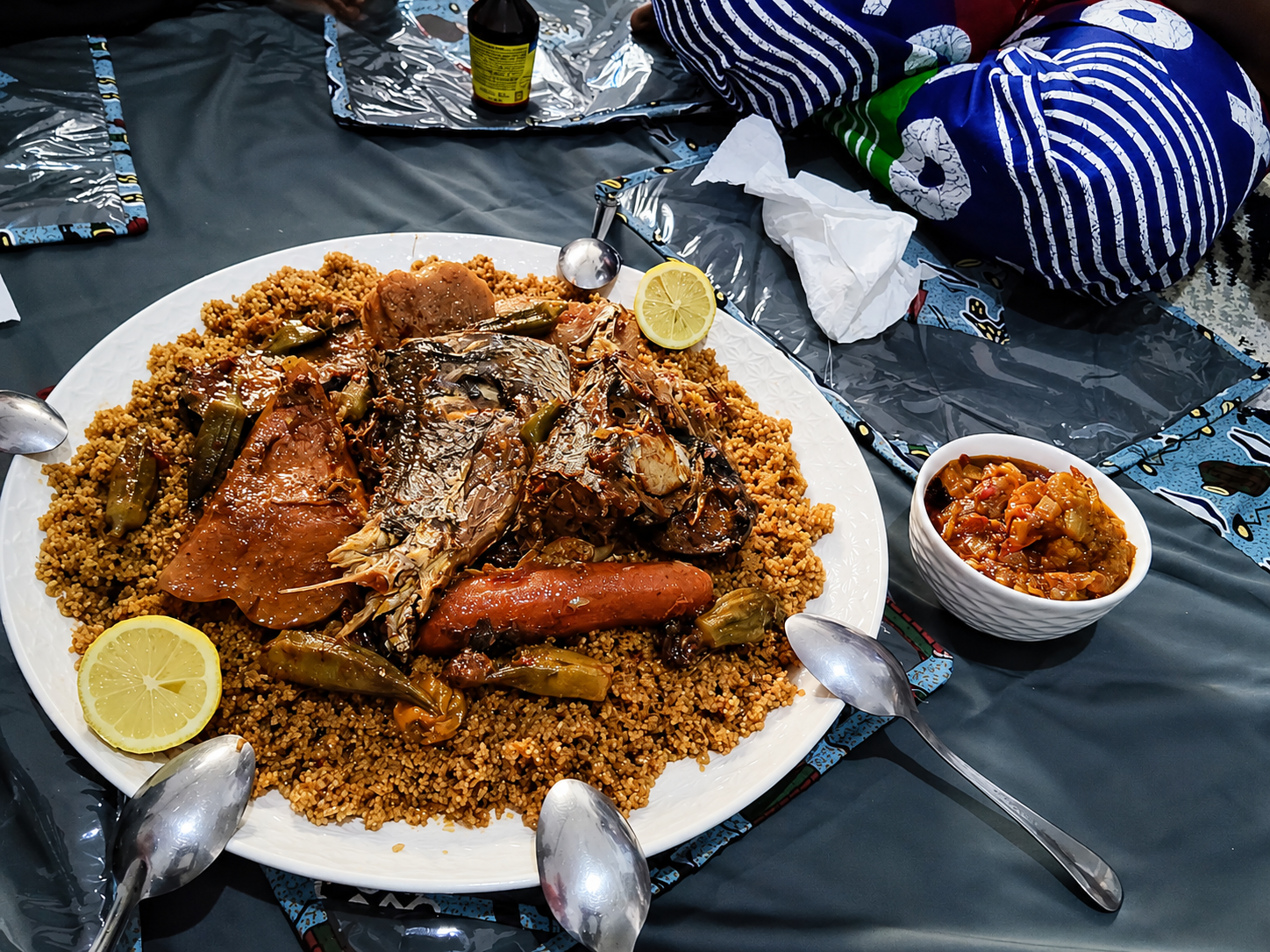
- Final assembly o The rice is arranged in a large communal dish, with vegetables, fish, and chilies harmoniously placed on top, drizzled with a little broth or flavored oil.
- Finishing: some add yët (dried mollusk), nététou (fermented néré condiment), pounded bissap (sorrel), or a spicy accompanying sauce.
3. VARIATIONS, ADAPTATIONS, AND RELATED RECIPES
3.1. Thieb variations • Ceebu jën "red": the most well-known; tomato sauce, colorful dessert. • Ceebu jën bou wekh ("white"): tomato-free version, lighter, where the rice remains blond, tone-on-tone. • Ceebu yapp (meat rice, beef, mutton, chicken): urban adaptation or for fish-free days. • Ceebu guinar: chicken rice. • Thieb with fonio, millet, corn: rural or modern innovations, when rice is scarce. 3.2. West African derivatives and cousins • Jollof rice (Nigeria, Ghana, Togo, Sierra Leone…): rice cooked with tomato, vegetables, with or without meat; each country claims “the best jollof”; the competition is famous. • Riz gras, riz sauce, wolof rice (in Gambia, Mali, Ivory Coast, Guinea). • Influences in Senegalese dhal bat, benachin (Gambia).
4. SOCIAL PLACE AND SYMBOLISM OF THIEBOUDIENNE
4.1. Dish of sharing, generosity, and identity Thieboudienne is served in a large bowl or dish (“communal bowl”), around which family and guests gather, sitting on mats, each picking with their right hand (according to custom) or a spoon from their area of the dish. Noble pieces (fish head, carrot tip, chili) are symbolically distributed: to guests, elders, children, the head of the family. Serving a good thieb, generously garnished, well-flavored, varied in colors and textures, is proof of “teranga”: hospitality, honor, welcoming capacity, social bond. 4.2. Role in life cycles • Religious holidays (Tabaski, Ramadan, Easter) • Weddings, baptisms, funerals • Important visits, healing, departures and returns from travel • Friday break, “special” Sunday meal 4.3. Transmission and female expertise The preparation of thieb can last several hours and requires perfect mastery: cutting vegetables, seasoning, managing cooking (so that neither fish nor vegetables crumble), knowing how to “hydrate” the rice without turning it into mush. It is an art passed down from mother to daughter, from aunt to niece, a sign of domestic and social dignity.
5. NUTRITIONAL VALUE, HEALTH, AND BALANCE
• Source of complex carbohydrates (rice), noble proteins (fresh fish), fiber, vitamins (root and leafy vegetables), minerals (smoked/dried fish, mollusks, néré). • A complete meal often less fatty than it seems, traditionally very lightly salted (compensated by spices and broth), optimized by the diversity of garnishes. • Role in urban food security: caloric quality, satiety, ability to feed large families at a reasonable cost. • Adaptability: ingredients are adjusted according to seasons, market, and means (addition/omission of meat, eggs, vegetables, condiments).
6. MODERNITY, DIASPORA, AND INNOVATION
6.1. Diaspora and globalization Dakar, Paris, Brussels, New York… thieboudienne has become the standard-bearer of global Senegalese cuisine, served in Michelin-starred restaurants, food trucks, Afro brunches, street food, and family tables. It appears in culinary shows, international competitions, on Instagram or TikTok. It is a reunion dish for the diaspora, a “Proust's madeleine” for those from the country. 6.2. Fusion, adaptability, health • Vegan version (tofu or plant proteins, vegetables, fish replaced by seaweed or mushrooms). • New gastronomy: minute thieb, sushi-thieb, bowl-thieb, thieb rice cake, etc. • Rediscovery of local “superfoods”: local rice, millet, fonio, local fruits. • Promotion of “made in Africa”, short supply chains, organic sectors. 6.3. Issues and challenges • Fight against industrial standardization (ready-made sauces, artificial flavors, cubes). • Valorization of local rice versus imported rice. • Preservation of regional and national diversity. • Training of the new generation (workshops, videos, books, festivals…).
CONCLUSION Thieboudienne is much more than “rice with fish”: it embodies the soul of Senegal, the art of sharing, popular creativity, the memory of women, and the vitality of African modernity. It transforms, innovates, travels, unites, heals, and nourishes: it is both memory and future, identity and openness, a dish of the people and of celebration. Preserving, celebrating, and transmitting thieboudienne means defending a generous, inventive, flavorful Africa: an Africa at the table, open to the world, proud of its history, and master of its gastronomic destiny.
Practical notes and Senegalese terminology
Ceebu jën means “rice with fish” in Wolof. Its associated culinary art was inscribed on UNESCO’s Representative List of the Intangible Cultural Heritage of Humanity in 2021: this recognition concerns skills and transmission, not just a recipe. Red and white versions differ notably in their use of tomato; neither is simply tomato rice.
Prepare this speciality
Choose a detailed recipe, adjust the portions and prepare your ingredients before starting. Our cooking tips and food safety advice complement the steps described in the recipes.
Explore further: Cooking tips · Food hygiene and safety advice.
In my books
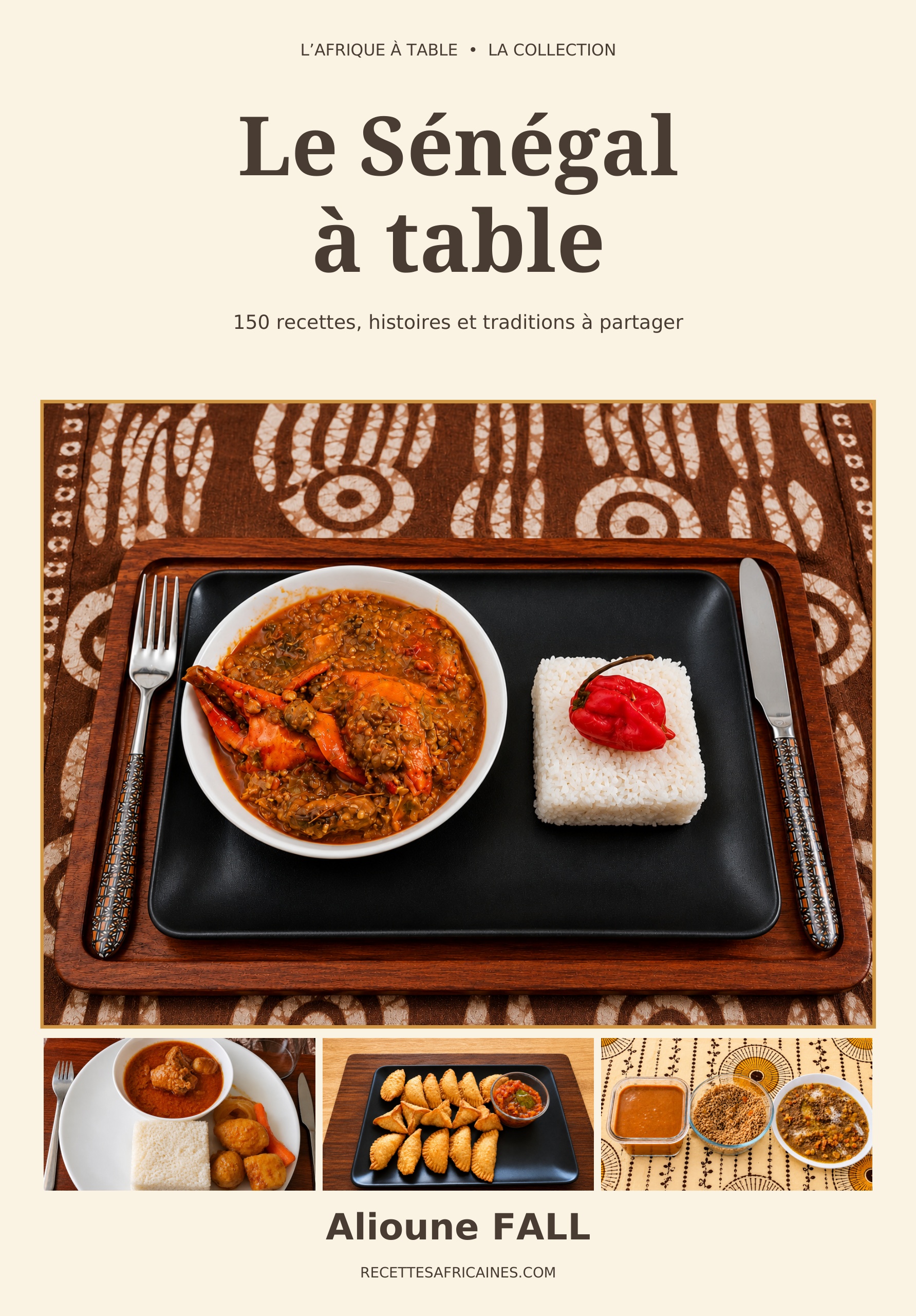
Explore Senegalese cooking with Le Sénégal à table, my collection of 150 recipes, stories and traditions to share. This book is in French, by Alioune FALL.
In the kitchen : Thiéboudienne
Recipes from the site to put your knowledge into practice:
Discover these cuisines at a restaurant
Explore our restaurant and caterer directories. Choose your destination and check the establishment’s menu to confirm which dishes are offered and available.
Continue exploring
Enjoy discovering ingredients and African cuisines? Join our newsletter. The illustrated PDF 10 sauces africaines incontournables is in French and is offered after confirming a subscription to the French or bilingual edition.