Ugali
Swahili (East Africa)
Understanding : Ugali
INTRODUCTION
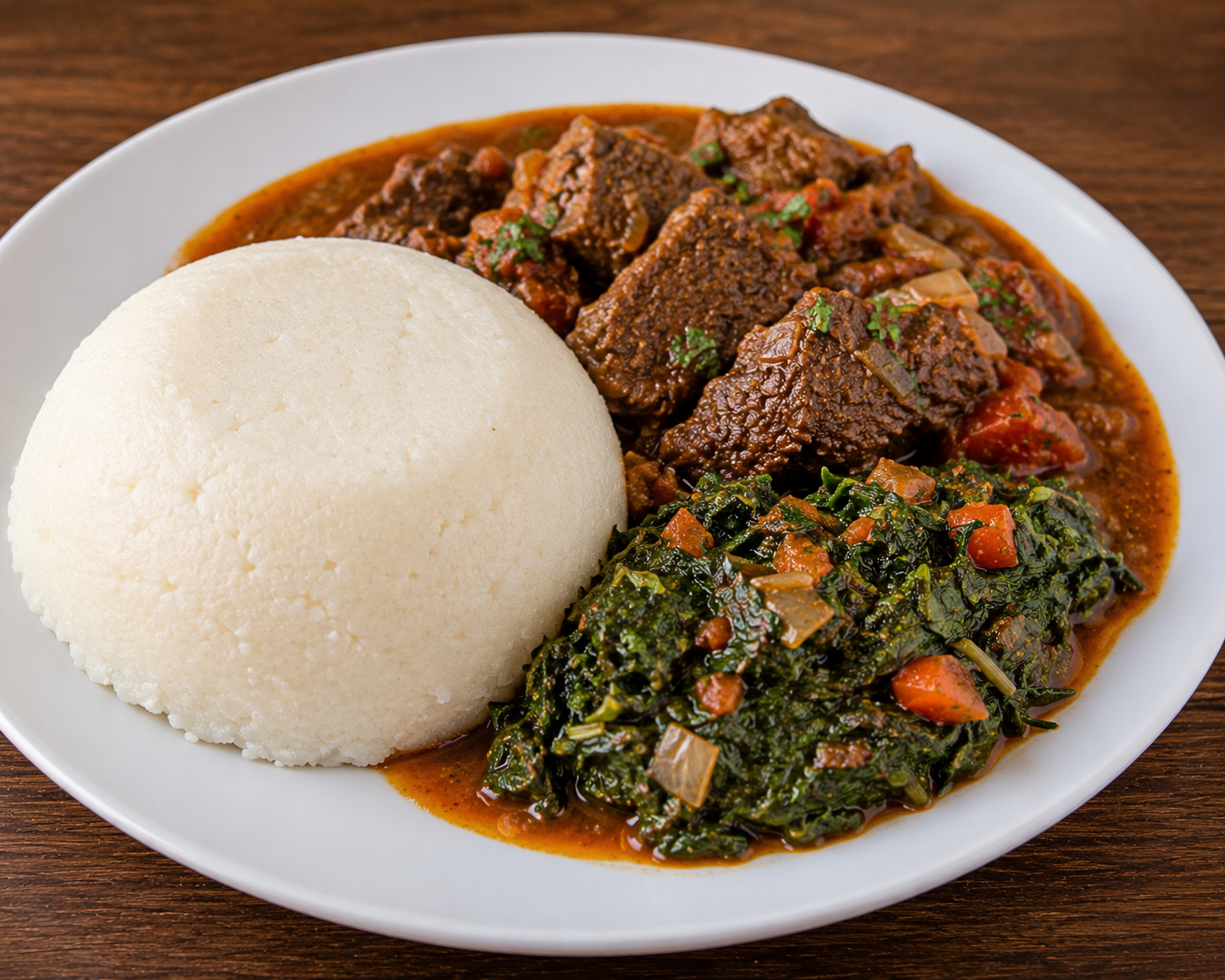
Ugali is one of the most iconic staple foods in East and Central Sub-Saharan Africa. A humble dish yet deeply rooted in daily life, it is synonymous with sustenance, identity, conviviality, and resilience. Behind this name, also found as "nsima" (Malawi, Zambia), "sadza" (Zimbabwe), "posho" (Uganda), "pap" (South Africa), "nshima", "foufou", "bugari", "bangi", or even "ugali wa mahindi" (Swahili: “corn ugali”), lies a technique and know-how passed down from generation to generation. From the Kenyan coast to the Rwandan highlands, from the Tanzanian savannas to Congolese villages, from South African townships to Kampala markets, ugali (and its cousins) forms the foundation of meals, a source of energy, satiety, and sharing. It is at the heart of eating practices, celebrations, rural and urban life, a true “daily bread of the African pot.” This text offers a detailed description of ugali: its history, raw materials, techniques, regional variations, symbolic and nutritional value, social and family status, contemporary place, and challenges for African food sovereignty.
1. ORIGINS AND CULTURAL HISTORY OF UGALI
1.1. Before corn: millet and sorghum The origin of ugali dates back long before the introduction of corn (Zea mays) by the Portuguese in the 16th century. Originally, millet (Pennisetum glaucum, Eleusine), sorghum, pounded yams, cassava root, or even cooking bananas served as the base for this dense paste, deeply rooted in Bantu and Niger-Congo eating habits. The development of corn, which is more productive and appreciated for its taste and texture, gradually transformed the cuisines of East and Central Africa, changing the face of ugali, which today is primarily a paste made from cornmeal. 1.2. Diffusion and linguistic diversity Ugali is named differently according to regions and languages: • Swahili (Kenya, Tanzania, DRC, Comoros): ugali • Malawi, Zambia, Zimbabwe, Mozambique: nsima, sadza, papa, farinha, xima • Uganda: posho • Central Africa (DR Congo, Cameroon, CAR): bugari, corn foufou, cassava foufou • South Africa: pap • Angola: funge • Rwanda, Burundi: ubugari, ibirayi (if made from potatoes) • Nigeria, Ghana: tuwo masara, kenkey (in specific West African recipes) Everywhere, the technique remains quite similar: cereal powder or meal, water, cooking, vigorous stirring, warm serving.
2. INGREDIENTS AND TRADITIONAL PREPARATION TECHNIQUES
2.1. Raw materials • White corn: dominant in Kenya, Tanzania, Zambia, South Africa, Uganda, DRC, Rwanda, Burundi... • Millet, sorghum: still used, especially during the dry season, in drier sub-Saharan regions, or by nomadic pastoralists. • Cassava: as a substitute or mixed, in forest areas (DRC, Gabon, Congo, Cameroon). • Alternative flours: sweet potato, potato, plantain, rice, depending on the environment, time, and availability. Semolina, fine flour ("posho meal", "cornmeal"), but also semi-whole or whole flour depending on the terroir and social class. 2.2. Cooking techniques
- Boil water in a thick-bottomed pot (“sufuria” in Kenya). The classic ratio is about 2 to 3 volumes of water to 1 of flour.
- Add the flour gradually – like rain – while stirring with a robust wooden spatula (“mwiko”, “lufulu”, “muteteke” depending on the region).
- Stir, turn, and mash by hand (with muscle) to avoid lumps and prevent the paste from sticking to the bottom: the ugali must become homogeneous, dense, supple but firm.
- Cook covered for a few minutes, then a final stir – the mwiko “stands up” in the dish.
- Shaping: the paste is balled, or molded at the bottom of the dish, sometimes into individual portions, or left in the pot until serving. 2.3. Secrets of the gesture • Mastery of the water-to-flour ratio (too liquid = porridge, too dry = crumbly). • Stirring speed to prevent crusts and lumps. • Expected result: tender, elastic paste, neither sticky nor floury – that tears into a solid but flexible ball.
3. ROLE IN MEALS AND CULINARY PAIRINGS
3.1. Central food “of the African pot” Ugali is generally not a “standalone” dish. It is placed in the center of the table, surrounded by accompaniments: • Brown sauces, tomato sauces, or okra • Meat stews, chicken, fish (grilled, fried, in sauce) • Leafy greens (sukumawiki – Tanzanian/Kenyan collard greens –, amaranth, sweet potato leaves, spinach) • Legumes: beans, peas, lentils • Fresh cheese (“maziwa mala”), yogurt (in Ethiopia/Tanzania), curdled milk • Pondu (cassava leaves), ndolé, palm sauces 3.2. Tasting rituals Ugali is served hot, sometimes scalding. Each person takes (usually with the right hand) a small ball, shapes it between their fingers, makes a “well” with their thumb, then scoops up the sauce or a few pieces of meat/vegetable. The act is convivial, collective: eating ugali means sharing the meal, conversation, and family intimacy. 3.3. Moments in the day • Breakfast (more liquid, in the form of porridge) • Lunch/dinner (dense form, associated with sauced dishes) • Festive meals: always present at weddings, funerals, village festivals, official receptions.
4. REGIONAL VARIATIONS AND INNOVATIONS
4.1. By cereal • Sorghum/millet (Kiswahili: ugali wa mtama): reddish-brown color, more tart taste, richer texture, ritual value. • Ugali wa mhogo/ubugari (cassava): lighter, stickier, popular with children, quick energy, often found in the Congo forest, equatorial plains. 4.2. By consistency • Soft (nshima, posho): polenta-like texture. • Very dense (Zimbabwe, Rwanda) to hold rich sauce well. • Porridge (“uji”, “kikoma”, “lesto”) for breakfast for babies/children, pregnant women. 4.3. By enrichment • Addition of butter, oil, milk, salt (among Kenyan pastoralists). • Sprinkling of herbs, chilies, caraway, spice blends – urban influence. 4.4. By presentation • Rolls, cut rectangles, individual portions for buffets. • “Instant” version: pre-cooked semolina, innovations for migration/urban youth.
5. SOCIAL, SYMBOLIC, AND IDENTITY PLACE
5.1. Foundation of food sovereignty Ugali is very rarely absent from rural homes; it structures food autonomy, links the farmer to the land, and guarantees food during lean seasons or crises. 5.2. Sign of welcome and sharing Offering ugali means opening one's door, showing generosity, honoring the guest: reserving it in the center of the table, sharing from the same pot. 5.3. Ritual of transmission • Learning to stir ugali is entering adulthood (rite of passage). • Women who make “successful ugali” gain respect and status. • Initiation dish for young people, a test of household/culinary aptitude during marriage. 5.4. Identity marker • In Kenya: “Ugali na Sukuma wiki” embodies the vast majority of the population. • Zambians, Malawians, Tanzanians say: “without nsima, I haven't eaten.” • With every move, migration, urban displacement, or expatriation, ugali resurfaces as a memory dish.
6. NUTRITIONAL VALUE AND HEALTH
6.1. Energy intake • Rich in complex carbohydrates, very low in fat, satiating, easily digestible (if quality raw material). • Combined with vegetables, fish, meats: ideal nutritional balance for rural physical effort. 6.2. Fiber and dietary completeness • If whole grain flour: excellent source of fiber, minerals (magnesium, iron, calcium, phosphorus, potassium). • Combines with legumes to compensate for lysine deficiency (amino acid), typical of cereals. • Low glycemic index for certain unrefined variants. 6.3. Adaptation/limits • If excessive consumption of white flour: less fiber, risk of dietary monotony. • Interdependence with the corn market (vulnerability to price increases, precariousness of local supply chains).
7. MODERNITY, CHALLENGES, AND DIVERSITY
7.1. Urbanization and evolution • Ugali present everywhere: canteens, fast-food restaurants, chic “African-style” restaurants, hotel tables, street markets. • Enriched varieties (chia seeds, fonio, amaranth, African quinoa) among dietitians and modern chefs. 7.2. African diaspora • Export of African corn flour, development of world food brands, African brunches highlighting ugali and sauces. 7.3. Food sovereignty, crisis, and adaptation • Promotion of “eat local” in the face of massive imports of American corn: revaluation of millet, sorghum, cassava. • Research on more resistant varieties, support for agroecology. 7.4. Creative gastronomy • Ugali revisited: gratin, dumplings, gnocchi, African-style polenta, snack croquettes, ugali pizzas.
CONCLUSION Ugali is much more than a side dish: it is the beating heart of East and Central African cuisine. It structures life, forges memory, connects the field and the city, tradition and modernity, family and community. A symbol of endurance, fraternity, generosity, and autonomy, it provides all of Africa – and beyond – a taste of terroir, pride, and a rare sense of sharing. Preserving, valuing, and reinventing ugali means defending the continent's rural intelligence, the strength of social ties, food sovereignty, and the transmission of taste — for an Africa that is standing tall, solid, modern... and deeply rooted.
Prepare this speciality
Choose a detailed recipe, adjust the portions and prepare your ingredients before starting. Our cooking tips and food safety advice complement the steps described in the recipes.
Explore further: Cooking tips · Food hygiene and safety advice.
In my books

Continue exploring the continent’s cuisines with Africa at the Table — 54 countries, 54 iconic dishes, by Alioune FALL. This book is in English.
In the kitchen : Ugali
Recipes from the site to put your knowledge into practice:
Discover these cuisines at a restaurant
Explore our restaurant and caterer directories. Choose your destination and check the establishment’s menu to confirm which dishes are offered and available.
Continue exploring
Enjoy discovering ingredients and African cuisines? Join our newsletter. The illustrated PDF 10 sauces africaines incontournables is in French and is offered after confirming a subscription to the French or bilingual edition.