Yam
West Africa
Understanding : Yam
INTRODUCTION
Yam (genus Dioscorea) holds a tutelary, symbolic, and essential place in African cuisine. Much more than a simple food, it embodies fertility, prosperity, strength, and the memory of African peoples, particularly in West and Central Africa where it is celebrated as the "queen of tubers," at the heart of mythology, rites of passage, agriculture, and culinary innovation. Its cultivation and sharing structure the calendar, the rhythm of villages, the economy, and the collective imagination of entire regions, from Nigeria to Ghana, Cameroon to Togo, Benin to Ivory Coast, as well as Congo and Gabon. This detailed portrait traces the history, origin, biogeography, botanical diversity, production, preparation methods, culinary uses, nutritional value, sacred aspects, modern innovation, and contemporary challenges of yam in Africa.
Where to find it
Look for the exact food-grade form required by the recipe at markets and specialist shops. Check the product name, ingredients, condition and storage instructions.
Explore further: Cooking tips · Food hygiene and safety advice.
History and uses
1. ORIGIN, HISTORY, AND BOTANICAL DIVERSITY
1.1. Origins and domestication Yam is a tuber of the genus Dioscorea, native to the humid forests and savannas of Africa, Asia, tropical America, and some Pacific archipelagos. Africa, and particularly the Gulf of Guinea region, is an epicenter for the domestication of several major yam species consumed today (Dioscorea rotundata - white yam; D. cayenensis - yellow yam; D. alata - winged yam/Chinese yam, adopted more recently). Archaeological remains and oral tradition attest to the tuber's ancient presence in African diets (at least 3000-4000 years), associated with the management of fertility, agrarian cycles, migrations, exchange systems, and inter-community reciprocity. 1.2. Diversity of species and varieties • Dioscorea rotundata: known as white yam, the most widespread; base for fufu, pounded yam; white to ivory flesh, starchy or sticky texture depending on varieties. • Dioscorea cayenensis: yellow yam, with orange flesh, sweet and fragrant taste, often used for frying or stews. • Dioscorea alata: winged/purple yam, originally from Asia, very present in Central Africa. • Dioscorea bulbilifera, D. dumetorum, D. opposita: so-called “wild” or secondary yams, sometimes toxic raw, often consumed locally after processing. A single village can thus cultivate up to 10-20 varieties — productivity, taste, texture, and storage capacity vary according to soil type, season, and prestige.
2. AGRICULTURAL CYCLE, PRODUCTION, AND ECONOMY
2.1. Cultivation techniques Yam propagates by cuttings (tuber head/sprouts), on earth mounds, in rich and well-drained soils, often enriched with compost and plant debris. Field preparation (plowing, ridging, mulching) is highly ritualized in yam-growing societies (Yoruba, Igbo, Ashanti, Bamiléké…). Planting requires strength, community labor, and intergenerational solidarity (plowing festivals, weeding vigils). Mature yams are harvested after 7 to 10 months, sometimes with songs and propitiatory ceremonies. 2.2. Economy and trade In Nigeria, Ghana, and Benin, yam structures the market and festivities: the “new yam” symbolizes the year, success, dowry, and hospitality. Tubers serve as symbolic currency, gifts within kinship, and a source of competition between villages (who has the biggest/longest). Surpluses are sold fresh in markets, stored in granaries, and exported to the African diaspora (France, United Kingdom, United States…).
3. PREPARATION AND EMBLEMATIC DISHES
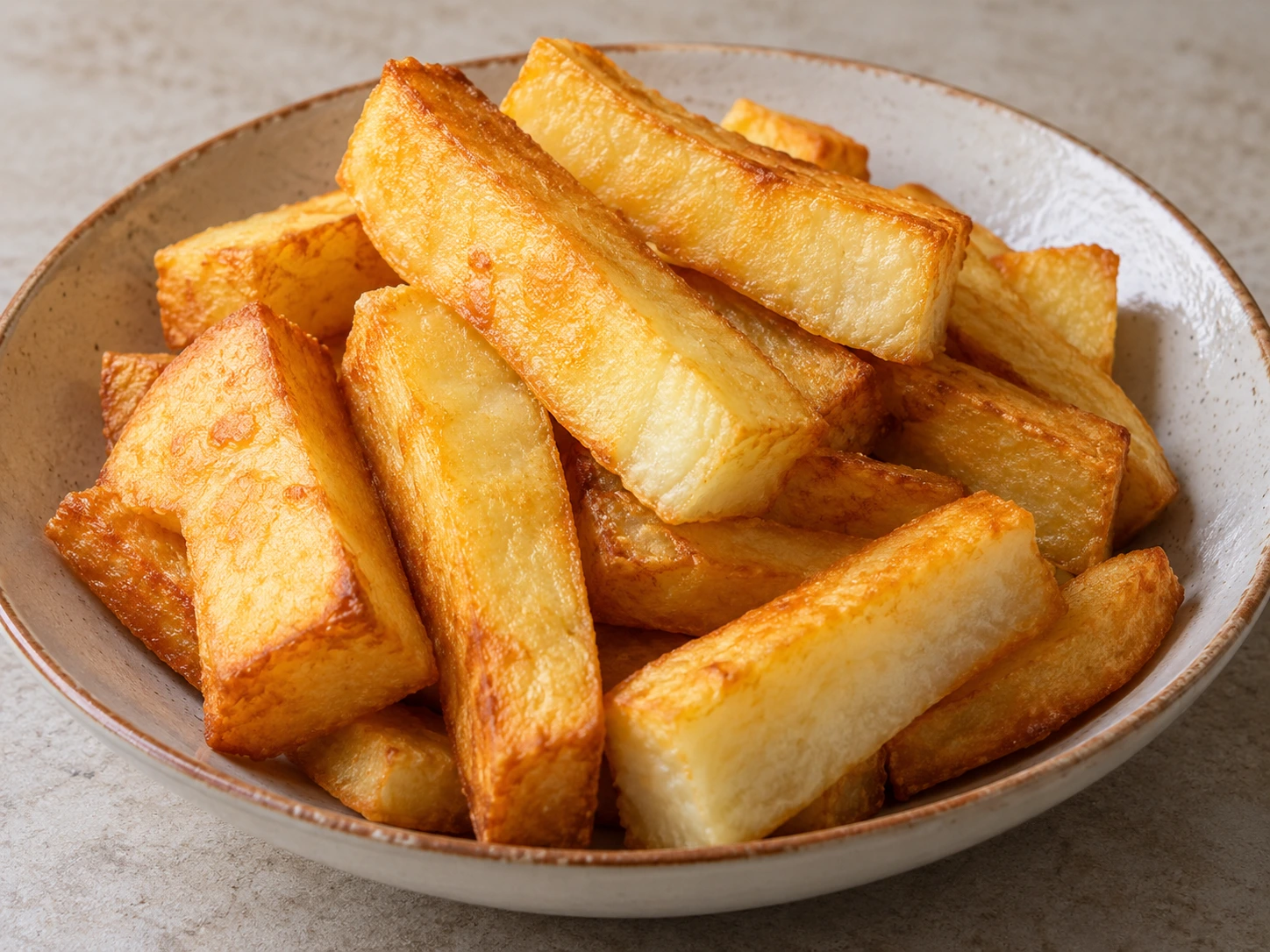
3.1. Basic preparation methods • Boiled: cut into slices, cooked in salted water, served alone or with sauce (“yam and sauce,” “llo koklo” in Togo, Ghana). • Fried: sliced, fried in palm oil or peanut oil, irresistible street food. • Roasted (“roasted yam,” “asaro” in Nigeria, “bankyé” in Ghana): cooked under ashes, on embers, or in an oven. • Pounded yam (yam fufu, Iyan, Foufou, Amala): after boiling, the hot flesh is pounded in a mortar until smooth, elastic, and silky, served rolled into a ball with thick sauces (egusi soup, efo riro, groundnut soup, leafy green soup…). • Sweet/savory puree: mashed, flavored with nutmeg, vanilla, palm oil, sometimes enriched according to popular or gourmet recipes. 3.2. Traditional dishes • Fufu/Pounded yam/Iyan (Nigeria, Ghana, Ivory Coast, Benin, Togo, Cameroon) – A ball of pounded yam, served with tomato, seed, leaf, okra, fish, meat, or snail sauces. • Asaro (Yam porridge - Yoruba): tender yam pieces cooked in a tomato, chili, palm oil sauce, sometimes with fish or meat pieces. • Konkonmé/Akple (Ghana, Togo): fermented yam or pounded with flour from other tubers. • Yam balls/Yam croquettes: fried balls, contemporary street food, made from leftover pounded or grated yam. • Yam flour (“elubo,” amala): dried and ground yam powder, used for porridges or alternative “bread.” • Fofo d’igname (Ivory Coast, Benin, Togo): yam puree combined with other vegetables, or as a side dish for rich sauces. 3.3. Role in baking, crepes, innovation Yam flour used in: • “Breadfruit bread,” bread, gluten-free biscuits, flatbreads, • Modern crepes or pancakes, enriched or vegetarian, • Yam couscous, semolina for haute cuisine or dietetics.
In my books

Continue exploring the continent’s cuisines with Africa at the Table — 54 countries, 54 iconic dishes, by Alioune FALL. This book is in English.
Explore further
4. NUTRITIONAL VALUE AND HEALTH
4.1. Richness and balance • Mainly composed of complex carbohydrates (starch), yam is digestible, energetic, low in fat, and gluten-free. • Moderate protein, but better than that of cassava or potato. • Significant contribution of potassium, phosphorus, magnesium, iron, vitamins B6, C, beta-carotene (yellow varieties). • Rich in dietary fiber, mucilage (aids digestion, transit, satiety). • Yam contains phenolic compounds, antioxidants, and natural “phytoestrogens” (diosgenin). 4.2. Virtues and therapeutic claims • Prevents constipation, nourishes the microbiota (prebiotic). • Used during convalescence, by athletes, children, pregnant women (for satiety, reasonable energy intake). • In traditional medicine: yam is attributed with strengthening, fertilizing, detoxifying virtues, and hormonal balance (myths around plant hormones).
5. SOCIAL, SYMBOLIC, AND RITUAL PLACE
5.1. Ceremonial and festivities • New Yam Festival (Ibo, Yoruba, Ashanti, Bamiléké, Fon…): annual ceremony of the first harvest, followed by dances, sacrifices, blessings, and popular banquets, prohibiting any consumption before the celebration. • Rites of initiation, passage, dowry: yam is offered to the chief or fiancé, ensuring social integration. • Moments of solidarity: planting, harvesting, and preparation are subjects of collective work (“ton tonnya” in Ewe), songs, and friendly rivalries around the “biggest yam.” 5.2. Transmission and family identity • Women's knowledge: seed selection, garden management, storage techniques (ventilated granaries, cellars). • Knowing the name, taste, and preservation of each variety – knowledge transmitted by mothers, grandmothers, initiates. • Notion of “yam land” = agrarian supremacy of a clan, chieftaincy, lineage.
6. DISSEMINATION, INNOVATION, AND MODERNITY
6.1. Urbanization and diaspora • Yam travels, expatriates, in suitcases, families, specialized supermarkets in Europe, USA, Asia. • Culinary innovation: yam fries, vegan puree, gnocchi, gratins, “yam burger,” cakes, spicy chips. 6.2. Research and development • Varietal selection for yield, resistance, preservation. • Industrial processing (instant flours, chips, puree, packaged products for the diaspora). • Promotion of organic, pesticide-free yam, fair trade channels. 6.3. Challenges: • Labor cost (demanding cultivation), difficult storage (susceptible to mold), post-harvest losses; • Competition with other starch sources (rice, cassava); • Risk of abandoning local varietal heritage in favor of industrial hybrids.
CONCLUSION Yam embodies the nourishing power, ritual memory, resilience, and collective identity of rural and modern Africa. A royal food for celebrations, the “white bread” of the village, a marker of terroir prestige, a key ingredient in the culinary arts, it remains one of the flag bearers of the diversity, genius, and vitality of African cuisine. At a time when food security, health, and respect for traditions are being renewed, safeguarding, transmitting, and innovating around yam means preserving both the foundation of the plate and the bedrock of culture for future generations.
BON APPÉTIT!
© Photo credit: recettesafricaines.com. All rights reserved.
In the kitchen : Yam
Recipes from the site to put your knowledge into practice:
Discover these cuisines at a restaurant
Explore our restaurant and caterer directories. Choose your destination and check the establishment’s menu to confirm which dishes are offered and available.
Continue exploring
Enjoy discovering ingredients and African cuisines? Join our newsletter. The illustrated PDF 10 sauces africaines incontournables is in French and is offered after confirming a subscription to the French or bilingual edition.