Broken Rice
Africa, Asia
Understanding : Broken Rice
INTRODUCTION
Broken rice, sometimes called "riz cassé" in French-speaking Africa or "local rice" in many countries, holds a prominent place in African cuisine, particularly in West Africa. Beyond its status as a "less noble" product in global markets, this irregularly shaped grain, partially fractured during husking or transport, has become emblematic of several recipes, culinary identities, and economic sensitivities of a continent where rice has established itself as a dietary staple. Long associated with a substitute or economy food, broken rice actually has a history that touches on peasant tradition, urban culture, agrarian developments, the inventiveness of women cooks, and social stratification. Today, it is celebrated in iconic African dishes such as Senegalese thiéboudienne (or ceebu jën), symbolizing the continent's ability to transform a by-product into a gastronomic icon, to adapt its diet to economic realities, and also to integrate this rice into logics of sovereignty, short supply chains, and identity affirmation in the diaspora. This detailed description traces the historical, agricultural, culinary, social, economic, and symbolic dimensions of broken rice, explores its processing and uses, and explains how it has become much more than a simple side dish in many African countries.
1. ORIGIN, HISTORY, AND SPREAD OF BROKEN RICE IN AFRICA
1.1. Rice in Africa: an overview Rice (primarily Oryza glaberrima, indigenous African rice, and later, Oryza sativa, imported Asian rice) established itself in the African diet after several waves of introduction, via Arab trade, the Atlantic slave trade, and colonization. Initially cultivated in river valleys and deltas (Senegal, Sierra Leone, Guinea, Mali, Nigeria), it gradually replaced millet, sorghum, and yam in cities and for the middle class. Its spread accelerated with globalization, the "cheap rice" policy of the 1970s-80s, urbanization, and the rise of West African ports. Massive quantities of Asian rice were then imported, especially broken rice – a by-product of industrial polishing and packaging. 1.2. Broken rice: a "by-product" turned star Broken rice, long perceived as a "secondary," "inferior," or "crisis" product in Asia, consists of grains fragmented during the husking, transport, or polishing of whole rice. It is sold cheaper than "whole" rice, particularly in African markets seeking affordable foods, but its culinary qualities (quick cooking, sauce absorption, tender texture, local flavor) have conquered kitchens and tables, becoming the essence of major popular dishes.
2. PRODUCTION TECHNIQUES AND PROCESSING CHAINS
2.1. The "breaking" process • After harvesting, rice must be dried, husked (to remove the hull), and then polished. • During these manual or industrial operations, fragile grains break. These fragments, of various sizes, are sorted and separated from whole grains (head rice). • Broken rice can be a mixture of small pieces and broken whole grains. 2.2. Sources of broken rice in Africa • Importation: Mainly from Asia (Thailand, Vietnam, India, Pakistan), where "broken rice" is massively exported in bulk or in economical bags. • Local production: With the revival of African rice (river rice, valley rice, lowland rice, "local rice"), broken rice from artisanal or semi-industrial husking is sold in village and urban markets. 2.3. Economic aspects • Broken rice costs 10 to 40% less than whole rice (depending on origin, breakage rate). • It represents a source of income for many African sectors, particularly for women's cooperatives and small husking units. • Its low price makes it accessible to modest families, while guaranteeing an excellent satiety/quality/price ratio.
3. TASTE QUALITIES AND COOKING TECHNIQUES
3.1. Texture and culinary properties • Broken rice admirably absorbs flavors: its small, irregular grains catch the sauce, cooking juice, and broth aromas. • It cooks faster than whole rice (10-20 minutes) and can be prepared in "one pot," which is suitable for African cuisine. • After cooking, it has a soft, tender texture – neither too sticky nor too dry – ideal for eating with the hand or a communal spoon. 3.2. Versatility • Appreciated in both stews and "dry" dishes, it adapts to all African recipes (stir-fries, riz gras, porridges…).
4. CULINARY USES AND ICONIC RECIPES
4.1. West Africa: the kingdom of thiéboudienne Senegalese thiéboudienne (or ceebu jën in Wolof, literally "rice with fish") is the king dish where broken rice finds its apotheosis. Around a large bowl filled with rice, tinted with tomato, infused with vegetables and fish, the broken rice, tender but firm, soaks up the sauce, forming the bond of conviviality. The particular cooking of thiéboudienne, which requires the rice to absorb almost all the broth, would not be the same without the broken grain. Its ability to carry the tomato, root vegetables (cabbage, carrot, African eggplant, cassava), chili, the flavor of smoked or dried fish, and herbs, makes it the central element of the dish (whereas elsewhere, rice is only a side dish). 4.2. Other countries and recipes • Riz gras (Nigeria, Ivory Coast, Benin, Burkina Faso, Guinea, Togo): a family dish based on broken rice cooked with meat, tomato, chili, aromatics, fish, or chicken. The broken grain binds the sauce, giving a creamy texture. • "Jollof rice" (Nigeria, Ghana, Sierra Leone, Gambia…): a legendary dish where broken rice is often preferred for large events, as it withstands long cooking times, absorbs spicy sauce, and can be eaten hot, warm, or cold. • Riz à la sauce: an economical daily dish (broken rice + okra, leaf, peanut, fish/chicken sauce). • Riz "one pot": simmered at the bottom of the pot, to use or supplement pieces of meat, dried fish, or leftovers from the day before. 4.3. Street food and diaspora Broken rice is found in street food in Senegal, Mali, Ivory Coast, in jollof bars in London, Paris, New York, as an "authentic" base. In the diaspora, it marks the identity of the dish "like back home."
5. SOCIAL, CULTURAL, AND IDENTITY PLACE
5.1. Symbol of conviviality Broken rice is the rice of the "communal bowl": it is eaten by hand, in a circle, during large gatherings, ceremonies, festivities, weddings, funerals, or simple family meals. Its texture, its way of absorbing the sauce, make it the link between guests, the expression of solidarity, respect for elders, and the generosity of the hostess. 5.2. Cultural and heritage identity In some countries (Senegal, Mali, Guinea), broken rice is not just a default choice: it becomes an identity claim – "the true thiéboudienne is only possible with broken rice!" The diaspora, Afro-fusion chefs, celebrate its difference and integrate it into modern "Afro-gastro." 5.3. Transmission and innovation The perfect cooking of broken rice is a test of skill for young women/future wives, an element of family transmission and local prestige. Innovators, Afro chefs, and food bloggers make it the basis of revisited dishes (African poke bowl, broken rice burger, broken rice risotto, cold salads with African flavors).
6. NUTRITIONAL VALUE AND HEALTH IMPACT
Rice, even broken, remains primarily a carbohydrate source, rich in complex starches, low in fat, digestible, gluten-free, satiating, and economical. • It provides long-term energy. • Can be enriched by its association with legumes (beans, cowpeas), vegetables, meats, fish. • "Local broken rice" (unbleached) can retain more minerals and fiber than highly polished Asian rice. Limitations: • Risk of deficiency if the meal is limited to rice (necessity of rich sauces for dietary balance) • Sometimes presence of overcooked broken grains or poor quality grains in the informal market.
7. MODERNITY, FOOD POLICY, AND SOVEREIGNTY
7.1. Local production, short supply chains Faced with dependence on Asian imports, many African countries (Senegal, Nigeria, Guinea, Ivory Coast, Mali…) are reviving the local rice sector. Local broken rice is valued as "country rice," sometimes labeled, sold in cooperatives. 7.2. Resilience and social role In times of crisis (floods, rising global prices, Covid-19), broken rice stands out as a food security solution: storable, simple to cook, appreciated by all, adaptable to modest budgets and large families. 7.3. Culinary innovation Afrofood startups are incorporating broken rice into global gastronomy: galettes, world salads, vegan dishes, "gluten-free" dishes, processed products (broken rice flour, croquettes, ready-to-eat meals), trendy urban street food.
8. CONTEMPORARY CHALLENGES
• Fighting the "inferior" perception of the product • Improving local quality (husking, sorting, moisture management) • Training, valuing recipes, documentation (heritage protection of ceebu jën, jollof, riz gras, etc.) • Limiting dependence on Asian imports • Structuring the sector to guarantee income and recognition for local actors
CONCLUSION
Broken rice, long marginalized, has emerged as a star food, forming the basis of African cuisine's identity, economy, and innovation. Through its texture, its ability to carry sauces, and its universality as a bowl, it symbolizes both popular vitality and the continent's capacity for resilience and transformation. Celebrating, transmitting, and valuing broken rice contributes to affirming a joyful, inventive, communal food sovereignty, essential for Africa today and tomorrow.
Where to find it
African grocery shops and international food aisles are good starting points. Check which form the recipe needs: whole grain, flour, semolina or a precooked product. Cooking times vary.
Explore further: Cooking tips · Food hygiene and safety advice.
Search Amazon.fr — affiliate link →
Check availability and delivery on Amazon.fr. Compare ingredients, packaging and sellers.
As an Amazon Associate I earn from qualifying purchases.
In my books
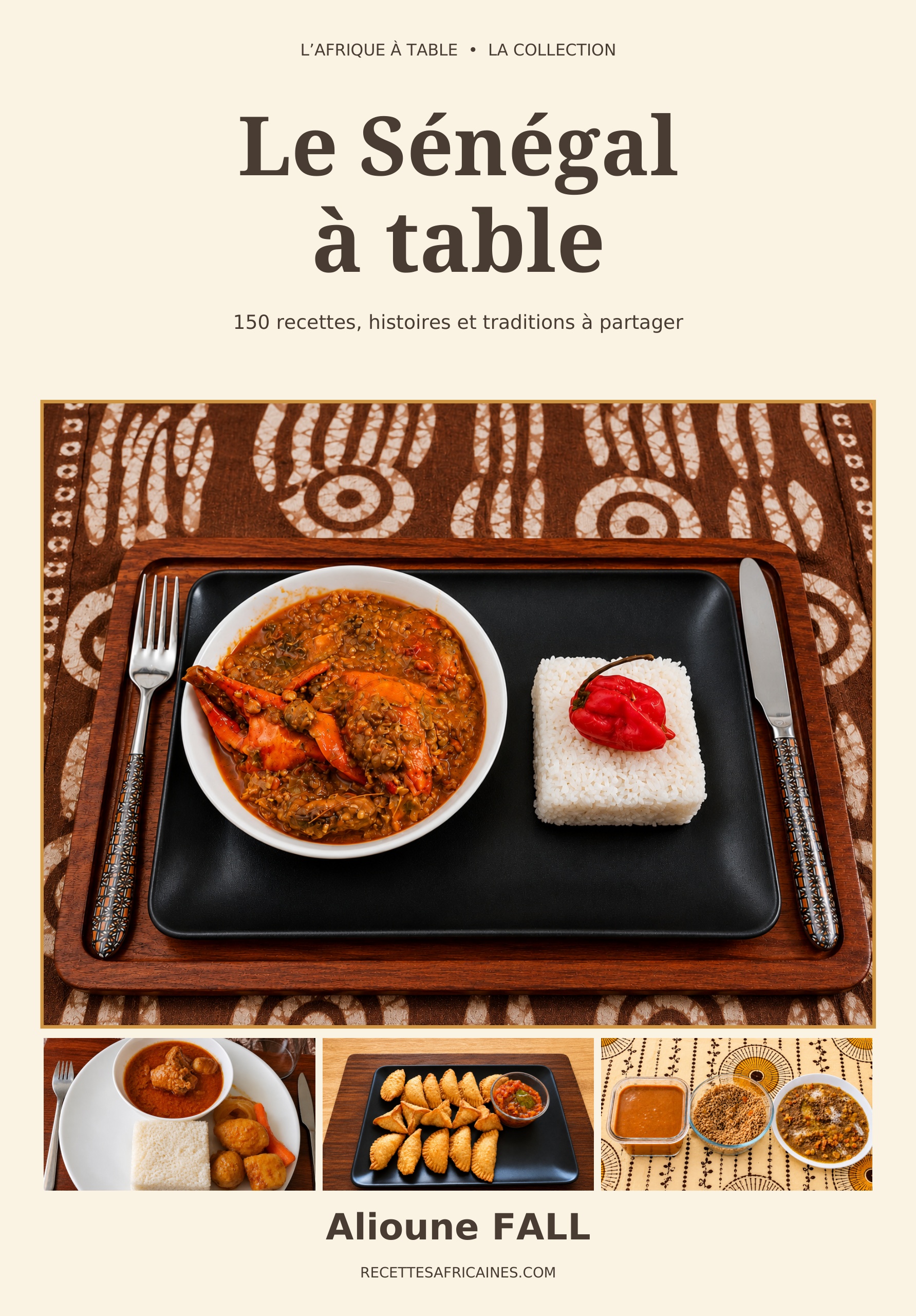
Explore Senegalese cooking with Le Sénégal à table, my collection of 150 recipes, stories and traditions to share. This book is in French, by Alioune FALL.
In the kitchen : Broken Rice
Recipes from the site to put your knowledge into practice:
Discover these cuisines at a restaurant
Explore our restaurant and caterer directories. Choose your destination and check the establishment’s menu to confirm which dishes are offered and available.
Continue exploring
Enjoy discovering ingredients and African cuisines? Join our newsletter. The illustrated PDF 10 sauces africaines incontournables is in French and is offered after confirming a subscription to the French or bilingual edition.