Ras el Hanout
Arabic (Maghreb)
Understanding : Ras el Hanout
INTRODUCTION
Ras el hanout (in Arabic رأس الحانوت, literally "head of the shop" or "top of the shelf") is undoubtedly THE most mythical spice blend of the Maghreb, a symbol of refinement, generosity, and savoir-faire in North African gastronomy. Essential in Morocco, Algeria, Tunisia, and even Libya, ras el hanout transcends time and space: in every grain, it embodies the memory of caravans, the genius of spice merchants, the dreams of family celebrations, and the magic of a cuisine that embraces world history. Behind this name, there are over 1000 variations: each family, each region, each spice merchant offers "their" version, an object of pride and transmission, mostly kept secret. While ras el hanout is now universally acclaimed in world cuisines and haute gastronomy, it remains the guarantor of a North African way of life, memory, and identity, patiently woven from the East and Africa. This detailed description explores the origin, composition, preparation, emblematic recipes, versatility, social value, symbolism of ras el hanout, its modernity, and the challenges of its heritage inscription – to understand why it remains the "captain" of African taste.
1. ORIGIN, HISTORY, AND SPREAD OF RAS EL HANOUT
1.1. A Commercial and Scholarly Heritage Ras el hanout was born from history: that of Mediterranean triangular trade, the Maghrebi crossroads between sub-Saharan Africa, the East, Europe, and the spice route. With the development of souks and "hanouts" (spice and herbalist shops), the most renowned merchant offered his best, most subtle, and precious composition, sometimes made of several dozen spices, at the "head of the shelf." Tradition dictates that every major event (wedding, festival, diplomatic meal) leads to the custom preparation of a complex blend, proportioned according to families, regions, seasons, and sometimes even health or wealth. Ras el hanout thus crosses the ages, a companion to couscous, tagine, méchoui, enriched by exchanges with the South (black gold, peppers, roots), with the East (cinnamon, cardamom, nutmeg), India (turmeric…), Europe (nutmeg), and Berber worlds (local herbs, flowers, roots). 1.2. Myth, Variants, Transmission A prestigious blend, ras el hanout is subject to all variations: there is no "true" ras el hanout, but an infinite number of "true" ones depending on the terroir, the hand, the event. The expression thus refers as much to the social performance of the merchant as to the refinement of the housewife or chef: transmitting the recipe to a daughter-in-law or granddaughter is transmitting a heritage. Its power of seduction, its flavor, and even its color ("yellow ras," "red ras," "black ras") testify to a plural history, never fixed.
2. COMPOSITION OF RAS EL HANOUT
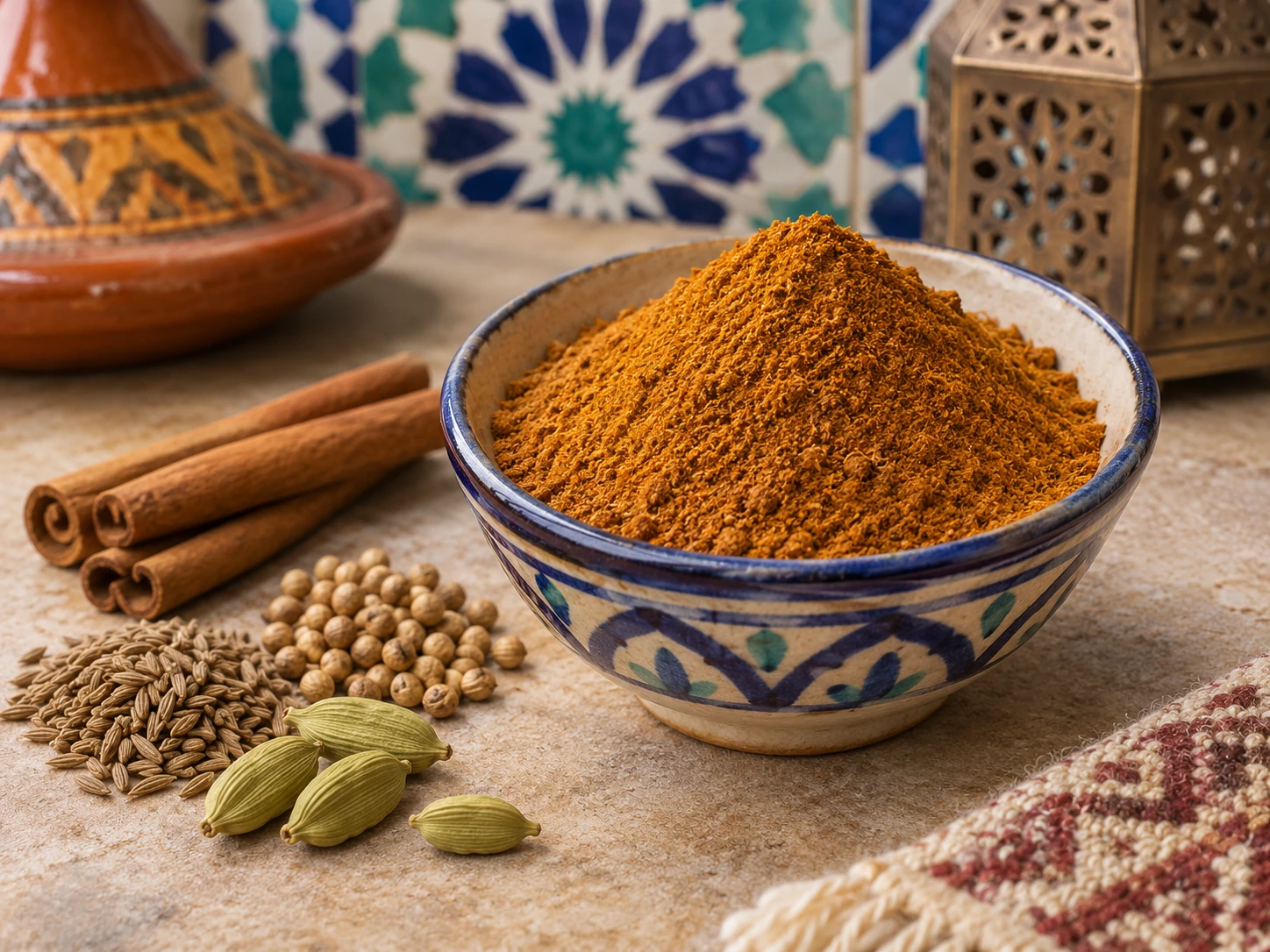
2.1. "Core" Ingredients There are as many ras el hanout blends as there are families – but certain "core" elements are found: • Coriander (seeds) • Cumin • Black or white Guinea pepper • Cinnamon • Green cardamom • Nutmeg • Cloves • Sweet (paprika) or hot pepper • Ginger • Turmeric • Mace (nutmeg flower) • Fennel • Fenugreek • Anise seeds • Lavender or dried rose • Galangal, cubeb, grains of paradise (in "rare" ras blends) • Allspice 2.2. Rarer or "Luxury" Ingredients (in certain signature blends) • Iris root • Asafoetida • Bay berries • Long pepper • Orange blossom or lavender flowers • Nigella seeds • Dried rose petals • True Ceylon cinnamon • Datura seeds (strictly traditional, highly regulated, rarely used today) The number of spices varies: 7, 12, 24, and even, it is said, 27 for some masters in Algiers or Fez. Commercial blends are sometimes lightened or "modernized," but the base is always harmonious, without a single dominant flavor. 2.3. Preparation and Roasting The key to ras el hanout is in the preparation: • Spices are roasted separately to develop their aromas • Finely ground (mill, mortar, or pestle) • Filtered to retain only the noble powders • Mixed in a precise order • Rested (sometimes) before use for flavor maturation The color varies from bright orange-yellow (lots of turmeric, ginger, saffron) to reddish-brown (dominant paprika, cinnamon) to black (grains of paradise, cubeb, nutmeg).
3. MAIN USES IN AFRICAN CUISINE
3.1. King dish: couscous Ras el hanout is the backbone of classic couscous (lamb, vegetables, meatballs…), both for flavoring the semolina, broth, meat balls (kefta), and for giving strength to the sauce. 3.2. Tagine and Stewed Dishes It is essential in meat, lamb, chicken, vegetable/root, olive, prune, quince, chickpea, dried apricot, or prune tagines. It gives them their aromatic richness and sensory identity, making them indispensable dishes of the Maghreb. 3.3. Méchouis and Grills Basic blend for dry applications: dry marinades, rubbing on roasted lamb shoulder/piece, on skewers (kebab), base for chermoula. 3.4. Soups, Sauces, Broths An addition to "chorba" soups, harira, or in vegetable and chickpea broth during Ramadan. Also used for keftas (minced meat balls), minced meat tagine in tomato sauce. 3.5. Pastries, Desserts, Drinks • Subtle blend for gazelle horns, date cakes, gingerbread • Added to tea, homemade mulled wines, semolina desserts, roasted citrus, flavored creams. 3.6. Creative and Afro-Fusion Cuisine • Association with fish, seafood • Dairy products, terrines, fruit salads • Fusion cuisine: ras el hanout burger, sauces for grilled vegetables, spicy hummus…
4. SOCIAL, HERITAGE, AND SYMBOLIC ROLE
4.1. Hierarchy of Taste, "Spice of Kings" Ras el hanout is "reserved" for grand dishes, for celebrations (weddings, births, Eid, family gatherings, distinguished guests). It signifies the economic capacity, refinement, and social respectability of the household. Possessing "the best ras el hanout on the market" is to assert oneself as a high-level cook. 4.2. Know-how and Transmission Knowing how to compose, dose, roast, and "awaken" one's ras el hanout is the prerogative of maternal memory: the recipe passes from mother to daughter, sometimes preciously kept secret. 4.3. Commerce, Neighborhood Ties, Merchant's Knowledge Going to "one's designated spice merchant," debating the qualities of blends, participating in special preparation for a celebration: all these foster social ties and respect for the artisanal chain. Market blends (souk) are the pride of towns and villages. 4.4. Place in Rituals Certain versions are used for medicinal purposes: digestive, warming, aphrodisiac, in fortifying decoctions, or to bless a newborn or a journey.
5. NUTRITIONAL VALUE AND BENEFITS
• Rich in antioxidants (turmeric, cinnamon, ginger, pepper…) • Stimulates digestion through the synergy of "carminative" spices • Warming and stimulating effect, useful for boosting appetite, getting through winter, supporting convalescence • Contributes to salt reduction: flavors dishes without excessive sodium • Flavors and energizes nutritious soups for pregnant women, convalescents, athletes
6. MODERNITY, INNOVATION, DIASPORA
6.1. Globalization Ras el hanout is now present in the global spice range (organic stores, European supermarkets, culinary platforms) and inspires Michelin-starred chefs, "world cuisine" caterers, food trucks, and Afro-Mediterranean brunches. It is sold ready-to-use or custom-made (diaspora brands, "spice kits," viral video recipes). 6.2. Modern Gastronomy • Molecular cuisine: spherification, infusion of ras el hanout in clear broths, reduced sauces, airy pastries. • Cross-pollination with South African, West African, European cuisines – in woks, hot sauces, vinaigrettes, marinades for tropical fish. • Snacking, finger food: empanadas, bricks, accras, revisited with ras el hanout. 6.3. Quality Chains and Transmission • Local markets, short supply chains, traceability • Workshops for children, new migrants, the diaspora • Tourism and museum projects (Couscous House, Spice Route)
7. LIMITS, CHALLENGES, AND PERSPECTIVES
• Risks of industrial standardization, impoverishment of flavors, "quick-fix" blends without proper roasting • Loss of know-how among younger generations, in urban areas, due to preference for fast or imported dishes • Preservation (spice oxidation, need for good drying and storage practices) • Need to value regional diversity: preserving the ras el hanout of Fez, Marrakech, Constantine, Algiers, Tunis, etc.
CONCLUSION Ras el hanout is much more than a "spice blend": it is the sensory memory, the secret symphony, the identity card, and the dream of North African cuisine. Offered, transmitted, renewed, it carries within it generosity, the art of blending, openness to others, and the dialogue of all the heritages of the Mediterranean and African regions. Preserving, transmitting, and innovating around ras el hanout ensures African cuisine its intelligence, nobility, and modernity — a permanent invitation to travel, share, and celebrate the senses.
Where to find it
Look for the exact food-grade form required by the recipe at markets and specialist shops. Check the product name, ingredients, condition and storage instructions.
Explore further: Cooking tips · Food hygiene and safety advice.
Search Amazon.fr — affiliate link →
Check availability and delivery on Amazon.fr. Compare ingredients, packaging and sellers.
As an Amazon Associate I earn from qualifying purchases.
In my books

Continue exploring the continent’s cuisines with Africa at the Table — 54 countries, 54 iconic dishes, by Alioune FALL. This book is in English.
In the kitchen : Ras el Hanout
Recipes from the site to put your knowledge into practice:
Discover these cuisines at a restaurant
Explore our restaurant and caterer directories. Choose your destination and check the establishment’s menu to confirm which dishes are offered and available.
Continue exploring
Enjoy discovering ingredients and African cuisines? Join our newsletter. The illustrated PDF 10 sauces africaines incontournables is in French and is offered after confirming a subscription to the French or bilingual edition.