Harissa
Arabic (Tunisia, Morocco, Algeria...)
Understanding : Harissa
INTRODUCTION
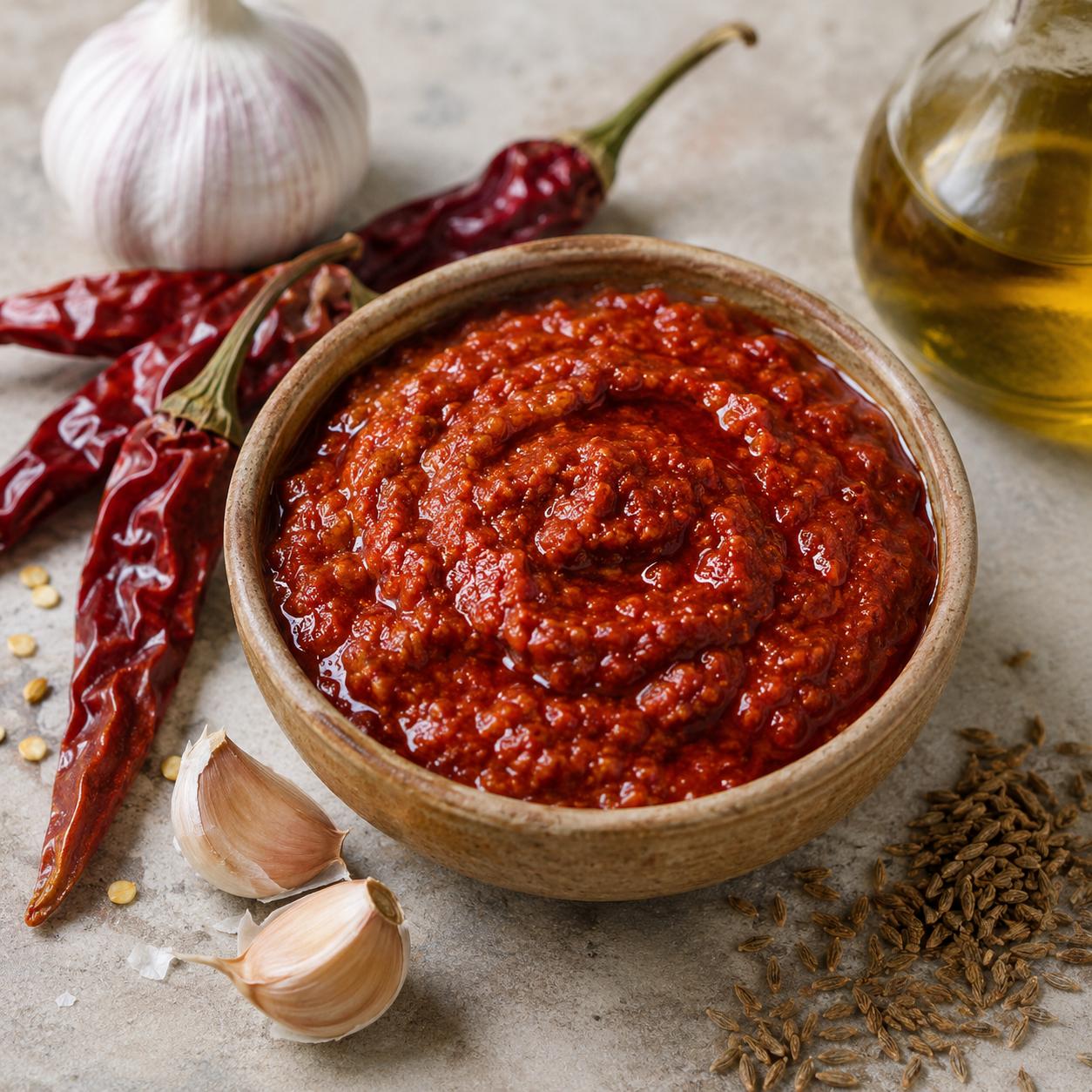
Among the most famous condiments of the Mediterranean region and the Maghreb, harissa holds a prominent place in African cuisine. A concentrate of sun, warmth, and flavors, this blend of ground red chilies, garlic, spices, and oil, originating from Tunisia, has established itself as an emblem of Maghrebi, African, and now global taste. But harissa is much more than just a spicy paste: it embodies the history of plant and people circulation, culinary creativity, the transmission of gestures, the sociability of meals, the structuring of agricultural markets… and the art of using fire to celebrate life. This detailed description explores the origins, technical elaboration, regional variety, daily, festive, ritual, and creative uses of harissa, its nutritional and symbolic values, its integration into modernity, its diasporic diffusion, and its ability to still shape the food identity of a large part of North Africa and beyond.
Where to find it
Look for the exact food-grade form required by the recipe at markets and specialist shops. Check the product name, ingredients, condition and storage instructions.
Explore further: Cooking tips · Food hygiene and safety advice.
Search Amazon.fr — affiliate link →
Check availability and delivery on Amazon.fr. Compare ingredients, packaging and sellers.
As an Amazon Associate I earn from qualifying purchases.
History and uses
1. ORIGINS, HISTORY, AND SPREAD OF HARISSA
1.1. Birth of a condiment Harissa as we know it today has its roots in Tunisia, as early as the 17th century, following the introduction of chili peppers to Africa after the discovery of America and the first great Columbian exchanges. Before chili peppers, North African cuisines used pepper, local seeds, and aromatics to season dishes and meats. Chili peppers, brought back by the Spanish and Portuguese, adapted wonderfully to Tunisian lands (Cap Bon, Nabeul region…), Algeria, and Morocco, and gradually became the base of harissa. Its name is said to come from the Arabic harasa (to crush, to pound), unless its origin is Berber. 1.2. Diffusion and regional structuring While harissa is a strong symbol of Tunisia (consumed daily, a marker of national culinary identity), its use extends throughout the Maghreb (Capsicum grown in Algeria, Morocco), penetrates Egypt, Libya, Mauritania, and influences the culinary traditions of Berber, North African Jewish, sub-Saharan (Sudan, Mali, Niger…) communities, and even in Europe and the Middle East via the diaspora.
2. INGREDIENTS: DIVERSITY IN TRADITION
2.1. Chili pepper, the beating heart of harissa • Red chili pepper (Capsicum annuum or frutescens): picked ripe, sun-dried, it gives harissa its color, heat, and unique aroma. Depending on the terroir, it can be mild, strong, long, or round. • Chili peppers can be used fresh (for a moist, light harissa, ready for immediate use) or dried (for a concentrated paste with a long shelf life). 2.2. Aromatics and spices • Garlic: pounded or grated for aromatic power; • Cumin, coriander (ground seeds, to add depth); • Caraway (karwiya): typical of Tunisian harissa; • Fennel seeds; • Black cumin, mild or hot paprika, sometimes dried mint: depending on the family. 2.3. Olive oil It protects the paste from air, gives it creaminess and shine, and extracts or tempers the chili's strength. Olive oil enhances taste and preservation. 2.4. Salt It ensures preservation, reveals the chili's bouquet, and facilitates texture.
3. TRADITIONAL PREPARATION AND INNOVATIONS
3.1. Artisan method
- Stemming, deseeding, drying of red chilies.
- Quick rehydration (for dried ones) or direct processing in a mortar or stone mill.
- With chosen spices (caraway, cumin, coriander) and garlic, pound until a purée consistency is achieved.
- Add salt and a drizzle of olive oil while kneading.
- Harissa is placed in jars, covered with oil, and stored for a long time in a cool or dark place. In some regions (Cap Bon), harissa is allowed to ferment slightly before potting, which gives it a subtle acidity, complexifies the aromas, and extends preservation. 3.2. Modern methods • Electric choppers, blenders, or food processors are sometimes used at home. • Industrial harissa (Conserves du Cap Bon, Zina, others…) is sterilized, pasteurized, and packaged in tubes, cans, jars, or vacuum-sealed for export and urban consumption.
4. CULINARY USES IN AFRICAN CUISINE
4.1. Harissa as a condiment • Universal accompaniment: soup, stew, sandwich, tagine, couscous, nothing escapes harissa – it is always served in a small separate dish, with everyone dosing according to their taste. • Dip: for dipping bread, flatbread, a piece of cheese, raw vegetables. • Tunisian “Lablabi”: chickpea and stale bread soup flavored with garlic, cumin, and garnished with harissa to taste. • Kefta, merguez, skewers, North African shawarma: marinades or hot sauce. • Accompaniment for grilled fish, méchouia sauce (grilled pepper/tomato salad), ojja (egg dish), ravioles (briks). 4.2. Harissa as a cooking base • Red couscous: harissa dissolved in the broth, to enhance meat, vegetables, chickpeas. • Tagines, stews, sauces: harissa is sautéed with tomato and onion at the beginning of the dish to infuse the entire preparation. • Street food and fast food: Tunisian sandwiches, shawarmas, kebabs, paninis, all Maghrebi street food finds its spicy “kick” here. 4.3. Other variations • Green harissa: a fresh variant with coriander, mint, and green chili, very popular among young urban chefs. • Fruity harissa: chili/pepper/tomato mix, for milder preparations. • Sweet harissa: touched with dried fruits (nuts, dates, figs) to accompany cheeses or desserts (modernity).
In my books

Continue exploring the continent’s cuisines with Africa at the Table — 54 countries, 54 iconic dishes, by Alioune FALL. This book is in English.
Explore further
5. SOCIAL, IDENTITY, AND RITUAL PLACE
5.1. Dish of hospitality and conviviality Harissa punctuates family meals, celebrations, receptions: it is a sign of a successful welcome, of a table that shares the host's strength, audacity, and warmth. In the Maghreb, it puts everyone on an equal footing, with each person able to dose according to their taste. 5.2. Family and feminine transmission The “good harissa” is the secret of the mother, aunt, grandmother. Its preparation in autumn, after the harvests, mobilizes the whole family: sorting, pounding, kneading, potting – it is a rite of passage, a transmission, a shared memory. 5.3. Place in rural and urban economy The cultivation, drying, and sale of chili peppers, the production of spices, and the sale of homemade or cooperative-made harissa constitute a crucial part of the domestic and artisanal female economy. 5.4. Symbolism Harissa, “fire of the Maghreb,” evokes courage, vitality, virility, the strength of ancestors and the home. It is put on the bread of new mothers, in wedding dishes, upon return from exile...
6. NUTRITIONAL VALUES AND HEALTH
• Rich in vitamin C, E, antioxidants (chili, garlic): boosts immunity, protects the cardiovascular system, promotes digestion. • Appetite suppressant effect: capsaicin reduces appetite, boosts satiety. • Warming, circulatory effect: ideal for mountainous regions, or as a stimulant. • Caution: Its spiciness is not recommended for sensitive stomachs, children, pregnant women (except in moderation).
7. MODERNITY, DIASPORA, INNOVATIONS
Harissa conquers the world: • Restaurateurs and Michelin-starred chefs use it in sauces, mayonnaise, marinades, vinaigrettes, spicy ice cream, brownies, cocktails. • Global sales: from the United States to Japan, Tunisian harissa is establishing itself in tubes, jars, food trucks. • Vegan, organic variants, artisanal harissa with local chilies, export of seeds and young shoots. • Identity marketing: Tunisian harissa is PDO labeled (2022), the first African condiment to obtain this international distinction.
8. LIMITS, CHALLENGES, AND RESISTANCE
• Industrial standardization: risk of crushing terroir nuances, family recipes, the “living” taste. • Chili industry: dependence on certain varieties (climate, agricultural crisis). • Fragile transmission: artisanal “know-how” is being lost, with some young people preferring to buy rather than make. • Uniformization: “Westernized” harissas are sometimes very diluted, far from the original “fire.”
CONCLUSION Harissa, more than a condiment, is a living culinary memory and a heritage of African creativity. It condenses the warmth of the Maghreb, the generosity of women, the humble art of daily gestures, and openness to influences from afar. Always on the table for sincere meals, it embodies resistance, modernity, conviviality, and the pride of a taste that never apologizes. To taste harissa is to taste, in a burst of flavors, the long shared history of the peoples of Africa, their genius with fire, and the power of their dreams.
In the kitchen : Harissa
Recipes from the site to put your knowledge into practice:
Discover these cuisines at a restaurant
Explore our restaurant and caterer directories. Choose your destination and check the establishment’s menu to confirm which dishes are offered and available.
Continue exploring
Enjoy discovering ingredients and African cuisines? Join our newsletter. The illustrated PDF 10 sauces africaines incontournables is in French and is offered after confirming a subscription to the French or bilingual edition.