Pounding in a Mortar
Africa (ancestral technique)
Understanding : Pounding in a Mortar
INTRODUCTION
Pounding in a mortar is much more than a simple culinary preparation gesture in sub-Saharan Africa: it is a true ritual, a tangible and intangible heritage, the memory of a continent shaped by necessity, innovation, and matriarchal or communal transmission. Through pounding – the action of crushing, grinding, or homogenizing food using a large pestle in a mortar, usually made of hardwood – each cuisine, each culture weaves its relationship to taste, texture, aromas, and sociability. From village to city, from millet to cassava, from yam to leaves, from cereals to sauces, the mortar marks the transition from raw ingredients to the collectivity of the shared dish, while signifying the expertise, power, and creativity of women (and sometimes men), masters of transformation. This detailed text explores the history, technique, diversity of uses, social and symbolic dimensions, modernity, and prospects of this foundational gesture of African cuisine.
Putting the technique into practice
Follow a detailed recipe when applying this technique. Quantities, equipment and cooking instructions depend on the preparation you choose.
Explore further: Cooking tips · Food hygiene and safety advice.
History and uses
1. HISTORY AND SPREAD OF THE MORTAR IN AFRICA
1.1. An Ancestral Tool The mortar – in its oldest form: a stone basin, hollowed out by use, long before the agricultural era – has accompanied African societies since prehistory. Archaeology attests to its presence across the continent: Paleo-Macina, Niger Basin, Nile Valley, Great Lakes, equatorial forest. The emergence of major food crops (millet, sorghum, yam, cassava, maize) and hardwood craftsmanship (iroko, caïlcedrat, mahogany, baobab) transformed the mortar into an everyday object: light, solid, portable, sometimes personalized or adorned (ethnic symbols, lineage motifs). The pestle, a direct complement, expresses strength, mastery of rhythm, and the memory of the gesture. Mortars are passed down from generation to generation, given as dowries, wedding objects, or even rites of passage. 1.2. Social and Geographical Spread The practice of pounding in a mortar permeates all of sub-Saharan Africa: West Africa, Central Africa, the Great Lakes, Southern Africa, and, to a lesser extent, the Horn. Each people has its own variation, specific dimensions, preferred materials, and “sagas” or riddles surrounding the use of the mortar.
2. MORTAR POUNDING TECHNIQUES
2.1. Dimensions and Materials • Mortar: often a hollowed-out trunk 30 to 80 cm high, 20 to over 50 cm in diameter; some mortars are specially reserved for millet, others for cassava, others for condiments or palm oil. • Pestle: elongated wooden stick (up to 1.5 m), sometimes double-headed (for two pounders), or shorter (fouyaya, family pestle). 2.2. Steps of Classic Pounding Preparation • Cleaning, shelling, peeled tubers, sorted cereals, sometimes pre-soaking or pre-cooking depending on the recipe. Pounding • The rhythm depends on the desired consistency/texture (fine, grainy, thick or light paste). • Sometimes, two people pound in rhythm, exchanging a song to regulate the gesture and enliven the task. • The force of the blow, the speed, and the skill create a homogeneous paste, without splashes or chips. Sifting, Reprocessing, Finishing • It is sifted (screen, artisanal sieve), fibers and peels are removed, then, if necessary, re-pounded. • For some recipes, hot oil, herbs, or spices are incorporated, by hand or with the pestle.
3. DIVERSITY OF CULINARY USES OF POUNDING
3.1. Pounding Cereals • Millet and sorghum: husking the grain before cooking (porridges, tchèp, couscous, tô). Pounding removes the husk, produces semolina of various sizes, and prepares flour. • Maize: Semolina, "pap" porridge, pancakes, banku (Ghana), couscous. 3.2. Pounding Tubers • Cassava: for fufu, foufou, chikwangue, bobolo, the root, first cooked or fermented, is pounded to obtain an elastic paste. • Yam: pounded yam (foufou, iyan), a star in Nigeria, Ghana, Benin, Côte d'Ivoire, is emblematic of festive meals: flesh cooked in water then pounded (often by two people) until an elastic, smooth, and shiny consistency is achieved. • Sweet potato, plantain: mixed dishes, thick purees. 3.3. Pounding Leaves and Vegetables • Cassava, amaranth, sweet potato leaves: pondu (DRC, Gabon), saka saka (Congo), iconic dishes where the leaves are finely pounded, sometimes cooked then pounded, then simmered in sauce. • Leaf sauces (sauce feuille, efo, m’boga): the mortar releases the fibers, homogenizes the mixture, and provides the characteristic melting texture. • Spices, chili peppers, ginger, garlic, peanuts for fresh or dry condiment pastes, soumbala, bean paste (akara, moi-moi). 3.4. Pounding and Composite Paste • Peanut: dry pounding to obtain paste or powder, base for mafé, sauces, artisanal butter. • Melon/egusi seeds, sesame, squash: sauce paste, snacks. • Cowpea, black-eyed pea: pounding for fritters (akara), purees or porridges. 3.5. Various Non-Food Uses • Mixing medicinal herbs, making soaps, ointments, salves. • Ceremonies (pounding millet for initiation, macerated concoctions during rites of passage).
In my books
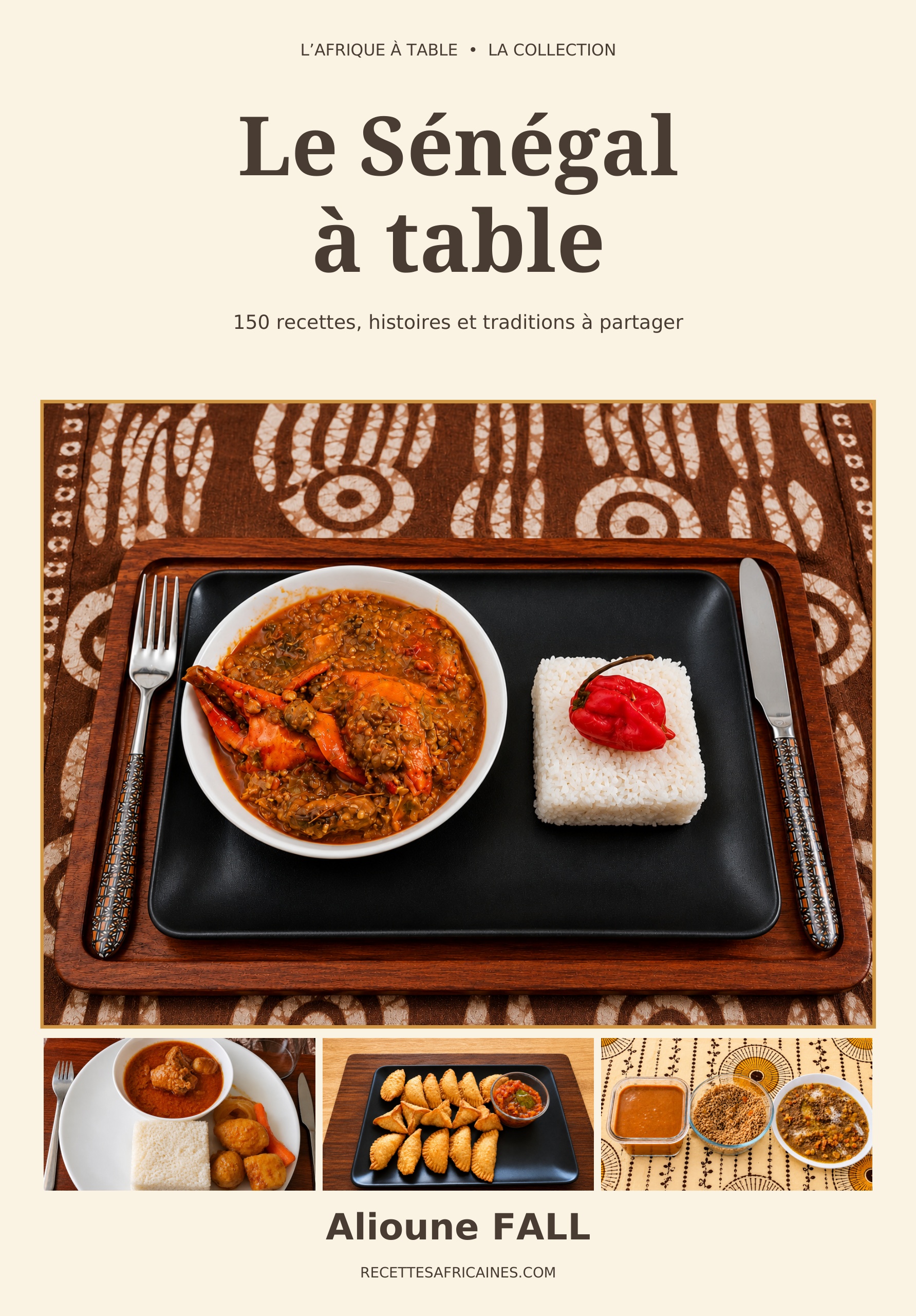
Explore Senegalese cooking with Le Sénégal à table, my collection of 150 recipes, stories and traditions to share. This book is in French, by Alioune FALL.
Explore further
4. POUNDING, SOCIABILITY AND COLLECTIVE MEMORY
4.1. Pounding and Community Connection Traditional pounding brings together women and children: it is a space for exchange, singing, education, and transmission. Gossip, work songs, stories, prayers, and formulas for good health or a child's success are shared. The sound of the pestle punctuates village life, signaling the preparation of a celebration, a wedding, or the arrival of guests. 4.2. Status and Mastery A “good hand at the mortar,” “the yam hand,” or “fufu hand” confers prestige, marital status, and recognition in the community. The success of the texture of foutou or pounded yam is judged on special occasions. 4.3. Place of the Mortar in the Family and Rites The mortar can be inherited, named, decorated, buried with the mistress of the house. It accompanies the dowry, the coming out of a young girl (initiation), and appears in tales and proverbs.
5. SYMBOLISM, HERITAGE AND PATRIMONY
5.1. The Mortar as a Symbol of Fertility and Power • Object of strength and union: two people pounding together unite strength and knowledge, an act sometimes reserved for newlyweds the day after the wedding. • It marks fertility, prosperity, household stability, wisdom. 5.2. Rituals • Pounding millet to offer the first fruits to ancestors or the earth deity. • “Sacred” mortar during funerals, pounded by women to call for rain, ward off illness. • Ritual songs, dances imitating pounding during initiations, circumcisions, seasonal festivals, or harvest.
6. MODERNITY, TRANSFORMATIONS AND CHALLENGES
6.1. Place in Urban Cuisine The arrival of the food processor, blender, grain mill, or electric pestle replaces traditional pounding in some urban environments. But many dishes are still considered “less good” without a mortar: the taste of the terroir, the texture, and the structure are different. 6.2. Heritage Revival and Afro-Pride Artisanal pounding becomes a marker of authenticity in Afro restaurants, gastronomic workshops, TV series, and Afro "food" social networks. Younger generations are learning the “return to hand-pounding,” and chefs are promoting “hand-pounded fufu.” 6.3. Feminism, Health and Ergonomics Pounding is physically demanding, sometimes a source of back pain, gender bias (female chore), and exhaustion. Projects for ergonomic mortars, lighter pestles, and cooperative organization help lighten the task.
7. ISSUES AND FUTURE
• Safeguarding the practice: documentation, training, valuing the gesture through research, culinary tourism, living museums, competitions. • Innovating without losing texture or social connection: combining robot and pestle to keep the spirit. • Raising awareness of regional diversity: each terroir, each “hand” has its signature. • Including pounding in a mortar in African intangible heritage, as a symbol of resilience, conviviality, ingenuity, and the strength of African societies.
CONCLUSION Pounding in a mortar is much more than a tool or a technical step: it is a culinary, social, and identity act, a multi-handed score where memory, innovation, femininity/humanity, and the African community spirit are played out. It connects the earth to the plate, tradition to modernity, the body to the community. Preserving, transmitting, and adapting the practice of the mortar is to honor the heritage and guarantee the living, flavorful, resilient, and supportive future of African cuisine.
Discover these cuisines at a restaurant
Explore our restaurant and caterer directories. Choose your destination and check the establishment’s menu to confirm which dishes are offered and available.
Continue exploring
Enjoy discovering ingredients and African cuisines? Join our newsletter. The illustrated PDF 10 sauces africaines incontournables is in French and is offered after confirming a subscription to the French or bilingual edition.