Smoking
Africa (preservation technique)
Understanding : Smoking
INTRODUCTION
Smoking is one of the oldest methods of food preservation and preparation in the world, and Africa is no exception to this millennia-old history. Long before the advent of refrigerators or industrial preservation additives, African peoples developed a set of sophisticated smoking techniques to dry, store, and enhance the taste of meat, fish, tubers, and, more rarely, cereals or cheeses. Today, although modernity has introduced new means of preservation, smoking remains essential in African culinary culture: it connects the peasantry to the urban market, ancient rituals to contemporary cuisine, family economy to gastronomic innovation.
This detailed description delves into the origins, know-how, practices, regional diversity, symbolic, gastronomic, and economic functions, nutritional benefits, and the place of smoking — from the family hearth to urban gastronomy, from the bush village to the African diaspora.
Putting the technique into practice
Follow a detailed recipe when applying this technique. Quantities, equipment and cooking instructions depend on the preparation you choose.
Explore further: Cooking tips · Food hygiene and safety advice.
History and uses
1. HISTORY AND ORIGINS OF SMOKING IN AFRICA
1.1. An ancestral global heritage Smoking, combined with drying and salting, has been attested since prehistory, long before humans learned to read or write. It arose from the need to extend the shelf life of perishable goods in hunter-gatherer societies and then in farming and herding communities. Africa, a continent with hot and often humid climates, adopted smoking very early on as an indispensable complementary process to salting, sun-drying, and fermentation. 1.2. Pan-African diffusion and local innovations From the Maghreb to the Sahelian savannas, from Congo to Madagascar, from the Gulf of Guinea to the Nile Valley, each region developed its relationship with fire, smoke, and wood, adjusted its forest essences, perfected its ovens, grills, and smokehouses. Sometimes a vital necessity during periods of surplus (abundant hunting or fishing), sometimes a social or cultural marker, smoking has endured through misfortunes, migrations, and interethnic exchanges.
2. MAIN SMOKING TECHNIQUES IN AFRICA
2.1. Hot smoking (direct smoking) The most common method. The food (meat, fish, cut tubers) is placed directly above a low fire (charcoal, green wood, peanut or rice husks, sawdust). The heat and smoke gradually cook, dehydrate, and impregnate the food. The temperature is maintained at 60-80°C, rarely higher. Examples: village barbecues, smoked fish around Lake Chad or the Niger River, traditional market ovens. 2.2. Cold smoking (indirect smoking) Used more for larger pieces or to extend preservation. The smoke source is physically separated from the product: the smoke winds its way into a room or closed cabinet where the food rests. Temperatures below 30°C, so no cooking, but strong flavor impregnation and slow drying. Examples: drying of giant capitaine fish in the DRC, sausages (in the Maghreb), “kilishi” bushmeat in Nigeria/Sahel. 2.3. Mixed smoking, salting, and fermentation Often, smoking is the last step after salting, marinating (in spices, herbs, lemon juice, basting with peanut paste…), or even a brief fermentation (especially for certain fish). This greatly enhances preservation, taste, and food safety. 2.4. Equipment, practices, and woods used Earthen hearths, holes dug in the ground, wooden tripods, bamboo or metal grills, barrel ovens, smoking huts (wood, earth, sheet metal). The choice of wood (mango, néré, acacia, palm, eucalyptus, dried banana leaves, sawdust) impacts the color, aroma, shelf life, and even the color of the food (golden, amber, dark). The dosage of fire, humidity, product positioning, and rotation rhythm are learned in childhood and transmitted orally.
3. DIVERSITY OF SMOKED FOODS AND REGIONAL SPECIFICITIES
3.1. Smoked fish Smoked fish is the most widespread smoked food in Africa, both marine and freshwater. West African coast (Ghana, Ivory Coast, Nigeria, Benin, Cameroon, Senegal, Gabon…): tilapia, catfish, sardine, capitaine, sea bream, shrimp, mullet, caught, washed, gutted, salted, often split in half, arranged in fillets or whole on grills, smoked for several hours to several days. Role in the women's economy: fishing, smoking, and fish trade are traditionally the domain of “mamas” (women) who supply the continent and export to Europe or African capitals. Smoked fish is essential in urban markets where it serves as an aromatic, a meal, or an ingredient in sauces (mafé, soupou kandja, seed sauces, ndolé…) Artisanal or semi-industrial techniques: clay ovens (Clarias, Chorkor oven in Ghana), wood suspended under roofs or in “smoke huts”. 3.2. Smoked meats Bushmeat: antelope, buffalo, monkey, porcupine, pork, zebu, lamb, poultry, smoked in strips, pieces, sometimes whole. South African biltong, Nigerian kilishi, Cameroonian suya: thinly sliced beef, antelope, goat, marinated, dried/smoked, spiced, and grilled. Maghrebi sausages (merguez, khlii), ham, dried meat from the High Atlas. Kabyle charcuterie, dried meat from the Sahel, smoked beef from Gabon or Cameroon. 3.3. Tubers, grains, cheeses Cassava, sweet potato, yam, sometimes stored on smoked racks to combat insects or initiate fermentation. Fulani and wagashi cheeses (Benin, Nigeria): “curd cheese” sometimes smoked over low heat to preserve it longer and flavor it. Cereals: rarely smoked alone, but sometimes the bread oven gives semolina or bread a sought-after wood-fired flavor. 3.4. Smoked condiments Spices, dried leaves, chilies, néré or melon seeds are sometimes grilled/smoked to intensify their taste before being pounded into condiments or incorporated into sauces (ogiri, soumbala, dried fish powder…).
In my books
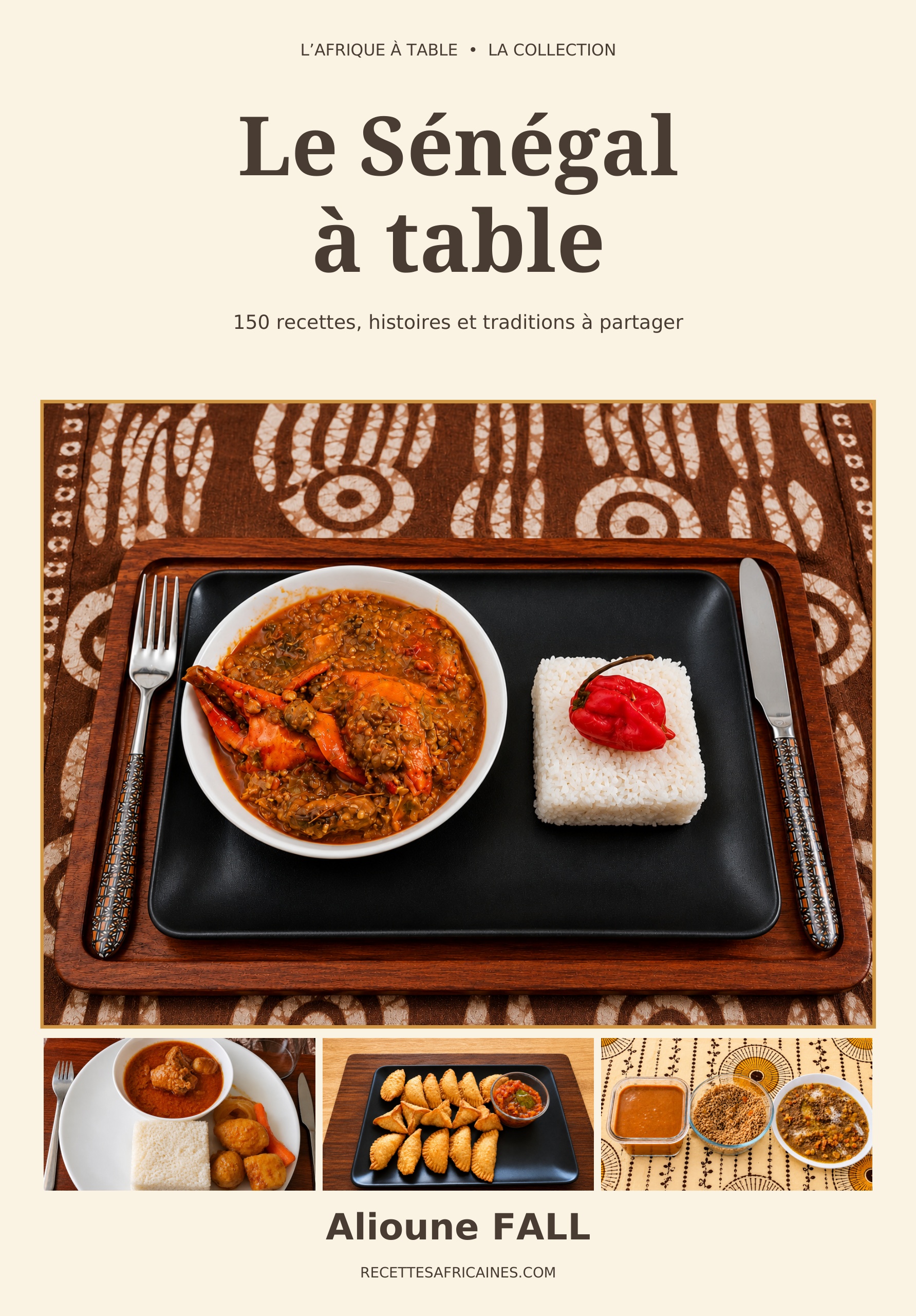
Explore Senegalese cooking with Le Sénégal à table, my collection of 150 recipes, stories and traditions to share. This book is in French, by Alioune FALL.
Explore further
4. FUNCTIONS OF SMOKING IN AFRICAN SOCIETY
4.1. Beyond preservation: safety and economy Before the era of the “fridge,” smoking was synonymous with food security: it allowed people to enjoy fish or meat long after the fishing or hunting season. In isolated regions, it was (and often still is) the only way to transport animal protein to rural villages and towns. Smoked fish and meat supply local markets: they are sold, bartered, and exported (even to Europe and North America). 4.2. Place in the rural and women's economy In most regions (Nigeria, Ghana, Ivory Coast, Cameroon, Senegal), fish smoking is a “business” managed by women: they handle purchasing, smoking, storage, sales, and master the transmission of know-how. 4.3. Gastronomic role, taste, rituals Smoking is not just a strategy of austerity or survival: it provides a unique, deep, woody, sometimes iodized or full-bodied aroma that magnifies sauces (domoda, mafe, djoumgblé, sauce feuille, pondu, ndolé…) and symbolizes hospitality, celebration, and mastery of the local terroir. Certain major celebrations require smoked fish or meat; some family transmissions make the smokehouse a “place of memory.” 4.4. Place in modern cuisine and the diaspora In African metropolises, the “smoked touch” on rice, chicken, or mafé distinguishes “real mom's cooking” from fast and bland food! The diaspora carries smoked fish in their suitcases, cooks it in burgers, tapas, quiches, modernizes the technique in electric smokehouses or fusion recipes.
5. NUTRITIONAL AND HEALTH BENEFITS
Concentrated protein: smoking dehydrates, thus concentrating proteins and minerals. Less fat: fat melts and drains into the fire. Powerful flavor: a small piece is enough to enhance, making meals more economical. Natural bactericide: smoke limits bacterial proliferation, prevents botulism, repels insects. Risks to monitor: Residues of potentially toxic compounds (hydrocarbons, PAHs, if smoking is poorly controlled or over too high a fire). Overconsumption of salt or omega-3 deficiency if food is only smoked. Increased hygiene needed (fight against botulism, secondary contamination).
6. CULTURAL, IDENTITY, AND SYMBOLIC ASPECTS
Place of learning and sociality: the smokehouse is a space for conversation, gathering, a school of “eating well together.” Female/maternal transmissions: the good “smoking hand,” the secrets of the grill or essences, are jealously guarded, revealed at the daughter's maturity or during the village festival. Ceremonies: some peoples require smoked meat for funerals, weddings, healing, welcoming strangers. 6.1. Imagination and memory The smell of the smokehouse, the taste of smoked fish or beef, are the madeleine of several generations, a direct link to the village, childhood, celebration.
7. INNOVATIONS, CHALLENGES, AND CONTEMPORARY RENEWAL
7.1. Modernization of tools Appearance of ovens with better ventilation, metal smokehouses, HACCP controls for urban markets and export. 7.2. Culinary innovations Afro-fusion chefs revisit the smoked touch: smoked fish burger, risotto, quiches, tapas, revisited sauces, urban barbecue. 7.3. Export, green economy, and sustainability Challenge of over-exploitation of wood (deforestation linked to artisanal smoking) Research into recycled sawdust, alternative essences, wood-saving ovens. Reflection on health impact (reduction of toxic residues…)
CONCLUSION Smoking is not just an African “grandmother's trick.” It is a pillar of food security, culinary identity, innovation, and conviviality. It embodies an unbreakable link between land, home, family, memory, and the future. In every woody aroma, every golden grill, every sauce flavored with smoked fish, Africa tells its story, its resilience, its pride — and its ever-renewed ability to transform necessity into pleasure and to sublimate cuisine, whatever its modernity.
Discover these cuisines at a restaurant
Explore our restaurant and caterer directories. Choose your destination and check the establishment’s menu to confirm which dishes are offered and available.
Continue exploring
Enjoy discovering ingredients and African cuisines? Join our newsletter. The illustrated PDF 10 sauces africaines incontournables is in French and is offered after confirming a subscription to the French or bilingual edition.