Bobotie
Malay/Cape (South Africa)
Understanding : Bobotie
INTRODUCTION
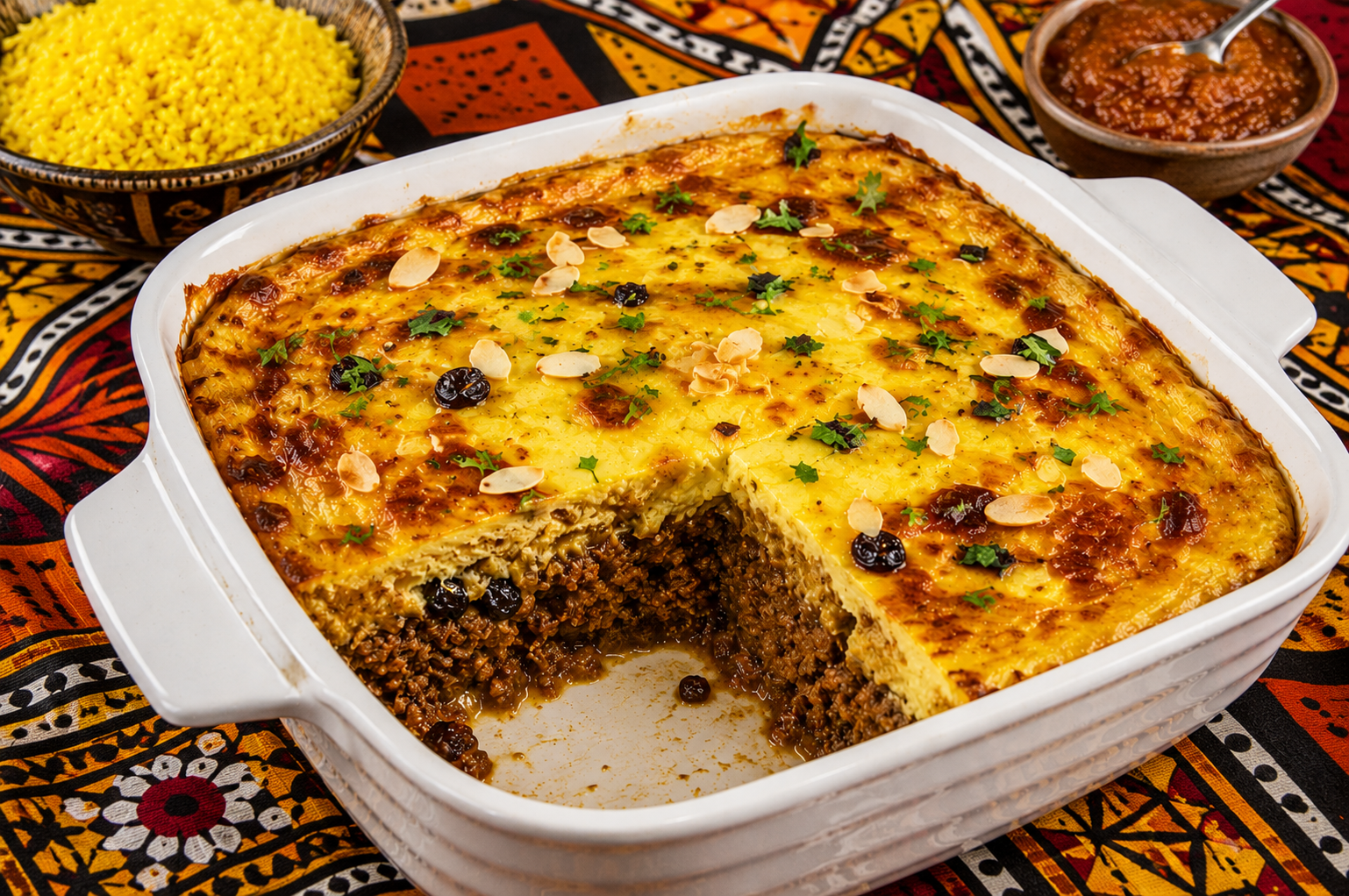
Bobotie is an icon of South African cuisine, a dish rich in history, nourished by the multiple influences that make up South Africa's colorful cultural fabric. Beyond its appearance as a simple meat gratin seasoned with spices and topped with an egg and milk mixture, bobotie embodies the culinary creativity born from human exchange, colonization, migration, and cultural blending. This dish, though rooted in the Cape region (Western Cape), carries the flavors of the East, India, Europe, and, of course, Africa. Its history, techniques, ingredients, and place in South African life make it a living testament to the routes of slavery, the Malay diaspora, and the intercultural dialogue that is modern African cuisine. In what follows, we will explore its origin, composition, preparation, variations, as well as its social function, its positioning in contemporary African gastronomy, and its symbolic significance, to fully grasp its importance on the African continent.
Prepare this speciality
Choose a detailed recipe, adjust the portions and prepare your ingredients before starting. Our cooking tips and food safety advice complement the steps described in the recipes.
Explore further: Cooking tips · Food hygiene and safety advice.
History and uses
1. HISTORY AND ORIGIN OF BOBOTIE
A well-traveled dish The history of bobotie dates back several centuries and illustrates the circulation of culinary techniques and flavors between continents. According to most historians, this dish has its roots in the Indonesian and Malay world (Malay Archipelago) of the 17th century — a time when Dutch colonists administering the Cape imported not only slaves from Indonesia, Madagascar, India, and East Africa, but also their culinary traditions. The term itself is said to come either from the Indonesian word “bobotok” (a dish made with coconut, spices, and meat), or from the Malay word “boemboe” (spice mixture). The oldest written recipe for bobotie in South Africa dates back to 1609, compiled in a Dutch cookbook. Bobotie was adapted, transformed, and perpetuated by the Cape Malay community — descendants of deported slaves working in the Cape Colony. The encounter with Dutch, then British, cuisine gave bobotie its current form: a dish based on seasoned minced meat, mild spices, and dried fruits, topped with an egg mixture and baked in the oven.
2. COMPOSITION AND PREPARATION
Basic ingredients A traditional bobotie is prepared with: Minced meat: most often beef or lamb, sometimes pork, rarely game. Onions: sautéed in oil. Eggs: both to bind the meat and prepare the final crust. Milk: soaking the breadcrumbs and used in the crust. Bread: soaked in milk, then crushed and mixed with the meat for tenderness. Spices: curry powder (often homemade), turmeric, ground coriander, mustard seeds, cinnamon, ginger, sometimes cumin. Herbs: bay leaf, thyme, parsley. Dried fruits: raisins and/or dried apricots, which define the typical sweet-savory combination. Condiments: chutney (ideally peach/gooseberry chutney, or homemade atchar), apricot jam and/or lemon zest, sometimes slivered almonds. Garlic, lemon juice, and vinegar, for freshness and balance. Salt, pepper, an optional touch of brown sugar. Oils or butter for cooking. Step-by-step preparation Aromatic base: Onions and garlic are gently sautéed in oil, then enhanced with spices (curry, turmeric…) to release their aromas. Meat: The minced meat is added and crumbled over medium heat until lightly browned. At this point, the bread previously soaked in milk and crushed, dried fruits, herbs, chutney, lemon zest, seasoning, and part of the eggs are incorporated. Assembling: This homogeneous mixture is transferred to a suitable dish (often a rectangular or oval mold), gently pressed down. Topping: The remaining eggs are whisked with milk, possibly seasoned with turmeric, then this mixture is poured over the filling. Baking: Garnish with bay leaves and bake (180°C) until the top layer is golden and the preparation is firm, releasing sweet aromas of spices and fruits. Serving Bobotie is served hot, accompanied by yellow turmeric rice, sautéed vegetables (green beans, carrots, peas…), sometimes pickles (atchar), sliced bananas, grated coconut, or apricot jam, to vary textures and affirm the sweet-savory spirit of the dish.
3. FLAVORS AND NUTRITIONAL VALUES
Bobotie is a celebration of balance: the sweetness of fruits and chutney responds to the subtle spice, the richness of the meat is lightened by the bread and milk, the moisture of the golden crust recalls that of a flan, in contrast to the density of the filling. The variety of spices makes it a warm, comforting, and stimulating dish all at once. It is nutritious, combining proteins, carbohydrates, minerals, and vitamins, and can be further balanced by adding vegetables, legumes, or by replacing the meat with a plant-based alternative (lentils, chickpeas, vegan alternatives).
In my books

Continue exploring the continent’s cuisines with Africa at the Table — 54 countries, 54 iconic dishes, by Alioune FALL. This book is in English.
Explore further
4. PLACE AND SYMBOLISM OF BOBOTIE IN AFRICAN CUISINE
Symbol of the “Rainbow Cuisine” In South Africa, bobotie is often rightly considered a symbol of the “Rainbow Nation,” a term referring to the mosaic of cultures united in this territory. It belongs exclusively to no single ethnic group but is found in mixed-race (Coloured), white, Indian, and black families alike. Served at public holidays, Sunday family meals, or highlighted in gourmet restaurants specializing in Cape Malay cuisine, it embodies a painful past but also the hope of a shared future. A Dish of Memory and Identity For descendants of slaves and the Cape Malay community, bobotie is living heritage. It recalls oral transmissions, adaptation to local products, resourcefulness in the face of colonial restrictions, creativity in ingredient choices, and the conviviality of multi-generational tables. It is not uncommon to see, in families, a family recipe book where the bobotie version is the pride of the elders. A Festive and Sharing Meal Bobotie transcends the everyday: it is served during major celebrations, weddings and birthdays, community meals in churches or associations, and collective meals for national holidays (especially Heritage Day). Preparing a bobotie is an act of generosity: one cooks for many and shares; the dish is easily cut, transported, and enjoyed both hot and warm, allowing everyone to feel included at the table.
5. REGIONAL VARIATIONS AND MODERNITY
Homemade versions Every family has its variation: adaptations are made according to means, tastes, religions (use or non-use of pork), or regions (fish-based byrek on the coast). Some replace milk with coconut milk, add fresh or candied apricots, modify the spice blend, or swap wheat bread for local grains. Contemporary cuisine Today, bobotie appears on the menus of modern Cape bistros, food trucks, hotel buffets, and airport restaurants. It inspires diet-friendly versions (lean meat, tofu, vegetables), gluten-free, or vegan options. South African chefs internationally make bobotie a signature dish, sometimes served in mini-portions (tapas or verrines), or integrated into fusion creations (bobotie-stuffed ravioli, empanadas, spaghetti with bobotie sauce). Bobotie is not static; it lends itself to innovation and experimentation while honoring its heritage.
6. INFLUENCE AND SPREAD BEYOND THE CAPE
Bobotie, while remaining deeply rooted in South Africa, inspires and is found in other communities on the continent and in the diaspora. It has influenced other sweet-savory dishes like certain tagines, couscous, or African gratins, as well as spiced meatballs from East Africa. Through migration and international curiosity, the recipe has spread to African diasporas, particularly in the United Kingdom, the United States, Australia, and Canada, where it appears at themed dinners or community events.
7. CONCLUSION
Bobotie, with its historical dimension, unique flavor, adaptability, and social importance, is much more than a South African regional dish. It carries the memory of cultural blending, the genius of culinary survival, the enthusiasm of sharing, and the beauty of African diversity. Preparing and tasting a bobotie means reconnecting with ancestral gestures and connecting to the great history of African peoples, their generosity, their sense of celebration, and their constantly renewed creativity. A symbol of a mixed past looking towards the future, bobotie today stands as a pillar of African cuisine, rich in meaning and future, inviting the world to the table of the Cape and, through it, to that of an entire continent.
ENJOY YOUR MEAL! © Photo credit: recettesafricaines.com. All rights reserved.
In the kitchen : Bobotie
Recipes from the site to put your knowledge into practice:
Discover these cuisines at a restaurant
Explore our restaurant and caterer directories. Choose your destination and check the establishment’s menu to confirm which dishes are offered and available.
Continue exploring
Enjoy discovering ingredients and African cuisines? Join our newsletter. The illustrated PDF 10 sauces africaines incontournables is in French and is offered after confirming a subscription to the French or bilingual edition.