Bunny Chow
Indian/Zulu (Durban, South Africa)
Understanding : Bunny Chow
INTRODUCTION
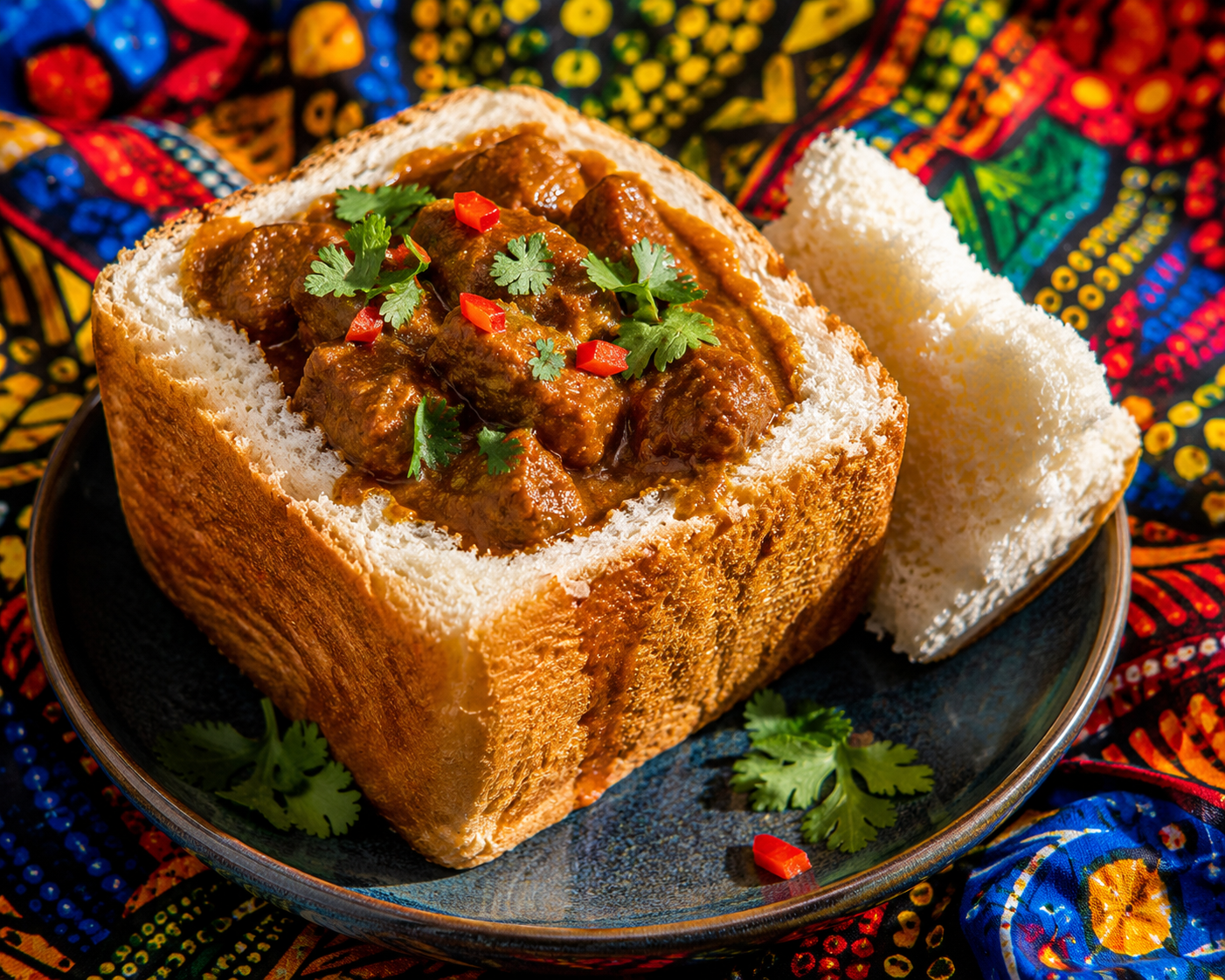
It's impossible to talk about Southern African street food without mentioning "Bunny Chow." This dish, whose name is intriguing, embodies popular ingenuity, the legacy of immigrant communities, creativity in the face of constraints, and the urban conviviality of South Africa. Seemingly simple – a hollowed-out loaf of bread filled with a fragrant curry – it tells a complex story, leaves a lasting impression, and continues to tantalize taste buds across the country, especially in Durban where it originated. Behind its unassuming appearance lies a history of migration, diversity, struggle, and cultural resilience. Bunny chow is now a culinary icon, popular far beyond the South Asian diaspora from which it originated, and it perfectly symbolizes the "Rainbow Nation," this vibrant and diverse South Africa. Let's delve into the history, technique, variations, and place of bunny chow in African culture, before detailing its recipe and secrets, as well as its nutritional qualities and food pairings.
Prepare this speciality
Choose a detailed recipe, adjust the portions and prepare your ingredients before starting. Our cooking tips and food safety advice complement the steps described in the recipes.
Explore further: Cooking tips · Food hygiene and safety advice.
History and uses
1. ORIGINS AND HISTORY OF BUNNY CHOW
A creation of Durban's Indian community The history of Bunny Chow begins in the 1930s-1940s in Durban, South Africa's main port, but above all, the beating heart of the country's Indian community. This community, stemming from forced migrations (indentured laborers to work on sugar cane plantations from the 19th century) and then voluntary migrations from British India, had managed to preserve and adapt its culinary traditions to South African realities. Legend has it that Indian restaurateurs, eager to serve Black and Indian workers, especially those not allowed to frequent restaurants during apartheid, had the idea of hollowing out a loaf of bread to fill it with curry – a nourishing, economical dish, and above all, easy to take away and eat without utensils. WHY "BUNNY CHOW"? The name "Bunny Chow" blends history and irony. It does not refer to the animal "bunny." "Bunny" is said to derive from "bania," the name of an Indian merchant caste common in Durban at the time, and "chow" meaning "food." The dish was also called "Kota" in Zulu ("quarter loaf," for a quarter of a loaf of bread), the other popular form in South Africa. A dish of borders and inclusion A true street dish, bunny chow is essentially a "world food": the result of a painful historical context, it has managed to cross racial barriers to establish itself among all communities in South Africa. Its popular symbolism is immense: it is celebrated as a success of fusion, mixing, and constant adaptation. Bunny chow has become the food of penniless students, night owls, workers, as well as families and tourists who come to taste the most authentic Durban.
2. DESCRIPTION, RECIPE AND TECHNIQUES
a. What is a Bunny Chow made of? Its principle is simple: a loaf or a quarter of white or brown sandwich bread, cut "like a box" – the hollowed-out crumb serves as a "lid," the bread acts as a bowl, and the filling is a creamy, spicy, and generous curry. Typical ingredients: For the bread: • 1 industrial white sandwich loaf (or whole wheat, depending on taste) • Either the whole loaf is used, or more often a "quarter" (quarter of a loaf, hence the name "quarter loaf") For the curry filling: The filling can be vegetarian or meat-based. Bean, lentil, chickpea, potato, chicken, beef, or lamb curry: the curry is flavorful, well-seasoned, and thick enough not to soak the bread. Example of classic chicken curry: • 600 g boneless chicken pieces • 1 large onion, sliced • 2 peeled and crushed tomatoes or 200 g tomato pulp • 2 or 3 potatoes, diced • 2 cloves garlic, minced • 1 piece of ginger • 2 tablespoons curry spices (curry powder, garam masala, cumin, coriander, turmeric, chili powder) • Curry leaves (optional, typical of Durban) • Salt, pepper, vegetable oil • Fresh coriander, lemon wedges, red onions for serving b. Step-by-step preparation
- The curry: • Heat oil in a sauté pan. • Add onions, garlic, ginger, sauté for 3-4 minutes. • Stir in spices, stir until fragrant. • Add chicken, brown, then add tomatoes, potatoes, salt, and pepper. • Cover with a little water or broth, simmer over low heat until everything is tender and the sauce is well thickened (30 to 40 minutes). • Adjust seasoning, finish with a bunch of chopped coriander.
- Preparing the bread: • Cut the loaf or quarter loaf lengthwise. • Carefully remove the inside without damaging the crust (keep the crumb for "dipping"). • Generously fill with hot curry. • Close with the crumb as a lid.
3. Serving:
• Arrange on a plate or serve in newspaper for an authentic ambiance. • Accompany with red onion slices, lemon wedges, fresh chilies, and a small ramekin of chili sauce or raita.
In my books

Continue exploring the continent’s cuisines with Africa at the Table — 54 countries, 54 iconic dishes, by Alioune FALL. This book is in English.
Explore further
- CHEF'S TIPS AND ADVICE FOR A SUCCESSFUL BUNNY CHOW • Curry consistency: It should be slightly thick, never liquid, to hold in the bread and prevent it from getting soggy. Some add a spoonful of flour or mash a few potatoes to thicken the sauce. • Sturdy bread: Use bread that is not too fresh (slightly stale) so it doesn't collapse once filled. • Fresh spices: Add fresh coriander, curry leaves, mustard seeds for an authentic Durban touch. • Filling: The curry can be vegetarian (beans, lentils, chickpeas), vegan, or with meat/fish. • Plating: Always keep the removed crumb for dipping in the remaining sauce.
4. VARIATIONS, MODERNITY AND SPREAD OF BUNNY CHOW
a. Regional & community variations • Quarter: Common version, based on a quarter loaf, but some eateries offer the "half" or the full loaf, to share. • Kota townships: Beyond Durban, the "kota" in townships sometimes includes improbable fillings: fries, minced meat, cheese, egg, and sauces. • Vegan bunny: Butternut, chickpea, spinach curry. • Fish bunny: Fish curry in coastal regions, influenced by South Indian cuisine. • Mixed chow: Fusion version where curry is replaced by less classic fillings (chicken tikka, South African chakalaka, barbecues…). b. Everyday and festive dish Often enjoyed in markets, outside stadiums, at large student parties, concerts, and workers' celebrations, it remains a strong marker of South African popular culture. During Apartheid, it was sometimes the only hot dish accessible to non-white workers, which gives it a strong symbolic charge of inclusion and resistance today. c. International spread and creativity Arriving with the diaspora, bunny chow has conquered London, New York, Paris, and Johannesburg in the form of food trucks or in South African restaurants. Some chefs are reinterpreting bunny chow into bite-sized portions (mini filled breads), healthy versions with whole wheat or gluten-free bread, or as an "open bunny" like a tartine.
5. SYMBOLIC AND SOCIAL PLACE OF BUNNY CHOW
More than a dish, bunny chow has become a true totem: it recalls reinvention, resourcefulness, the solidarity of the most humble, the inventiveness of urban youth, and survival under constraint. It also embodies the success of "fusion food" that takes root in the pains of history, and asserts itself in the identity pride and joviality of the South African way of life. Its street food sharing refers to an essential African gesture: eating from the same dish, sitting together, braving the harshness of daily life with warmth, humor, and friendship. There are no barriers: rich or poor, white or black, Zulu, Indian or Afrikaner, everyone today enjoys bunny chow.
6. NUTRITIONAL BENEFITS AND ADVANTAGES
• Balanced: varied vegetables, legumes or meat, carbohydrates from bread, anti-inflammatory spices (turmeric, ginger). • Filling: designed to sustain a worker's day, this dish combines slow-release carbohydrates, protein, and fiber. • Vegan-friendly: chickpea, kidney bean, or fresh vegetable curry versions are rich in fiber, plant protein, vitamins, and minerals. • Conviviality: Encourages eating with fingers, without fuss. • Adaptability: dairy-free and egg-free (excluding "fusion" fillings), gluten-free possible. However, be mindful of the industrial white bread content: some may prefer whole wheat or sourdough bread to limit fast sugars and add fiber. The dish is quite salty and spicy, which suits South African climates, but can be adapted.
7. PAIRINGS, SIDE DISHES AND DRINKS
Traditionally, bunny chow is served alone, sometimes with • Onion slices, coriander, fresh chilies • Pickles or atchar (Indian-style pickled vegetables) • Crispy salads as a side dish As for drinks: a cold local beer, a South African soda ("Appletiser," ginger "Stoney"), or any refreshing drink is suitable. Some "fusion" variations are accompanied by a raita (yogurt with herbs and spices) to soften the heat of the spices.
CONCLUSION Bunny chow is much more than an economical dish or a tourist curiosity. It is a living testament to South African history, the successful meeting of cultures, the genius of the humble, and the art of living together. Simple, generous, infinitely adaptable, it supports the diversity of the African continent, its flavors, and its shared memories. Biting into a bunny chow means biting into the history of Durban, that of the South African people, and, by extension, into the creative vitality of African street food. If you travel to Southern Africa, don't miss it: whoever tastes bunny chow tastes the living and vibrant soul of the continent.
ENJOY YOUR MEAL! © Photo credit: recettesafricaines.com. All rights reserved.
In the kitchen : Bunny Chow
Recipes from the site to put your knowledge into practice:
Discover these cuisines at a restaurant
Explore our restaurant and caterer directories. Choose your destination and check the establishment’s menu to confirm which dishes are offered and available.
Continue exploring
Enjoy discovering ingredients and African cuisines? Join our newsletter. The illustrated PDF 10 sauces africaines incontournables is in French and is offered after confirming a subscription to the French or bilingual edition.