Funge
Kimbundu (Angola)
Understanding : Funge
INTRODUCTION
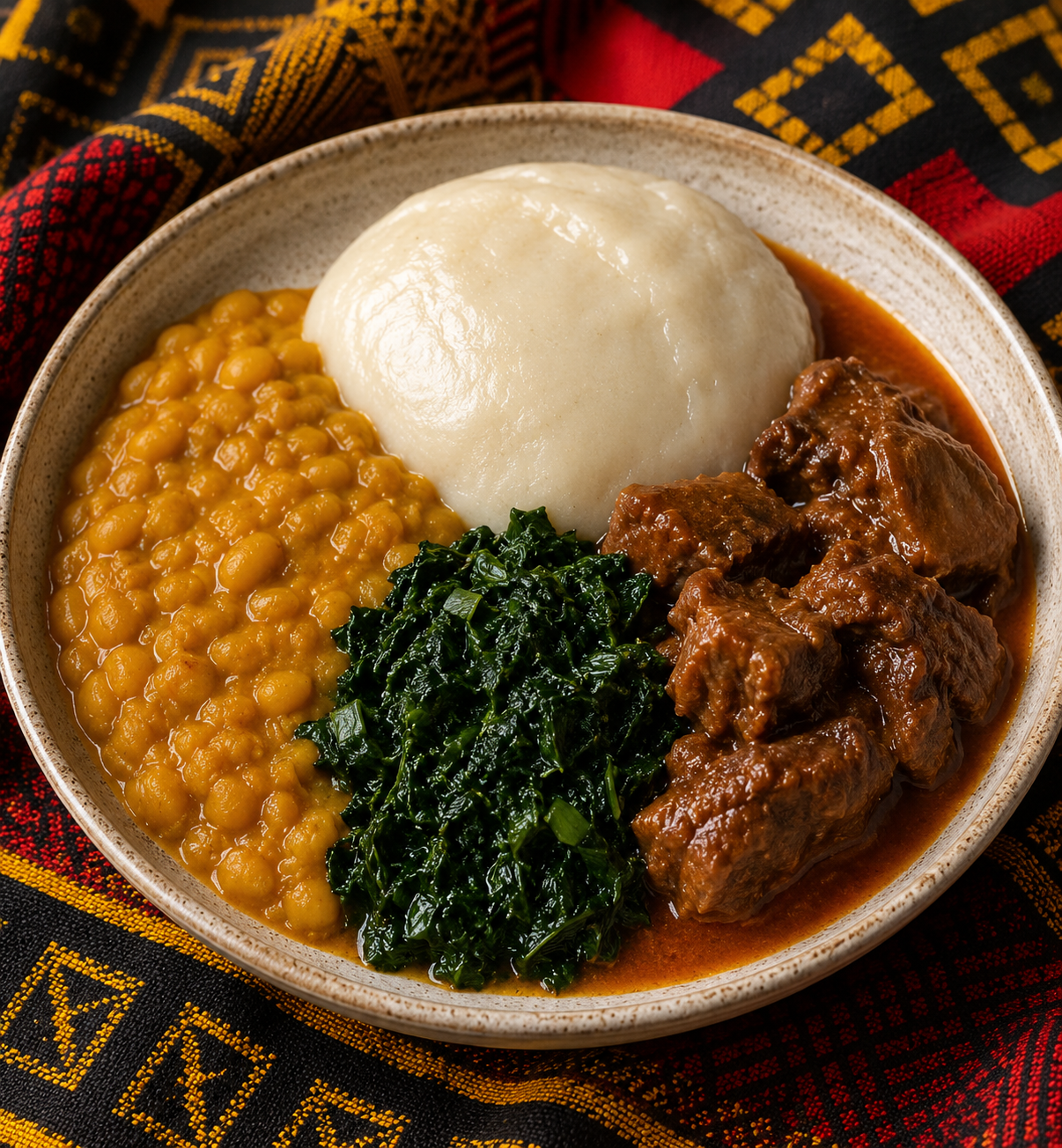
Funge (or "fúngi", "foungu", pronounced "founji" in Portuguese, sometimes also called funje or fungi) is one of the pillars of Central and Lusophone African cuisine, particularly in Angola, Congo (Brazzaville and DRC), São Tomé and Príncipe, and in African communities in Brazil and Cape Verde. A soft, elastic, and slightly sticky paste, obtained by cooking cassava or corn flour in water, funge holds a place in these societies reminiscent of fufu in West Africa, nsima in Malawi, or ugali in East Africa. At various times a daily dish, a base for rich stews, a foundation for family conviviality, and a marker of national identity in ceremonies or community meals, it embodies the simplicity, robustness, and immense creativity of African cuisines. Behind its neutral texture and preparation gestures lies a long history of transmission, rural innovation, social adaptation, and attachment to local traditions. This detailed description aims to explore the history, origins, manufacturing techniques, social, symbolic, nutritional dimensions, and modernity of funge, to highlight the depth and universality of this humble dish.
1. ORIGINS, SPREAD, AND HISTORY OF FUNGE
1.1. Cradle and geography Funge, as consumed today, is closely linked to the history of cassava (yuca, manihot esculenta), a tuber originating from South America, transplanted to Africa during the slave trade by the Portuguese between the 16th and 18th centuries. Cassava, resistant to drought, easy to cultivate, and highly productive, quickly conquered Central and Southern Africa (Angola, DRC, Gabon, Congo-Brazzaville, São Tomé and Príncipe…). Cassava funge became the staple food of the Congo Basin, Angola, and, by extension, the African diaspora in Brazil, particularly in the state of Bahia. Versions of funge based on corn flour (funje de milho, very popular in the regions of Bengo, Kwanza Sul, Uíge, Benguela) also quickly emerged, following the acculturation of corn in Southern Africa. 1.2. History and transmission The preparation of funge, passed down from mother to daughter, then adapted to urban contexts, remains both a daily act and a collective ritual: the pestle and wooden spoon, cooking in a large pot, the strength of the arm, the transmission of the right "knack," shared tasting directly from the dish—everything is memory and continuity.
2. INGREDIENTS, VARIATIONS, AND PREPARATION METHOD
2.1. Basic ingredients Cassava flour ("fuba de bombó" in Angola, "chikwangue" or "placali" for fermented variants, "kwanga" in DRC) Or corn flour ("fuba de milho") Water (sometimes salted, sometimes with a little broth) Some families add a pinch of salt or sometimes a little oil to "polish" the dough, but overall, the recipe remains intentionally very simple. 2.2. Traditional method Bring water to a boil in a thick-bottomed pot. For 500g of flour, count approximately 1.2-1.5L of water. Gradually pour in the flour, sprinkling or in portions, stirring constantly with a long wooden spoon ("pau de funge"). Stir vigorously until a homogeneous, soft, very dense paste is obtained that detaches from the sides: the funge is only ready when it "holds" the spoon upright, without lumps (an operation that sometimes requires two people, due to the vigor of the gesture and the difficulty of avoiding lumps). Serve hot, arranged in a communal dish, cover it with a cloth to keep it warm and prevent a crust from forming. Shape, according to custom, into balls, cones, using two oiled spoons or wet fingers. 2.3. Regional variations Cassava funge (most common): translucent white color, very elastic. Corn funge (milho): golden yellow color, slightly sweet taste and aroma. Pirão (Brazil, Cape Verde): funge prepared with fish or meat broth, more liquid, often served with seafood or crustaceans. Chikwangue, madesu, batons de manioc: fermented funge, shaped into sticks, wrapped in banana leaves, and steamed. Kwanga (DRC): funge fermented for a long time, very "wild" aroma, sometimes odorous, keeps longer.
3. PLACE OF FUNGE IN THE MEAL AND CULINARY ASSOCIATIONS
3.1. Universal side dish Funge serves as a "carrier food": it is not served alone, but systematically accompanies stews, sauces, or grilled dishes. Muamba de galinha or de peixe (Angola, DRC, Gabon): chicken or fish in red palm oil sauce, always accompanied by funge. Calulu: dish of cod or dried meat, tomatoes, okra, green leaves (kizaca), palm oil, funge. Pounded cassava leaves, smoked fish, peanut sauces, stewed beans (madesu), bushmeat… funge is found on all tables, from festive meals to construction site snacks. 3.2. Eating practice Unlike bread or rice, funge is rarely chewed for a long time: a portion is taken (often with the right hand, fingers moistened in a bowl of water), shaped into a ball or spoon, and soaked in sauce before being swallowed. This gesture—common throughout Africa—emphasizes conviviality, the absence of cutlery, and the closeness of sharing.
4. SOCIAL, SYMBOLIC, AND ECONOMIC DIMENSION
4.1. Food of conviviality and sharing The preparation and consumption of funge are inseparable from the collective. Family meals: each guest takes their share from the communal dish, in a perfect equality of gesture. Festive tables (boda, baptism, funerals): funge is one of the essential dishes, marking abundance, generosity, and respect for the guest. Intergenerational transmission: the preparation of funge is the "baptism" of young girls and boys into adult life, their ability to feed a household. 4.2. Identity symbol Funge, as much as muamba or calulu, is perceived as a "culinary DNA": For Angolans, it is the basis of national taste, the "bread of the earth." In the diaspora, it evokes native Africa, the nostalgia of a "true meal," the strength of the connection to ancestral roots. 4.3. Place in the rural and urban economy The production of cassava and its transformation into flour and then funge represents hundreds of thousands of agricultural, artisanal, and commercial jobs (from field to market, including mills, flour vendors, funge cooks in urban canteens).
5. NUTRITIONAL VALUE AND HEALTH
5.1. Nutritional profile Funge, depending on its base (cassava, corn, sorghum…), is a rich energy source of complex carbohydrates (starch), very low in lipids, and moderate in protein. Provides vitamins (vitamin C and B depending on processing), potassium, magnesium, fiber (if unrefined flour). Suitable for gluten-free diets (cassava, corn). Low in allergens, digestible, and satiating. 5.2. Necessary complements By its nature, funge is not a complete source of protein, fat-soluble vitamins, or iron. Hence the tradition of associating it with rich sauces (peanut, fish, leafy vegetables, meat, beans) to ensure nutritional balance. 5.3. Public health Easy to digest, funge is recommended for children, the elderly, or convalescents. In times of abundance, it prevents hunger and reduces fatigue. With its moderate glycemic index, it ensures lasting satiety.
6. CONTEMPORARY CHANGES AND INNOVATIONS
6.1. Urbanization and industrialization With urbanization and the modern pace of life, funge production has adapted: Pre-cooked flours, instant funge, ready-to-use funge Development of community electric mills to speed up processing This evolution allows for quick consumption but raises questions about the loss of taste, artisanal texture, and the collective family gesture. 6.2. Diaspora and modern gastronomy In Afro restaurants, funge is featured in small bites, as cassava "couscous" in tabbouleh, or in revisited desserts. In France, Portugal, Brazil, Afro-descendant chefs sublimate this paste through innovative gastronomic associations (truffled funge, funge gnocchi, Afro lasagna, funge tacos). 6.3. Diversification and health "Vegetarian funge" version with vegetable broth, spirulina, turmeric, associated with root vegetables. "Healthy" recipes incorporating chia, local seeds, fruit or leaf powder, in the wake of superfoods. Adaptation of funge to combat diabetes, malnutrition, or urban obesity. 6.4. Social profitability Projects for women's cooperatives, microcredit, organic sectors, sale of vacuum-packed dried funge, integration of young people into the urban agri-food sector.
7. LIMITS AND SUSTAINABLE DEVELOPMENT
7.1. Monoculture and environmental impact The rise of cassava monoculture (sometimes at the expense of biodiversity) prompts some actors to diversify cultivated varieties and recover local varieties. Processing waste (peels, soaking water) reused as fertilizer, animal feed, to reduce waste. 7.2. Health challenges Poor cooking or contamination of cassava flour: risk of cyanide poisoning. Need for standards and training to ensure the quality and safety of the final product, especially on a large scale.
CONCLUSION Funge, seemingly a modest soft pancake or white paste, is a cornerstone of African food culture. It carries the memory of an agricultural history, village solidarity, powerful femininity, and inexhaustible culinary creativity. In every moistened ball in the sauce, in every pot, every shared hand-to-mouth experience, African life pulsates: robust, warm, inventive. From the rural pot to the Afro-globalized starred table, funge—a nourishing foundation, an identity marker, an object of transmission and innovation—remains one of the most vivid witnesses to Africa's ability to invent, endure, and unite around taste, gesture, and sharing.
Prepare this speciality
Choose a detailed recipe, adjust the portions and prepare your ingredients before starting. Our cooking tips and food safety advice complement the steps described in the recipes.
Explore further: Cooking tips · Food hygiene and safety advice.
In my books

Continue exploring the continent’s cuisines with Africa at the Table — 54 countries, 54 iconic dishes, by Alioune FALL. This book is in English.
In the kitchen : Funge
Recipes from the site to put your knowledge into practice:
Discover these cuisines at a restaurant
Explore our restaurant and caterer directories. Choose your destination and check the establishment’s menu to confirm which dishes are offered and available.
Continue exploring
Enjoy discovering ingredients and African cuisines? Join our newsletter. The illustrated PDF 10 sauces africaines incontournables is in French and is offered after confirming a subscription to the French or bilingual edition.