Pili-Pili
Swahili (East and Central Africa)
Understanding : Pili-Pili
INTRODUCTION
At the heart of African cuisine, pili-pili holds a place that is as discreet as it is fiery: behind this name, one finds both the star African chili pepper, the small “Capsicum frutescens” with its reputation as a “bird’s eye chili,” and the artisanal chili sauce that enlivens, awakens, enhances, and sometimes electrifies dishes from Central and East Africa, as well as Southern Africa. While the name varies – pili-pili, periperi, piri-piri, malagueta, ndongo, chili sauce, depending on the location and language – its use has largely become established in popular kitchens, markets, canteens, and even in urban or Michelin-starred restaurants of the diaspora. Pili-pili, in its simplicity, has become a technical and sensory culinary heritage, a source of pride, creativity, and a symbol of hospitality. Through its fire, it connects generations of cooks, accompanies all forms of sharing, from family barbecues to large ritual feasts, and seduces all palates, from the most robust to the most delicate. This text offers a detailed description of pili-pili, from its history, botany, and African adaptation, to its manufacturing methods, uses and variations, social symbolism, health benefits, economic stakes, and its influence on global cuisine.
1. ORIGINS, HISTORY, AND JOURNEY OF CHILI IN AFRICA
1.1. From the New World to African soil Pili-pili, in the botanical sense, originates from… tropical America. Chili peppers (capsicum) were unknown in sub-Saharan Africa before the arrival of the Portuguese and Spanish in the 16th century via the Atlantic slave trade. But, like corn or cassava, chili quickly adapted: it thrives in poor soils, heat, resists drought, and requires very little care. In a few centuries, it would “re-Africanize” the continent’s taste. 1.2. The name “pili-pili” The name is said to come from Swahili (East Africa), where “pilipili” means “chili pepper,” but also – through its echoing sound – “strong chili.” The name refers to both the fruit, the plant, and, by extension, the sauce. Portuguese made it “piri-piri,” Angolan “ndongo,” Malagasy “sakay.” This glocalization explains the spread of sister sauces as far as Asia (Malaysia, Indonesia, Goa, Macao…). 1.3. Widespread diffusion and adaptation From the Congo Basin to Mozambique, from Kenya to Madagascar, from Cameroon to Zambia, each region has “its” pili-pili and its microclimate: the bird’s eye chili from Congo, elongated and terribly hot; the malagueta from Mozambique, fleshy and fragrant; the red chilies from Rwanda or Burundi, small but with great vivacity. It is ubiquitous as a side dish, condiment, natural preservative, enhancer of bland flavors, and a weapon against food poisoning.
2. CULTIVATION, HARVEST, AND PROCESSING OF PILI-PILI
2.1. A resilient plant Pili-pili peppers are among the most robust in African gardens: direct sowing, progressive harvesting, year-round production in equatorial zones. They can grow in pots or hedges, and require little water. This ease makes pili-pili a “crisis” food during periods when main crops are abandoned. 2.2. Harvest and uses They are picked red (ripe) or green (more herbaceous), depending on the use and the recipe. They can be stored fresh, dried (in the sun, on a rack, or smoked over a fire), or fermented. Some of the harvest is sold in markets, the rest is directly processed into sauce or oil.
3. PILI-PILI SAUCE: ARTISANAL PRODUCTION
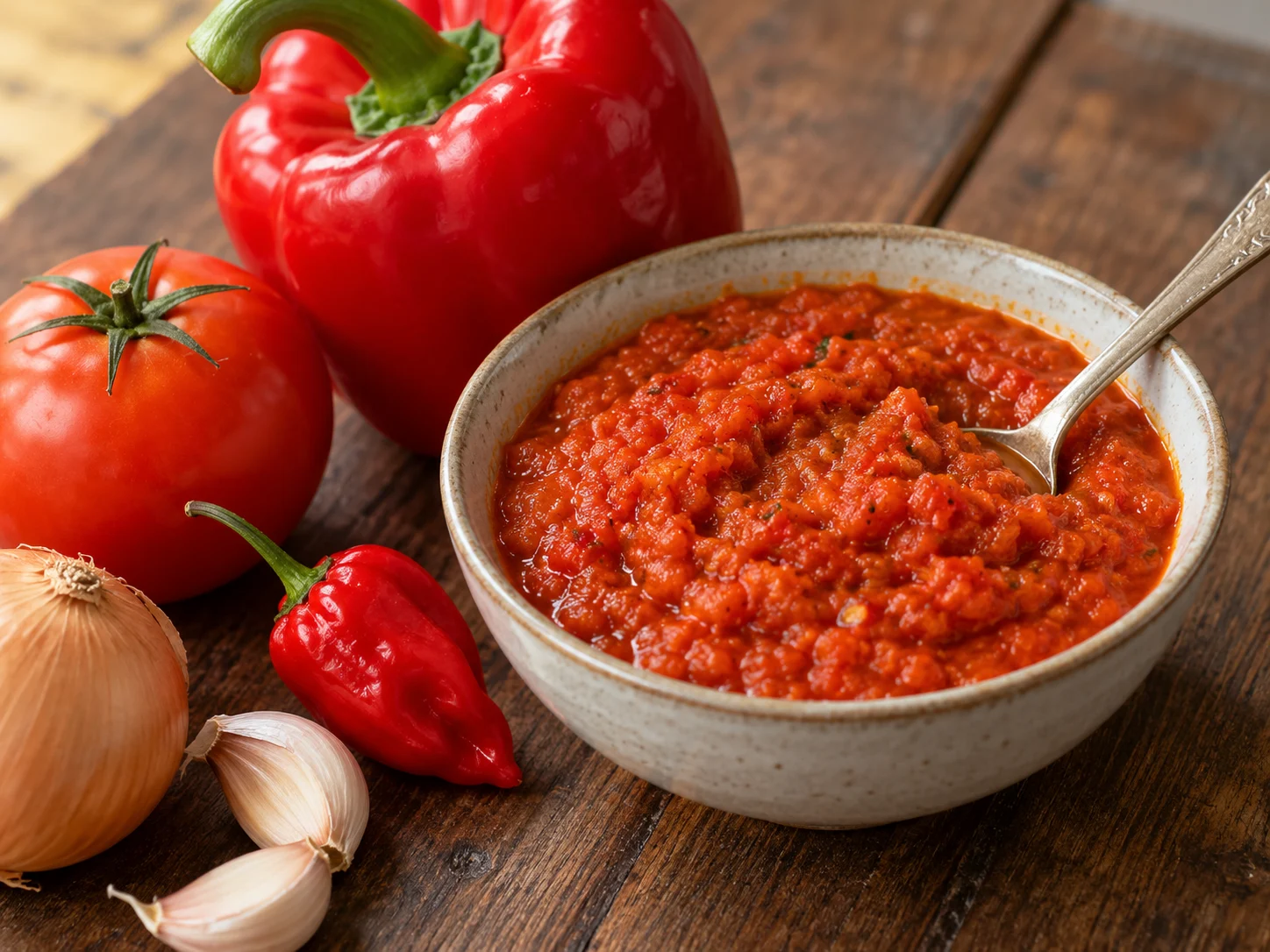
3.1. Basic ingredients The heart of the sauce: fresh or dried pili-pili, coarse salt, vegetable oil (peanut, cotton, sunflower, sometimes red palm oil in Central Africa or olive oil in the Indian Ocean). Depending on the region or family recipe, additions include: • Garlic • Onion • Ginger • Lemon/lime juice or vinegar (white, cane, rice) • Black pepper, passion berries, fresh herbs (parsley, cilantro) • Paprika, fresh tomato, carrot (to thicken and soften) • Honey or sugar (rare, to sweeten in a “Creole” style) • Bouillon cube (in the contemporary urban version) • Coconut milk (Mozambique, Angola, some areas of DRC) 3.2. Main homemade steps
- Sorting, washing: the chilies are stemmed, sometimes deseeded if a milder heat is desired.
- Grinding: with a traditional mortar (pounding), or blender, or grater, until a fine or grainy paste is obtained (according to taste).
- Mixing and short cooking: the paste is gently cooked in a little oil, with onion, garlic, ginger, herbs, until thickened. The sauce can also be kept raw (stronger), simply salted and vinegared.
- Maceration: for long preservation, the sauce can be “jarred” covered with oil.
- Filtering (optional): for liquid pili-pili, the pulp is filtered to keep only the oil.
- Potting: bottle, glass jar, artisanal plastic sachet. 3.3. Regional variations • White pili-pili: garlic, salt, lemon, little chili, to accompany fish. • Smoked pili-pili: chilies dried with smoke, woody taste, Congo, Gabon, Rwanda. • Raw green pili-pili: green chilies, lemon, herbs, very fresh and brutal. • Malagasy sakay: a derivative, with ginger and garlic, a Creole medley of sauce. • Rougaille and other relishes: chili-tomato-onion mix. • Oily pili-pili: chilies infused for several weeks in oil.
4. CULINARY USES, PILI-PILI SCENOGRAPHY
4.1. Always present at the table Pili-pili is often served in a small jar or dish: everyone adds a drop (or more!) according to their tolerance. It accompanies: • Grilled dishes (chicken, fish, skewers, meats, tripe, lamb) • Rice, cassava, fufu, bobolo, plantain. • Soups, leafy sauces, mafés, pondu, ndolé. • Afro sandwiches, burgers, omelets, pasta. • Fritters, breads, chips (for true enthusiasts!). 4.2. Market and neighborhood marker In markets, pili-pili signals the vendor’s toque, the seriousness of the maquis or “chop bar.” It is brandished as a selling point, sometimes offered “by the spoon,” to test the bravery of the tourist or neighbor. 4.3. Festive and sharing dish At gatherings, weddings, Tabaski, religious snacks, pili-pili accompanies feasts. It inaugurates the celebration, sets the mood, heats up the discussion. 4.4. Street food and diaspora In the city, pili-pili sauce is adopted in street food: African burgers, Afro pizza, fried chicken, neighborhood shawarma, “Congolese pili-pili,” and in urban brunches from Paris to Brussels. It travels in suitcases, jars, packages to the diaspora.
5. SOCIAL SYMBOL, RITUALITY AND IDENTITY OF PILI-PILI
5.1. Instrument of hospitality and challenge Offering pili-pili is to test resistance, bravery, and also the guest’s honor. In many cultures, “he who eats my chili is my brother,” and tolerance to heat is a mark of integration. 5.2. Mother-to-child transmission Tradition dictates that only “good hands” know how to “mount” the ideal pili-pili sauce; transmission of spices, seeds, secrets, strength of fire, anointing. It creates the legend of mamas, and sometimes of great Afro-descendant chefs. 5.3. Support for economic emancipation The chili/sauce sector is a female economic incubator: market gardening production, processing, retail sales, export to the diaspora, food truck circuits, snacks, and Afro delicatessens.
6. HEALTH, NUTRITION AND VIRTUE OF FIRE
Pili-pili does more than just spice up daily life: • Capsaicin: stimulates digestion, “boost” effect on satiety. • Vitamins C, A, E, beta-carotene, antioxidants. • Anti-bacterial, anti-parasitic action (traditional use to treat stomach ache, joint pain, flu-like symptoms). • However, caution is advised in cases of ulcers, sensitive intestines… Moderation is recommended, but pili-pili is rarely consumed in large spoonfuls (except in competitions!).
7. MODERNITY, GLOBALIZATION AND INNOVATION AROUND PILI-PILI
7.1. Diaspora and export Jars of homemade pili-pili sauce, infusions in Afro shops, and the rise of hot sauces made in Africa in food culture networks (USA, Europe, Middle East, Korea via South African/Angolan export). 7.2. Fusion cuisine and mixology Afro chefs revisit the sauce: pili-pili mayonnaise, butter, ketchup, chili oils, spiced cocktails, desserts (chocolate-chili), vegan dips. 7.3. Agroecology and survival Pili-pili proves to be a miracle plant against drought, malnutrition, a support for biocontrol (pest management), a tool for rural and urban revitalization.
8. CONTEMPORARY CHALLENGES
• Risk of standardization, loss of “handmade,” industrial standardization: necessity to preserve local recipes, the art of the pestle, artisanal fermentation. • Market flooded with diluted sauces, additives – demand for pure, organic, short supply chain, traceability. • Need for innovation to soften, diversify (mild pili for children, fruit/chili mixes).
CONCLUSION Pili-pili is one of the most vibrant faces of African cuisine’s modernity and tradition. Fiery, festive, social, identity-forming, economic, medicinal, it connects the intimacy of the cooking pot to the globalization of tastes. In every drop, every shared jar, burns the memory of the land, the hands of women, the meeting of continents, the power of fire and conviviality. To preserve, reinvent, and transmit pili-pili is to protect the soul of a joyful, resilient… and truly flavorful Africa.
Where to find it
Look for the exact food-grade form required by the recipe at markets and specialist shops. Check the product name, ingredients, condition and storage instructions.
Explore further: Cooking tips · Food hygiene and safety advice.
Search Amazon.fr — affiliate link →
Check availability and delivery on Amazon.fr. Compare ingredients, packaging and sellers.
As an Amazon Associate I earn from qualifying purchases.
In my books

Continue exploring the continent’s cuisines with Africa at the Table — 54 countries, 54 iconic dishes, by Alioune FALL. This book is in English.
In the kitchen : Pili-Pili
Recipes from the site to put your knowledge into practice:
Discover these cuisines at a restaurant
Explore our restaurant and caterer directories. Choose your destination and check the establishment’s menu to confirm which dishes are offered and available.
Continue exploring
Enjoy discovering ingredients and African cuisines? Join our newsletter. The illustrated PDF 10 sauces africaines incontournables is in French and is offered after confirming a subscription to the French or bilingual edition.