Brik
Tunisian Arabic (Tunisia)
Understanding : Brik
INTRODUCTION
Brik (or brick, بريك in Arabic) is one of the most emblematic culinary specialties of Maghrebi cuisine, particularly in Tunisia, where it is a true gastronomic pillar and social ritual. Simple in form but rich in history and flavors, brik comes in countless variations across North Africa, from Morocco to Libya. Over time, it has become both an everyday dish, a Ramadan essential, and a popular presence at major family celebrations. Behind its golden crispiness, brik reveals the genius of a people in the art of combining local ingredients and building bridges between regions, intimacy, and festivity. In this text, we will discover brik in depth: its origins, techniques, variations, social symbolism, nutritional benefits, chef's secrets, and contemporary adaptations. More than just a recipe, brik embodies the spirit of hospitality, African creativity, and the vitality of the continent's street food.
Prepare this speciality
Choose a detailed recipe, adjust the portions and prepare your ingredients before starting. Our cooking tips and food safety advice complement the steps described in the recipes.
Explore further: Cooking tips · Food hygiene and safety advice.
History and uses
1. ORIGINS AND HISTORY OF BRIK
1.1. Centuries-old roots The history of brik dates back several centuries. The word is believed to come from the Turkish börek, referring to many dishes made of thin dough, stuffed and cooked in oil or baked. The expertise of making very thin sheets, similar to Greek filo pastry or Turkish yufka, is thought to have arrived in North Africa during the Ottoman era, then adapted to local products to give birth to Tunisian brik. In Tunisia, brik established itself as a popular dish, difficult to date precisely but omnipresent in 19th-century culinary accounts and documents. Similar preparations are found in eastern Algeria (where it is also called bourek or m'hajja), and to a lesser extent in Morocco, where the more sophisticated bstilla (or pastilla) shares a distant kinship. 1.2. The brik sheet, an artisan's technique The specificity of brik lies in its thin, translucent sheet, called malsouka in Tunisia (or sometimes dioul in Algeria). It was traditionally made by hand, with expert skill: a semi-liquid dough made from durum wheat semolina, hydrated, is applied by hand in thin, overlapping circles on a very hot plate (gasâa). These sheets are then dried on a cloth, ready to be stuffed. Today, industrial production has made these sheets more accessible, but in many homes, the ancestral gesture persists for special occasions. 1.3. Symbolism and ritual place Brik is essential during Ramadan: it traditionally opens the ftour (breaking of the fast) in Tunisia, often with soup (chorba) and dates. But it is also invited to sacrifice feasts, weddings, and dinners with friends, where it symbolizes generosity and sharing.
2. DESCRIPTION, COMPOSITION, AND TRADITIONAL PREPARATION
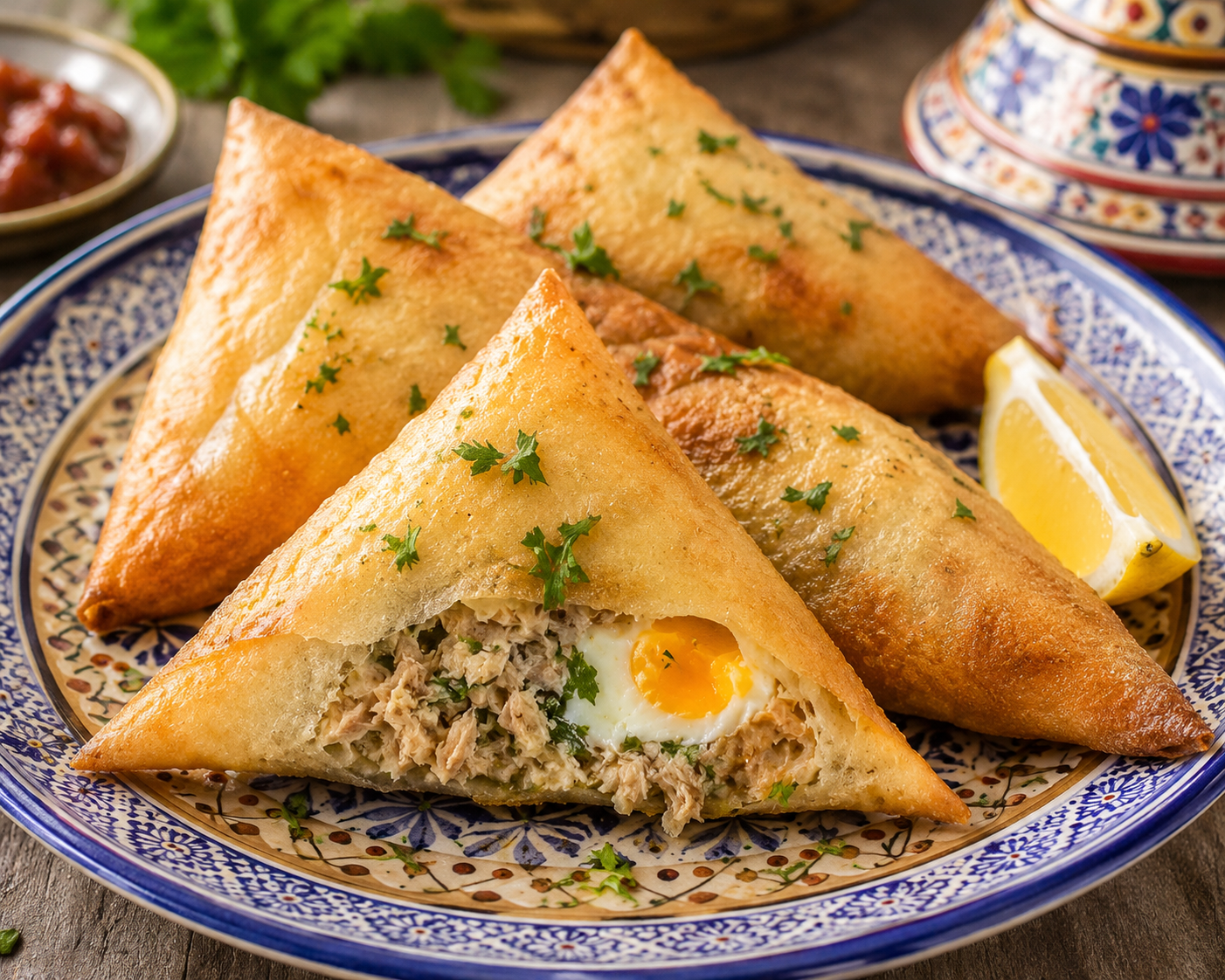
2.1. The classic recipe The most famous brik is brik with egg (بریك بالبيض/Brik bil beid), which requires precise skill. The steps are as follows: Ingredients (for 4 briks): • 4 brik or malsouka sheets • 4 extra-fresh eggs • 1 small cooked and mashed potato • 1 medium onion, finely chopped • 1 handful of flat-leaf parsley, chopped • 4 tbsp oil-packed tuna • Salt, black pepper, harissa (optional) • Neutral oil for frying (sunflower or peanut) • Lemon wedges, for serving Preparation:
- In a bowl, mix the mashed potato, onion, parsley, tuna, salt, pepper, and harissa if desired.
- Lay a brik sheet flat on a plate. Place a spoonful of the filling in the center. Make a small well and crack an extra-fresh egg into it.
- Gently fold the sheet into a triangle or half-moon, then seal the edges with a little water.
- Heat a large amount of oil. When the oil is hot but not smoking, gently slide in the brik. Cook for 1 to 2 minutes on each side: the sheet should be golden and crispy, the egg white cooked, the yolk runny.
- Drain on absorbent paper. Serve immediately, drizzled with lemon juice. Brik should be eaten very hot, as this is when it expresses its contrast between crispiness and a melting heart. 2.2. Infinite variations Brik can be customized endlessly: • With shrimp or fish: filling of shrimp sautéed with garlic, spices, and cilantro. • With kefta: lamb or beef, onions, spices. • With vegetables: zucchini, carrots, spinach, potatoes, fresh goat cheese or feta. • With cheese and herbs: for a modern or vegetarian touch. • Sweet: brik filled with date paste, dried fruits, and cinnamon (specialties sometimes prepared for holidays). • Algerian M'hajja: brik filled with parsley, onions, eggs, cooked in a pan without frying. Brik is also about conviviality: everyone can fill their own brik according to their taste!
In my books

Continue exploring the continent’s cuisines with Africa at the Table — 54 countries, 54 iconic dishes, by Alioune FALL. This book is in English.
Explore further
3. NUTRITIONAL BENEFITS AND ADVANTAGES
Nutritionally, brik offers an interesting balance: • Quality proteins: egg, fish, or meat. • Carbohydrates: provided by the brik sheet (flour, semolina) and possibly potato. • Good fats: depending on the filling (tuna, olive oil), the dish also provides necessary lipids. • Micronutrients and fiber: via parsley, onions, and added seasonal vegetables. • Moderate caloric intake: if cooked in hot oil that is not absorbed, the sheet absorbs little, making frying less greasy than imagined. It is a complete dish that can be enjoyed alone for dinner, or accompanied by a fresh salad, according to Tunisian tradition.
4. BRIK AND SOCIETY: CONVIVIALITY, GENDER, AND TRANSMISSION
4.1. Transmission rituals Brik is often the first festive dish that young people learn to prepare, under the watchful eye of elders. They explain the subtlety of folding, managing the frying (to prevent the egg from exploding!), and the art of the filling. In many families, making briks is a collective, warm moment, where people chat, discuss variations, and initiate the youngest into the transmission of the "knack." 4.2. Place in festive meals During Ramadan, it is difficult to imagine breaking the fast without a pile of golden briks. They are also offered at births, weddings, on the morning of major religious holidays (Eid...), where they symbolize the generosity of hospitality, prosperity, and the joy of reunion.
5. CHEF'S TIPS AND MODERNITY
5.1. Secrets to success • Ultra-fresh egg: it should be runny, but not run out of the sheet. Use a large spoon or a slightly hollowed bowl to assemble the brik. • Hot but not smoking oil: too cool, the brik absorbs oil; too hot, it burns. 180 °C is ideal. • Good quality sheet: A fresh, flexible but resistant sheet guarantees tear-free folding. • Careful draining: Place on several layers of absorbent paper, serve without delay. 5.2. New horizons Today, young Tunisian chefs are revisiting brik with unexpected fillings: duck breast, roasted seasonal vegetables, aged cheeses, mild spices. Some bake or pan-fry briks for a less greasy alternative. In mini version, it becomes an appetizer (finger food) at cocktails and events, attracting a new urban or international clientele. Brik is even gaining renown among the diaspora in France, Italy, and the United States, marking immigration celebrations and trendy restaurant menus.
6. CONTEMPORARY PLACE AND SYMBOLISM
In large Tunisian or Algerian cities, brik is inseparable from street food: it is found in markets, snack bars, and popular neighborhoods. It belongs to everyday tables as well as to haute cuisine. It embodies North Africa in all its diversity and cultural blending: Berber, Arab, Ottoman, Jewish, and French influences are found in this small crispy triangle. Ritual, convivial, ultra-adaptable, carrying memory and open to creativity, brik symbolizes the openness of the Maghreb, its hospitality, its ability to tirelessly reinvent ancient gestures.
7. PAIRINGS, ACCOMPANIMENTS, AND DRINKS
Traditionally, brik is served: • With a lemon wedge for acidity. • Accompanied by a mechouia salad, a Tunisian salad of grilled peppers, tomatoes, and onions. • Or a chorba (light soup) to temper the spiciness of Ramadan. • Drinks: mint tea, fresh citrus juices, or, for enthusiasts, a glass of ancestral leben (fermented milk).
CONCLUSION Brik is much more than a small golden fritter: it is the living and vibrant symbol of the Maghrebi table, street culture, outstretched hand, and African culinary modernity capable of drawing inspiration from the world while retaining its soul. Crispy, fragrant, versatile, joyful, brik remains an invitation to share, to friendship, and to gourmet pleasure – all that makes the richness of African cuisine, yesterday and today.
In the kitchen : Brik
Recipes from the site to put your knowledge into practice:
Discover these cuisines at a restaurant
Explore our restaurant and caterer directories. Choose your destination and check the establishment’s menu to confirm which dishes are offered and available.
Continue exploring
Enjoy discovering ingredients and African cuisines? Join our newsletter. The illustrated PDF 10 sauces africaines incontournables is in French and is offered after confirming a subscription to the French or bilingual edition.