Piri-piri
East Africa
Understanding : Piri-piri
INTRODUCTION
Piri-piri, also spelled peri-peri, pili-pili, or piripiri, is much more than just a spicy sauce: it's a culinary institution, a marker of identity, a symbol of the historical fusion between Africa, Europe, and America. Essential in Southern Africa (Mozambique, Angola, South Africa) as well as Central and East Africa, piri-piri has spread across the ocean to Portugal and Brazil, establishing itself as a universal flavor with African roots. In the streets of Maputo, in the markets of Luanda, at the rural tables of Mozambique, or in the "peri-peri chicken shops" of London, piri-piri embodies the passion for taste, the generosity of heat, the memory of history, and the creativity of African cuisine in motion. Behind its aromatic burn lies a story of migration, resistance, women's expertise, local heritage, a festive, family-oriented, and modern industry. This detailed description explores the origin of piri-piri, its journey across continents and eras, its preparation, its culinary variations, its social, economic, nutritional, and symbolic value, as well as its role in innovation and global gastronomy.
1. ORIGINS AND HISTORY OF PIRI-PIRI
1.1. The piri-piri pepper: an American migration, an African acclimatization The word piri-piri comes from Swahili or Kimbundu ("piri" = pepper, chili), and names the Capsicum frutescens pepper, originally from… South America. Introduced to Africa from the 16th century via the slave trade, intercontinental trade, and Portuguese colonization, the pepper took root in the gardens, farms, and forests of Mozambique, Angola, and throughout the southern continent, becoming hardy, small, very hot, and endowed with unique aromas. 1.2. The invention of piri-piri sauce Piri-piri sauce was born in the colonial wake, a cross between Portuguese marinating practices (garlic, oil, vinegar, spices) and the African use of fresh chili, herbs, and citrus. From the 19th century, piri-piri sauce became the basic condiment of Mozambique and Angola and was exported to Portugal, where it brought fame to churrasqueiras ("grills"), and then to the whole world through the diaspora.
2. INGREDIENTS, TECHNIQUES, AND REGIONAL VARIATIONS
2.1. The peppers "Piri-piri" refers to both the African bird's eye chili (Capsicum frutescens variety, small, thin, very pungent, around 100,000 Scoville units) and, by extension, other local chilies (malagueta, pili-pili, ndongo, pili). In South Africa and Portugal, the blend is adjusted to the desired strength. 2.2. Other key ingredients • Garlic • Vegetable oil (traditionally peanut, olive, or sunflower oil) • Vinegar (cane, rice, wine) • Lemon or lime juice • Salt, pepper • Herbs (coriander, oregano, parsley) • Paprika, black pepper, bay leaf (optional) • Onion (sometimes) • Ginger, cloves (in some regions) Local versions will include fresh or dried red chili, tomato sauce, coconut milk (Mozambique), citrus zest. 2.3. Traditional preparation • The chilies are crushed fresh or dried, pounded in a mortar with garlic and salt. • Oil, vinegar, lemon juice, herbs are added, then left to macerate for 24 hours to several weeks. • Each family, each restaurateur has their "secret" recipe: strong, mild, tangy, oily, dry, or green. • It can then be filtered (for a chili oil) or the pieces can be kept. 2.4. Packaging Today, piri-piri is sold in bottles, as a paste, in powder form, by the ladle in markets and supermarkets in Africa, Europe, and Brazil.
3. CULINARY USES AND EMBLEMATIC RECIPES
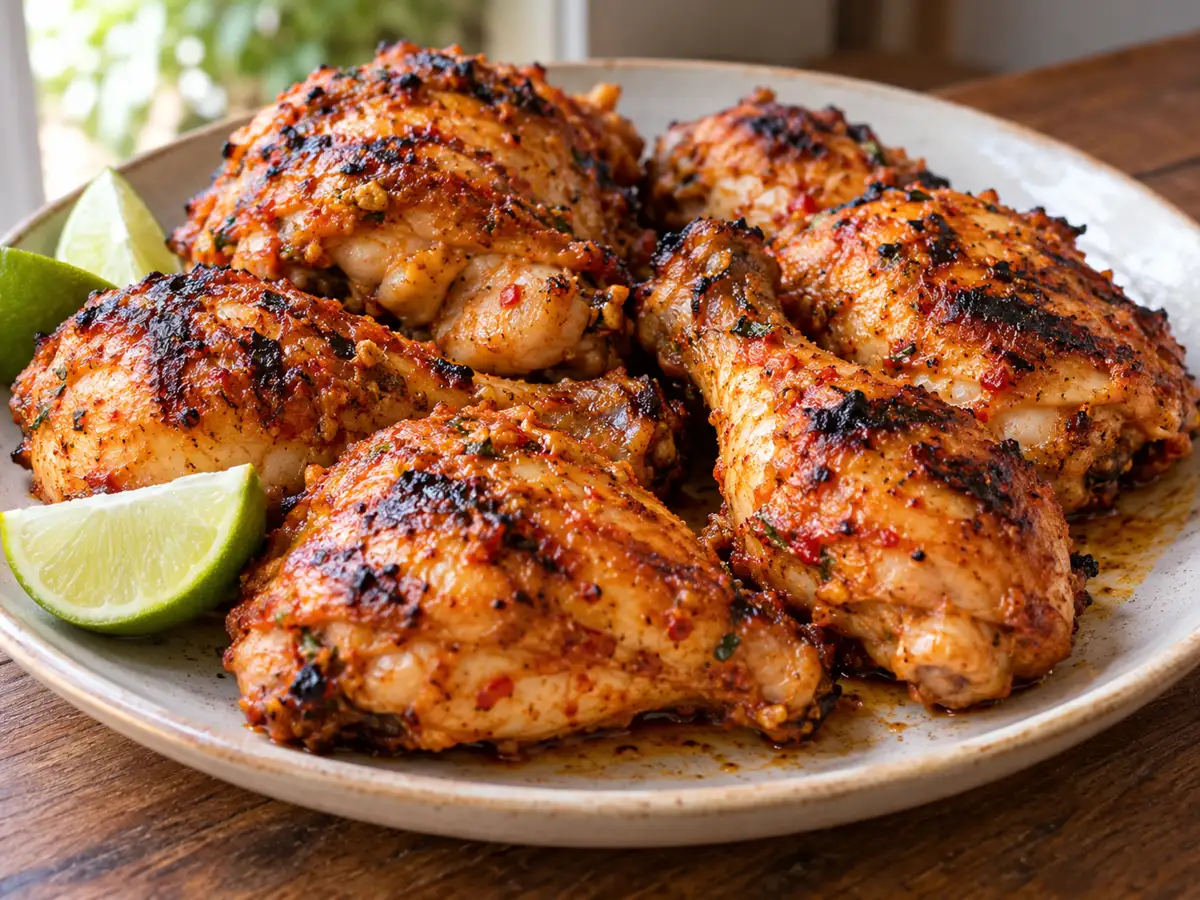
3.1. Mozambique, Angola, South Africa: historical heartland • Chicken Piri-Piri or Frango à Piri-Piri: chicken marinated for several hours, roasted over a wood fire or grilled, basted with piri-piri sauce during cooking, served whole or in pieces, crispy outside, juicy inside. • Camarão/Camarões a piri-piri (grilled or sautéed shrimp with sauce) • Ribs, beef, lamb, fish (such as "tilapia piri-piri", grilled sardines or mackerel) • Matapa piri-piri (cassava leaf sauce, palm oil, shrimp), a popular Mozambican dish. • Churrasco or braai (South Africa): all grilled meats benefit from a "piri-piri" brushing. 3.2. Side dishes • Potatoes, white rice, xima (cornmeal or cassava porridge), spicy salads, plantains • Cornbread or brioche, fresh baguette 3.3. Table rituals Traditionally, piri-piri is placed on the table in a small carafe: everyone adds it to their taste, on meat, sandwiches, fries, rice, or vegetables. 3.4. Street food, canteens, and celebrations From the Mozambican coast to the Angolan "boteco", piri-piri colors fritters, grilled meats, soups, sandwiches, and street barbecue. It accompanies the arrival of guests, the end of the day, cold beer, and conviviality.
4. SOCIAL, IDENTITY, AND HERITAGE PLACE
4.1. Symbol of conviviality In Maputo, Luanda, Johannesburg, Lagos, Lisbon, London, the mention of "piri-piri" immediately evokes the generosity of the table, shared meals, the refined simplicity of a collective, festive, always informal dish. 4.2. Female and family transmission Preparing piri-piri sauce according to the recipe of "pili-pili ya mama" or "da Vó" (grandmother's), is to value the maternal gesture, family memory, and transmission. Women sometimes pass on the best seeds, fermentation techniques, and proportions. 4.3. Pride, identity, ritual of fire Piri-piri also marks the family barbecue, a boy's rite of passage to "fire master", an offering during celebrations, on Sundays, for galette, or during an initiation ceremony. 4.4. Instrument of emancipation Economically, the production and sale of piri-piri peppers or sauce are major sectors, often female-led, supported by small markets, exporters, artisans, startups, and chefs.
5. PLACE IN GLOBAL GASTRONOMY, DIASPORA, AND INDUSTRY
5.1. Global piri-piri and Afro-fusion With the rise of chains such as Nando's (created in South Africa), Oporto (Australia), and the growth of Afrofood festivals, piri-piri has become an international star: London chicken shops, piri-piri burgers, flavored chips or popcorn, spicy pizzas, "peri-peri hot" jarred sauces. 5.2. Chefs and innovation New Afro and fusion chefs are revisiting piri-piri: piri-piri butters, mayonnaises, seafood marinades, vinaigrettes, sauces for poke bowls, ethnic street food. 5.3. Diaspora and heritage The sauce travels in suitcases, is bought online, and is establishing itself in Afro, Indian, West Indian, and Latino outlets, proving its ability to unite without diluting itself.
6. NUTRITIONAL AND HEALTH BENEFITS
Piri-piri is not just about taste: • Rich in capsaicin (the molecule responsible for heat): appetite suppressant effect, painkiller (endorphins), stimulation of digestion. • Source of vitamins (C, A, B6), trace elements, antioxidants. • Provides few calories if not fatty, but be careful with excessive oily sauce or salt. Some studies associate regular consumption of chilies with a cardiovascular and metabolic protective effect, but moderation is advised for sensitive individuals (ulcers, irritable bowel).
7. LIMITATIONS, ADAPTATIONS, AND CONTEMPORARY CHALLENGES
• Adaptation of strength: piri-piri sauce sold globally is often sweetened, less potent than grandmother's versions — an issue of authenticity. • Agricultural sector (chili) fragile in the face of climate change, intensification, monoculture. • Competition from Asian or American sauces (Sriracha, Tabasco), need to label African piri-piri. • Rediscovery of old methods (fermentation, long maceration), return of traditional, organic, preservative-free, fair-trade recipes.
CONCLUSION Piri-Piri is the flame of African taste, the memory of grandmother's garden, the scent of encounters, the convivial burn of shared sauce, the strength of a continent that transforms a "botanical migrant" into a global culinary emblem. In every pot, every grill, every sandwich, or every celebration, piri-piri unites ancestral and colonial Africa with urban modernity, from Maputo to London, from Luanda to Lisbon, and ignites the imagination and palate of the whole world. To transmit, value, and innovate around piri-piri is to preserve one of the most beautiful legacies of African cuisine and to continue writing, generation after generation, the powerful story of fire and the table on the continent and far beyond.
Where to find it
Look for the exact food-grade form required by the recipe at markets and specialist shops. Check the product name, ingredients, condition and storage instructions.
Explore further: Cooking tips · Food hygiene and safety advice.
In my books

Continue exploring the continent’s cuisines with Africa at the Table — 54 countries, 54 iconic dishes, by Alioune FALL. This book is in English.
In the kitchen : Piri-piri
Recipes from the site to put your knowledge into practice:
Discover these cuisines at a restaurant
Explore our restaurant and caterer directories. Choose your destination and check the establishment’s menu to confirm which dishes are offered and available.
Continue exploring
Enjoy discovering ingredients and African cuisines? Join our newsletter. The illustrated PDF 10 sauces africaines incontournables is in French and is offered after confirming a subscription to the French or bilingual edition.