Okra
Bantu (Africa)
Understanding : Okra
ORIGIN AND HISTORY
Okra originated in Africa, likely from regions around Ethiopia, Sudan, and West Africa, where it has been cultivated for over 3500 years. Its presence is attested since ancient Egypt, as evidenced by certain papyri. Arabs, great travelers and merchants, are believed to have facilitated its spread to Asia Minor, India, and then Southern Europe. During the slave trade era, okra was introduced to the Americas, particularly the Caribbean, Louisiana, and Brazil, where it enriched local culinary traditions.
BOTANICAL DESCRIPTION
An annual plant of the Malvaceae family (like hibiscus or hollyhock), okra can reach 1 to 2 meters in height. It produces large palmate leaves, and its pale yellow flowers, similar to those of hibiscus, give rise to elongated, soft, and tender green fruits (capsules), measuring 5 to 20 cm. These fruits, harvested young before they become fibrous, are what are consumed. The seeds inside are edible and rich in oil.
Where to find it
Look for it at a market or African grocery shop, fresh or frozen depending on the recipe. Ask the seller about the variety, ripeness and preparation instructions.
Explore further: Cooking tips · Food hygiene and safety advice.
History and uses
CULTIVATION AND PRODUCTION
Okra thrives in warm, humid, sunny regions, in light and well-drained soils. Its rapid growth, high yields, and resilience make it an essential subsistence food in many rural areas of Africa and Asia. The largest okra producers are Nigeria, India, Sudan, Egypt, and various nations in Central and South America.
NUTRITIONAL VALUE AND HEALTH BENEFITS
Okra fully deserves its nickname "super vegetable." In 100 grams of fresh okra, you'll find: • Calories: approximately 32 kcal • Protein: 2 g • Carbohydrates: 7 g • Fats: 0.2 g • Fiber: 3-4 g • Vitamins: A, B6, C, K, folates • Minerals: calcium, potassium, magnesium, iron, zinc
MAIN BENEFITS:
- Rich in fiber: improves digestion and regulates bowel transit.
- Low glycemic index: recommended for diabetes management.
- Antioxidant power: fights cellular aging.
- Source of minerals: promotes bone health, nerve health, and proper immune function.
- Low in calories: an ally for weight loss diets.
- Beneficial mucilage: protects the digestive system, soothes mucous membranes.
CULINARY USES
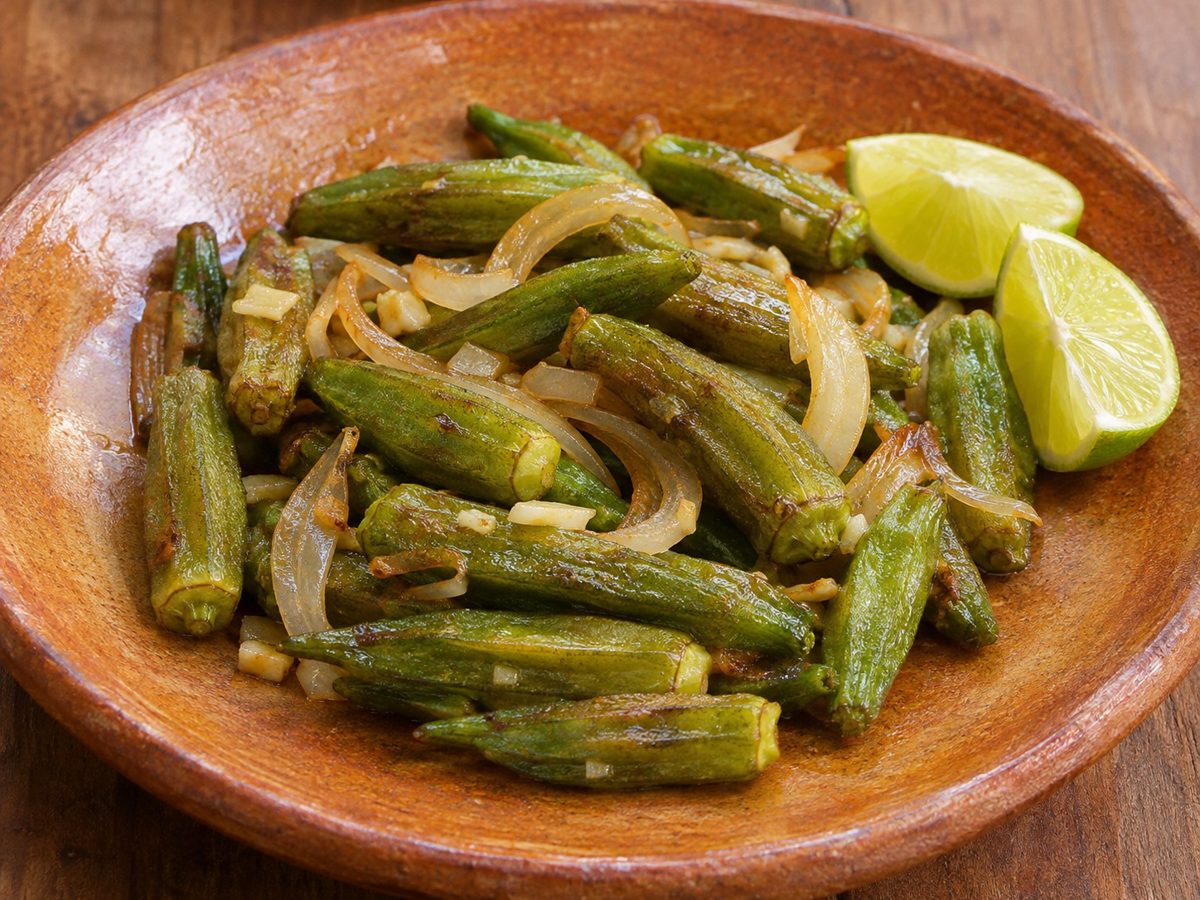
Okra is highly valued for its unique texture, which naturally thickens soups and sauces thanks to its mucilage. It can be prepared in an infinite number of recipes: • West and Central Africa: bamia sauces, okra soup, served with rice, fufu, or yam. • Maghreb, Egypt, Middle East: slow-cooked stews like "bamia," with tomato, lamb, or beef. • Louisiana-Caribbean: a key ingredient in Creole gumbo or callaloo soup. • India: stir-fried as bhindi masala with spices. • Brazil: used in feijoada or boiled. It can be grilled, fried, boiled, curried, or even pickled in vinegar. Its roasted seeds can replace coffee.
In my books

Continue exploring the continent’s cuisines with Africa at the Table — 54 countries, 54 iconic dishes, by Alioune FALL. This book is in English.
Explore further
MEDICINAL USES AND TRADITIONAL VIRTUES
In many traditional African and Asian medicines, okra is credited with virtues: • Soothing: used as a poultice to calm skin irritations. • Digestive remedy: the mucilage soothes gastritis and ulcers. • Tonic: a plant often recommended for convalescents or pregnant women due to its richness in nutrients and folates. • Vegetable fat: oil extracted from okra seeds, rich in unsaturated fatty acids, is used in food and cosmetics.
CULTURAL AND SYMBOLIC PLACE
Okra is much more than a food: it is a symbol. In Senegal, Nigeria, and Ivory Coast, it embodies conviviality; the okra sauce dish is shared during major events. In the African diaspora (Louisiana, Brazil), it symbolizes the culinary memory of ancestors and resilience in the face of exile.
PREPARATION TIPS
• To limit sliminess: cook whole okra, blanch briefly, or sprinkle with vinegar. • For crispiness: sauté quickly over high heat or grill whole. • Storage: consume fresh, otherwise store dried, frozen, or pickled.
VARIETIES
Several varieties of okra exist, from pale green to dark green, or even purplish. Depending on the region, the size and caliber change. African varieties are often finer and more tender.
CONCLUSION
Okra, a true gift from Africa to the world's food heritage, captivates with its versatility, nutritional qualities, and ability to connect peoples and traditions. Integrated into a balanced diet, it brings originality, texture, and health to the plate. Discovering or rediscovering okra means traveling, sharing, and valuing ancestral culinary knowledge.
By adopting okra in your kitchen, you perpetuate a millennial history, while choosing a virtuous vegetable for health and the planet.
ENJOY YOUR MEAL! © Photo credit: recettesafricaines.com. All rights reserved.
In the kitchen : Okra
Three recipes from the site to put your knowledge into practice:
Discover these cuisines at a restaurant
Explore our restaurant and caterer directories. Choose your destination and check the establishment’s menu to confirm which dishes are offered and available.
Continue exploring
Enjoy discovering ingredients and African cuisines? Join our newsletter. The illustrated PDF 10 sauces africaines incontournables is in French and is offered after confirming a subscription to the French or bilingual edition.