Egusi
West and Central Africa
Understanding : Egusi
INTRODUCTION
Egusi is one of the most emblematic ingredients in West and Central African cuisines. Behind this name, there are actually several varieties of oilseeds extracted from certain types of melons (Cucumeropsis mannii and Citrullus lanatus), specifically cultivated for their seeds and not for their flesh. Egusi embodies the creativity, diversity, and depth of African culinary heritage, supported by processing know-how, family transmission, and an adaptability that gives rise to a multitude of dishes ranging from the famous Nigerian egusi soup to the thick sauces of Cameroon or Ghana. While its fame primarily precedes it thanks to Nigeria's famous "Egusi Soup," egusi actually spans the entire Gulf of Guinea as well as the forest regions of Central Africa. It also carries significant symbolism – childhood memories, clan identity, food security – and invaluable nutritional properties.
This detailed description delves into the world of egusi: botany, origins, culinary uses, flagship recipes, cultural dimensions, modern innovations, and future challenges.
Where to find it
Look for the exact food-grade form required by the recipe at markets and specialist shops. Check the product name, ingredients, condition and storage instructions.
Explore further: Cooking tips · Food hygiene and safety advice.
Search Amazon.fr — affiliate link →
Check availability and delivery on Amazon.fr. Compare ingredients, packaging and sellers.
As an Amazon Associate I earn from qualifying purchases.
History and uses
1. ORIGINS, BOTANY, AND HISTORY
1.1. Egusi seeds The word "egusi" refers to a group of plants from the cucurbit family (the same as cucumber, melon, watermelon), whose seeds are harvested, dried, shelled, and consumed. These seeds are flat, beige to whitish, oily, and rich in protein. The main species are: Citrullus lanatus subsp. mucosospermus (white melon) Cucumeropsis mannii (egusi melon or white-seeded pumpkin) Sometimes, they are confused with classic pumpkin seeds (fluted pumpkin), but egusi has a unique texture, flavor, and thickening ability. 1.2. Origin and spread Varieties of edible-seeded melon have been domesticated since at least the Neolithic period in the Sahelian and West African forest regions. Egusi cultivation is found from Senegal to Nigeria, from Benin to the DRC, but also in Cameroon, Ghana, Togo, Côte d'Ivoire, Mali, and as far as Angola. The reason for their popularity: their ability to thrive in poor soils, their high nutrient content, their ease of storage, and their culinary versatility.
2. PRODUCTION CYCLE, PROCESSING, AND KITCHEN ARRIVAL
2.1. Cultivation and harvest Egusi melons are sown at the beginning of the rainy season. They grow on creeping vines, producing round to oval fruits of varying sizes (from the size of a papaya to a football), often not very flavorful for their flesh, but rich in seeds. When ripe, the fruits are harvested and split: the seeds are scraped out and washed thoroughly to remove all pulp. 2.2. Drying, storage, and shelling The seeds are sun-dried for a few days, then stored in fiber bags or jars. They are then shelled by hand or mechanically, then sold whole or ground in the market. 2.3. Processing In cooking, egusi is used: Whole or crushed: in dishes where it adds texture and crunch Ground: most common, to form a paste that serves as a thickener in sauces Pressed: to obtain egusi oil, less common but sought after for its gastronomic and cosmetic uses
3. NUTRITIONAL PROFILE AND BENEFITS
Egusi is a true nutritional ally: 30 to 50% lipids (mostly unsaturated, good for the heart) 25 to 35% protein (complete or nearly complete, ideal for cereal-based diets) 10 to 15% carbohydrates Fiber, minerals: calcium, iron, potassium, phosphorus, magnesium Provitamin A, vitamins B, E This profile makes it a source of satiety, energy, and growth, valuable in rural contexts or during periods of food scarcity (before harvests). Its fatty acids and vitamins contribute to skin and mucous membrane health, child growth, and recovery after illness or childbirth.
4. USES AND RECIPES IN AFRICAN CUISINE
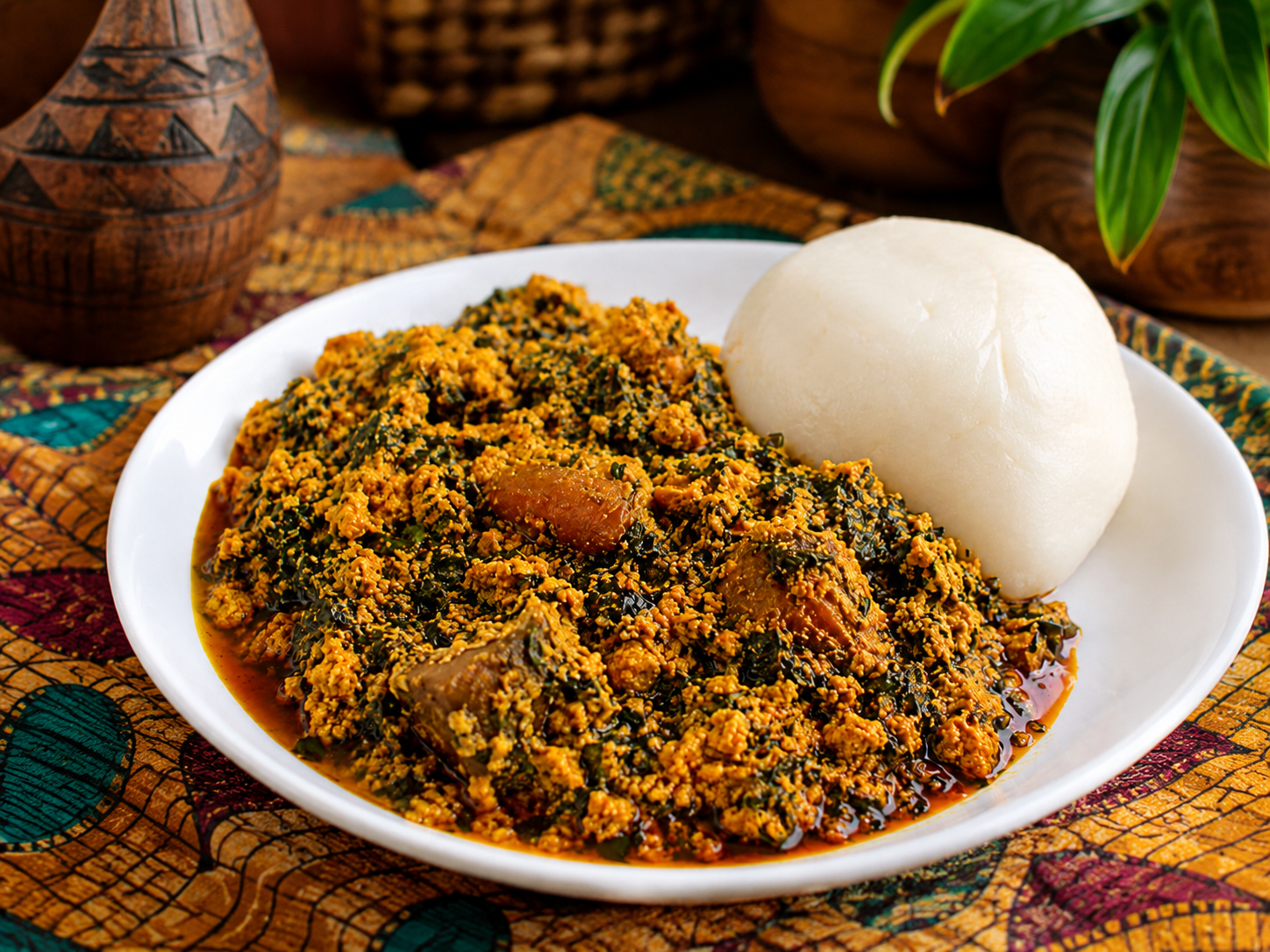
4.1. Egusi Soup (Nigeria, Ghana) This is the flagship dish, having become one of the culinary emblems of Nigeria and Ghana. "Egusi Soup" is composed as follows: Main ingredients: Ground egusi seeds Various meats (beef, goat, chicken, tripe) Dried or smoked fish, sometimes dried shrimp for umami Green leaves: bitterleaf, ugu, African spinach, cassava, or local kale Red palm oil Onions, garlic, fresh chili, bouillon cubes Other condiments (locust bean/dawadawa/ogiri for depth) Salt, pepper, spices, and, depending on the region, fresh or concentrated tomatoes Preparation: Brown meats and fish in a pot with palm oil, then add condiments Egusi seeds are mixed with a little water to form a paste, incorporated into the sauce Simmer until "balls" of egusi form (these characteristic "crusts") Finish with the green leaves Served with fufu, pounded yam, gari, eba, or rice This soup is omnipresent at celebrations, ceremonies, in restaurants, and in street food. Each cook has her secrets: mix of meats, spices, types of leaves, level of spiciness. 4.2. Soups and sauces in Cameroon, Gabon, Togo Mbika Soup (Gabon): thick egusi sauce with smoked fish, bushmeat, okra, local leaves Nkatekwan (Ghana): similar, usually with chicken or fish Sauce pistache (Cameroon): egusi sometimes combined with peanuts, oiled, simmered with meat or fish 4.3. Innovative dishes and side dishes Egusi cakes (steamed egusi cake): egusi paste steamed with aromatics (Nigerian street food) Fried balls or patties: protein-rich snacks popular during scarcity periods or at celebrations Thickener for vegetable, leaf, or legume sauces: instead of flour or peanut paste 4.4. Classic and modern uses Enriched porridge for children or the elderly (egusi added for nutritional value) Added to local cereals, porridges, akasa, or African couscous Modern desserts and ice creams, especially in diaspora cuisine – as sprinkled powder or paste
In my books

Continue exploring the continent’s cuisines with Africa at the Table — 54 countries, 54 iconic dishes, by Alioune FALL. This book is in English.
Explore further
5. CULTURAL, SOCIAL, AND ECONOMIC SYMBOL
5.1. Mark of hospitality and status Egusi dishes welcome honored guests, at wedding ceremonies, baptisms, or funerals. Preparing an egusi soup with a variety of meats or fish is synonymous with domestic mastery and generosity. Offering an egusi dish is to wish abundance and happiness. 5.2. Family transmission and learning Cultivating the melon field, the art of drying, sorting, grinding (with a traditional mill or on stone), recognizing perfect cooking: all this is passed down from mothers to daughters, sometimes from matrons to apprentice cooks. 5.3. Rural and urban economy Egusi is traded in all West African markets: in piles, small calabashes, sachets, or even in modern packaging. It is one of the rare sectors that fully values the short farmer-to-consumer circuit. Exports (to the diaspora) are also growing, responding to the increasing demand for traditional recipes.
6. INNOVATIONS, ECOLOGICAL CHALLENGES, AND NEWS
6.1. Modern adaptations In fusion cuisine and the diaspora, egusi inspires: Egusi burger sauce Quiches, vegetarian patties, croquettes Healthy gluten-free sauce thickener Combinations pair it with okra, modern vegetables (broccoli, mushrooms...) for healthy and innovative variations. 6.2. Preservation of agro-biodiversity Egusi cultivation requires no inputs, no heavy irrigation, and few pesticides. This is an ecological asset for family farming in the face of climate change. Research promotes the selection of adapted varieties, the conservation of local seeds, and post-harvest training to reduce losses. 6.3. Rivalry or complementarity with peanuts? Peanuts, abundant in Africa since the 16th century, compete with egusi as a sauce binder, but egusi retains a status of prestige, tradition, unique taste, and ceremonial cuisine.
CONCLUSION Egusi, a simple seed, is in reality a "superfood" inherited from African agricultural genius, celebrated from Nigeria to Gabon for its ability to bind, nourish, strengthen, and unite. Its presence in African cuisine transcends hunger and daily life: it seals social bonds, weaves memories, and transmits the taste of ancestors. Between nutritional value, expression of hospitality, culinary creativity, and ecological sustainability, egusi is as essential to West African gastronomy as couscous is to the Maghreb or yam to the Akan people. Behind a simple bowl of egusi soup, an entire continent pulsates, shares, invents itself, proud of its roots and rich in its possibilities.
In the kitchen : Egusi
Recipes from the site to put your knowledge into practice:
Discover these cuisines at a restaurant
Explore our restaurant and caterer directories. Choose your destination and check the establishment’s menu to confirm which dishes are offered and available.
Continue exploring
Enjoy discovering ingredients and African cuisines? Join our newsletter. The illustrated PDF 10 sauces africaines incontournables is in French and is offered after confirming a subscription to the French or bilingual edition.