Genfo
Ethiopia
Editorial collection: RecettesAfricaines.com · Publication director: Alioune FALL.
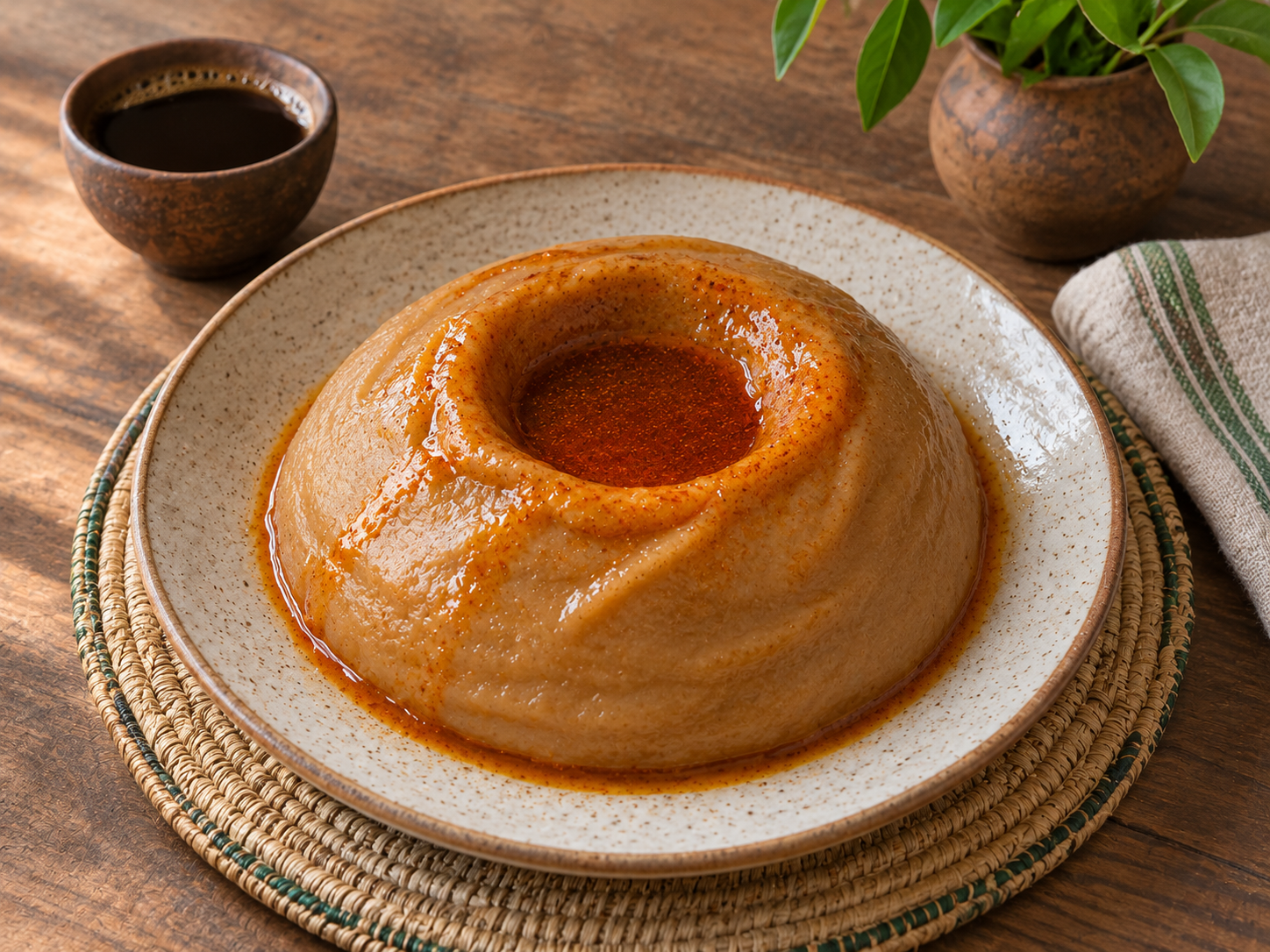
Porridge firm enough to shape
Genfo is a thick Ethiopian porridge made from cereal flour and worked into a soft, cohesive mass. Its consistency allows it to be gathered in a vessel, sometimes with a hollow for sauce. That shape is a serving reference rather than an obligation defining every version. Genfo is not drunk like thin porridge; it is enjoyed in portions in relation to its accompaniments. Its definition therefore combines milled cereal, hydration, working under heat and the finished texture. Although useful in translation, the single word porridge does not convey all that density or the act of shaping. Both the material and the gesture help explain the food.
What food studies document
Reviews of Ethiopian cereal products describe genfo as a firm porridge made from one cereal or a flour mixture. They record servings with butter, oil, spices or milk. This diversity prevents one flour being imposed on the whole family. Research on barley also places genfo among several grain transformations. Such documents record food practices rather than provide a birth certificate for the dish. A study date must not become an invention date. The Atlas uses these accounts to locate practices while leaving room for regional and household differences that would require more detailed investigation. Evidence can clarify a preparation without establishing an exclusive birthplace or an unchanged historical formula.
Flour and cereal are not interchangeable
Fine flour gives a more homogeneous surface than a product retaining particles that can be felt in the mouth. The cereal also supplies its own aromas and a different capacity to absorb water. It is therefore necessary to distinguish the dish name from the material used in one version. Barley, wheat and maize should not silently replace one another in a description. Roasted flour, where documented, changes the profile again. These differences do not require a new term for every mixture, but deserve to remain visible in related entries. Brown or pale colour alone cannot identify the grain, particularly once other ingredients and cooking have altered its appearance.
Hydrating, heating and working the mixture
The central transformation takes dry particles into a bound whole. Under heat, flour hydrates and starch helps thicken the mixture. Working it distributes water and limits dry patches or lumps. A thick mass requires different handling from an easily stirred soup: the utensil meets greater resistance and heat can be less evenly distributed. Skill is reflected in the homogeneity achieved, not simply in adding a large amount of flour. The recipe gives practical references for one version; the entry explains why even texture depends on balancing material, water, heat and the cook's action. Those relationships help make the preparation understandable without replacing the cook's judgement with a universal timing rule.
The serving hollow and its relationship to sauce
When genfo is presented as a ring or hollowed mound, the centre holds seasoned fat or sauce. This arrangement brings a relatively mild base together with a more expressive accompaniment. The shape is not merely decorative: it keeps components close without immediately mixing them completely. The proportion of sauce changes from one bite to another according to how a portion is taken. Another presentation can nevertheless preserve the same principle of contrast. The identity of a dish should not be judged solely by a central hollow. The serving gesture adds to the technical definition but cannot replace information about the porridge itself or the way it has been prepared.
Flavour, temperature and mouthfeel
Genfo has a cereal base whose intensity varies with the flour and any preceding treatment. Density does not necessarily mean hardness: a mass can hold its shape while yielding readily to a spoon. It may also become sticky if the intended balance is not reached. Fat creates a more slippery mouthfeel and carries spices; a milk accompaniment supplies another register, sometimes tangy according to the product served. Temperature changes the perception of flexibility and aromas. Describing the food at the time of eating is consequently more useful than assigning every property of a cooled portion to the hot dish. A good sensory account relates firmness, smoothness and flavour to the actual serving.
A family of practices, not a health promise
Some food publications place genfo within particular household uses. Those cultural observations should not be turned into prescriptions for all ages or therapeutic promises. A preparation of cereals, butter or milk can vary substantially according to the products and quantities used. The dictionary does not infer a medical effect. Its task is to describe the preparation's place, serving practices and the knowledge involved. Contemporary adaptations may change fats or flours. They should be identified clearly rather than presented as automatically more traditional or better for everyone who eats them. Recording an association is different from recommending the food for a medical purpose, and the distinction remains important.
Genfo, kinche and tihlo
Kinche retains a texture of cracked cereal that distinguishes it from a smoother flour-based mass. Tihlo involves shaping small portions of barley dough and a particular way of serving; it is not simply genfo divided into balls. Such comparisons organise vocabulary because one cereal can follow several technical paths. The raw material alone therefore does not determine the dish name. Milling, the work of cooking and the final form matter together. Comparing the preparations does not rank them: each involves gestures and uses deserving its own description and the names attested by its cooks. A shared ingredient provides a connection without erasing the techniques that make the foods distinct.
Recognising and documenting a version
To describe genfo, record the specified flour, the mixture's fineness, its ability to hold a shape and its accompaniments. Details invisible in an image should remain linked to a source or verified ingredient list. A smooth appearance does not guarantee absence of gluten, and sauce can introduce milk even when the base contains none. The linked recipe illustrates a concrete example without defining every member of the family. References allow documented practices to be compared, while sensory terms help explain what can be observed. This approach provides precision without freezing a living preparation or inventing an exclusive origin. It also leaves space for future testimony that can describe local differences more closely.
Explore further
Sources and review
Consulted and reviewed on 19 November 2026.