Kedjenou
Côte d'Ivoire
Understanding : Kedjenou
INTRODUCTION
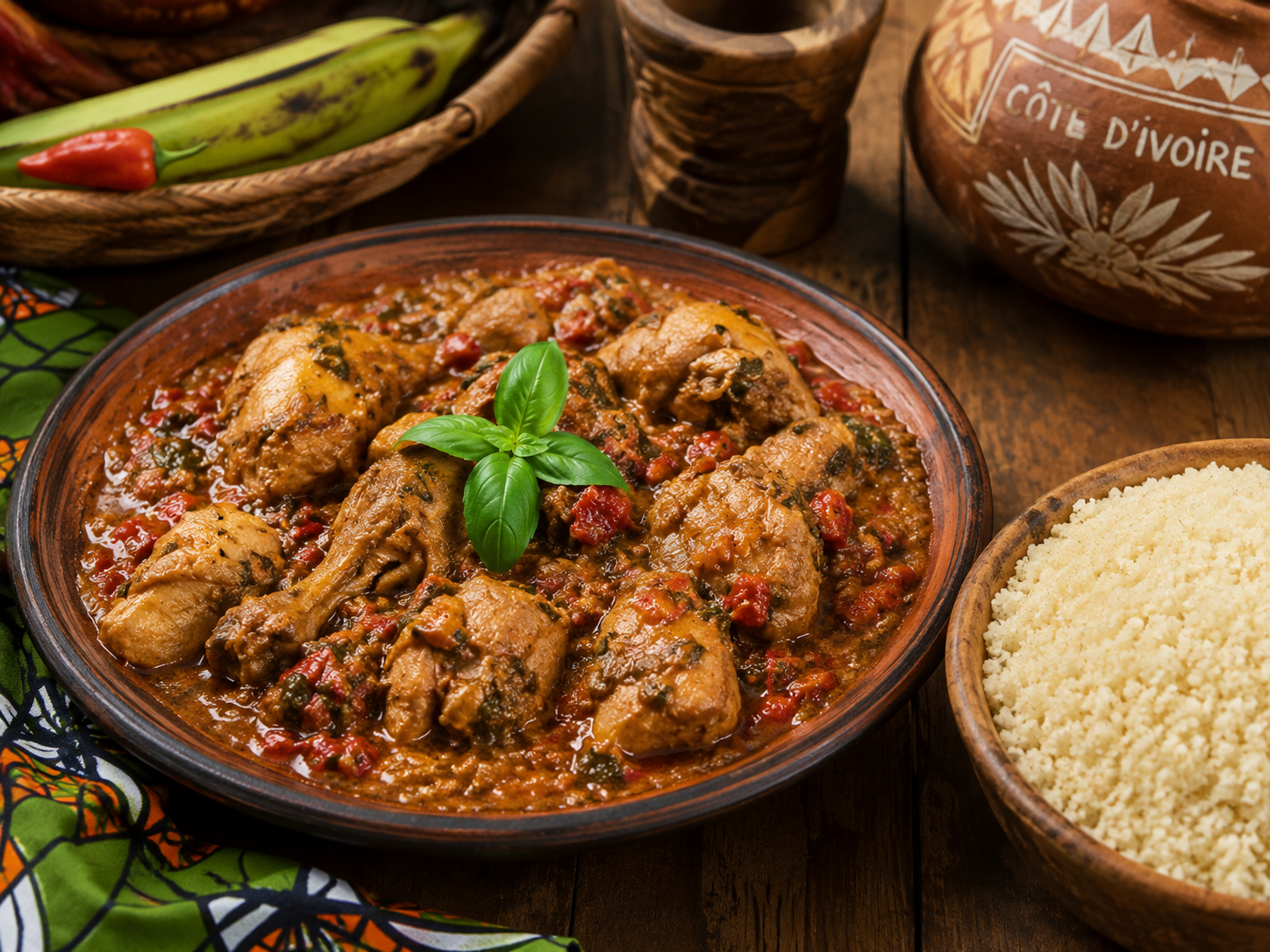
Kedjenou is an emblematic dish from Côte d'Ivoire, intrinsically linked to the culinary identity of the Akan peoples (Baoulé, Agni, etc.) and, by extension, recognized and celebrated throughout West Africa. This meat stew (usually chicken or guinea fowl, but also lamb, fish, or snails depending on the region and season), slowly simmered in a hermetically sealed pot called a canari or canari kedjenou, is distinguished by its waterless cooking method, which enhances the authentic flavors and taste of the ingredients. Much more than a simple recipe, kedjenou tells a story—that of the village, the bush, African markets, wood fires, family sharing, connection to the land, patience, and conviviality. Its technique, symbolism, and place in celebrations and daily life make this dish a true signature of Ivorian cuisine, admired from Central Africa to the diaspora, and now reinterpreted by chefs worldwide. This detailed description offers an immersion into the origin, composition, history, preparation, social role of kedjenou, its symbolic, nutritional, ritual, and modern dimensions, to understand why this slow-cooked stew has become a treasure of living African heritage.
1. ORIGINS, ETYMOLOGY, AND HISTORY
1.1. Etymology and Cultural Heritage The word “kedjenou,” of Baoulé origin, literally means “to shake inside the container.” This verb summarizes the dish's unique cooking method: instead of stirring with a spoon, the closed pot is gently shaken to mix the contents. This technique allows flavors, aromatics, vegetables, and meat juices to blend without opening the pot, thus preserving all the aromas and nutritional principles. 1.2. Birth of a Local Dish Kedjenou originated in the rural areas and forest villages of Côte d'Ivoire, where earthenware pots (canaris) were used for cooking with little or no water (supply could be difficult or precious), over a wood fire or embers. The slow cooking method was also adapted to rural life: the canari was placed, left to cook, while other activities were carried out. Quickly, this rustic, healthy, and inexpensive “village dish” (achievable with all proteins: chicken, guinea fowl, fish, or even game or snails) became an essential guest at markets, cabarets, maquis (popular Ivorian restaurants), and family kitchens.
2. INGREDIENTS AND COMPOSITION
2.1. The Protein Traditionally, kedjenou is prepared with a “bicycle” chicken (free-range chicken, raised outdoors with firm flesh, pronounced taste, and resistant to long cooking), or with guinea fowl, goat, or lamb, fish (tilapia, capitaine), or sometimes snails. The meat used is cut into pieces, sometimes pre-marinated in salt, chili, and lemon. 2.2. Vegetables and Aromatics • Onion: aromatic base, melting during cooking. • Fresh tomato: for acidity, lightness, and roundness of the sauce. • “African” eggplant (white or green, called “gboma” or “gnan n’man”), essential for texture. • Fresh chili: the heat of the dish, whole for aroma or split for more intensity. • Ginger, garlic: for aromatic power. • Bay leaf, thyme, local fresh herbs (African basil, celery, local bay leaves)... • **Pepper, salt, seasoning cube according to preference. • (Sometimes) bell pepper, carrot, okra, celery, depending on the season. 2.3. Absence of Water and Fats The specificity of kedjenou is that neither water nor oil is added; the moisture comes solely from the vegetables and the meat itself. This results in a short, concentrated sauce where all the juices intimately blend.
3. TRADITIONAL PREPARATION METHOD
3.1. The Canari / Pot • Use of a canari, a traditional clay pot (sometimes replaced now by a cast-iron or thick-bottomed pot, or even a pressure cooker for those in a hurry). • The inside of the canari is lined with banana leaves to develop a particular aroma (optional, depending on the region). 3.2. Arrangement and Cooking
- Arrange the meat pieces, coarsely chopped vegetables, aromatics, and whole or split chili in the pot.
- Salt, pepper, mix with hands to impregnate.
- Seal tightly with a lid or suitable aluminum foil to retain steam.
- Place the pot over gentle embers, or on medium-low heat, avoiding any opening for 40-60 minutes.
- Shake the canari every 10 minutes to turn the contents without opening, but never stir with a spoon (this would break the magic of kedjenou).
- At the end of cooking, the kasutera (cooking juice) is dense, the meat tender, and the vegetables stewed but still identifiable. 3.3. Finishing and Serving • Open the pot: the aroma is intense and enveloping. • (Optional) remove the chili for those who prefer it less spicy. • Pour the contents into a deep dish, drizzling with the cooking juice. • Sprinkle with chopped fresh leaves or serve plain.
4. ACCOMPANIMENTS AND MEAL PRESENTATION
4.1. Attiéké, Rice, Plantain: The Ivorian Trilogy Kedjenou is always enjoyed with an accompaniment: • Attiéké (fermented cassava semolina, a beloved Ivorian specialty), which perfectly absorbs the meat and vegetable juices. • White rice (aromatic or local), for a more neutral version. • Boiled or fried ripe plantain, providing sweetness and consistency. • Sometimes yam (boiled yam) or foutou (pounded yam paste). 4.2. Convivial Service Everyone eats together, with the meat shared according to age, rank, or family tradition. Attiéké is dipped in the sauce; conviviality is paramount, as it is a communal dish, a bond for family and neighborhood.
5. SOCIAL, IDENTITY, AND SYMBOLIC ROLE
5.1. A Dish for Celebrations and Sundays Kedjenou is not an ordinary everyday dish: it is generous, takes a long time to prepare, and is therefore often reserved for: • Festive meals (baptisms, new house purchases, the sacredness of Sunday) • Major events (returns from trips, funerals, weddings). Its presence on the table expresses the honor bestowed upon the guest, family success, and the joy of coming together. 5.2. Memory, Transmission, and Conviviality Preparing a kedjenou is telling a story: each family has its own dosage, its secret touch, the choice of chili or cult vegetables. Mothers, grandmothers, and then young women or men of the household inherit the knack and tradition. 5.3. Ivorian Identity and African Influence A symbol of Ivorian cuisine, kedjenou is a strong marker of national pride, often referred to as “the best dish in the country” in the diaspora, in culinary competitions, and on social media. Central Africa (Cameroon, Gabon, Congo, Guinea, etc.) also adopts kedjenou, adapting it with their local meats, spices, and herbs.
6. NUTRITIONAL VALUE AND HEALTH BENEFITS
• Non-fried meat: slow cooking, little to no fat, preserves tenderness, reduces cooked fats and harmful substances from grilling or frying. • Vegetables: high in fiber, vitamins A, C, E, potassium, magnesium, antioxidants. • Absence of excessive salt/sugar: diet-friendly and digestible. • Hydration: the short, dense sauce encourages consuming less rice or massive attiéké, more juice and vegetables. • Adaptable: skinless chicken, lean meats can be used, making it even healthier for children or seniors.
7. MODERNITY, DIASPORA, AND INNOVATIONS
7.1. Urban and Afro-Fusion Cuisine Kedjenou is conquering Ivorian and African restaurants, as well as fusion cuisine: cooked in a pressure cooker, oven, en papillote, or even sous vide by modern chefs. Some recipes enrich it with dried fruits, European vegetables, classic spices or Herbs de Provence, or reinterpret it in a vegan version (tofu, mushrooms, etc.). 7.2. Diaspora and Conviviality Kedjenou is now an ambassador dish for Côte d'Ivoire in Paris, London, Montreal, or Dakar. It is featured in culinary competitions, cooking workshops, community dinners, and African events around the world… It symbolizes the ability of Ivorian culture to adapt its roots to all contexts. 7.3. Fast Food and Dematerialization Kedjenou is now offered for takeout, delivered in containers, integrated into African food trucks, or even cooked in the form of a “wrap” of attiéké chicken kedjenou, Afro bowl, etc.
8. LIMITATIONS, CHALLENGES, AND FUTURE
• Risk of industrial standardization (bouillon cubes, factory-farmed chicken, quick preparation) which can distort authenticity. • Weakening of artisanal production and canari cooking in the era of modernity and agricultural changes. • Need for proactive transmission, workshops, preservation of taste and know-how. • Increased valorization needed in tourism, gastronomic, and educational circuits.
CONCLUSION Kedjenou, with its rustic simplicity and aromatic majesty, embodies the genius of African cuisine: extracting the best from the land, magnifying patience, uniting family, honoring guests, transmitting memory. A dish of Ivorian unity and pride, it has touched the heart of the continent and conquered the palates of gourmets worldwide. Density of taste, warmth of the dish, precision of time – kedjenou will long remain proof that African tradition, humble and sophisticated, possesses a modernity, universality, and depth that rival the great classics of the gastronomic world.
Prepare this speciality
Choose a detailed recipe, adjust the portions and prepare your ingredients before starting. Our cooking tips and food safety advice complement the steps described in the recipes.
Explore further: Cooking tips · Food hygiene and safety advice.
In my books

Continue exploring the continent’s cuisines with Africa at the Table — 54 countries, 54 iconic dishes, by Alioune FALL. This book is in English.
In the kitchen : Kedjenou
Recipes from the site to put your knowledge into practice:
Discover these cuisines at a restaurant
Explore our restaurant and caterer directories. Choose your destination and check the establishment’s menu to confirm which dishes are offered and available.
Continue exploring
Enjoy discovering ingredients and African cuisines? Join our newsletter. The illustrated PDF 10 sauces africaines incontournables is in French and is offered after confirming a subscription to the French or bilingual edition.