Kinkeliba
West Africa
Understanding : Kinkeliba
INTRODUCTION
Kinkeliba (Combretum micranthum), also known as “sékvé” or “sekou” in Bambara, “raayi” in Fula, “quinquéliba,” or “sage's herbal tea” or “Sahel tea,” is one of the most revered medicinal, dietary, and ritual plants in West Africa. Its dried leaves, infused like a caffeine-free “tea,” fill cups from Senegal to Mali, Burkina Faso to Niger, Northern Nigeria to Guinea, and have accompanied the social, spiritual, and gastronomic life of the Sahel and its diaspora for centuries. Much more than an herbal tea or a remedy, kinkeliba is the quintessential expression of popular pharmacopoeia rooted in oral tradition, Sahelian agroecology, and daily rituals: sunrise, breaking the fast, moments of relaxation, and care for body and soul. Today, in an era of healthy eating, a return to local products, superfoods, and the fight against lifestyle diseases, it is experiencing a “renaissance” in cities, organic markets, and tea houses worldwide. This detailed description invites you to explore the history, botany, harvesting and preparation protocols, nutritional and medicinal value, gastronomic, social, and cultural uses of kinkeliba, as well as its modern destiny, to showcase its richness, symbolism, and unifying dimension in African life.
1. ORIGIN, BOTANY, AND DISTRIBUTION
1.1. Kinkeliba, a botanical pillar of the Sahel Kinkeliba (Combretum micranthum) is a shrub from the Combretaceae family, growing mainly in the savannas, forest edges, and bush areas of the Sahel and Sudan. As a xerophytic plant, kinkeliba resists drought, stabilizes soil, protects against erosion, and plays a fundamental role in the Sahelian ecosystem: providing shade, shelter, and medicinal and food resources. The shrub reaches between 2 and 4 meters, with elongated, leathery, grayish-green leaves and small flowers arranged in spikes, followed by winged fruits. The used parts are the leaves and young shoots, harvested at the beginning of the dry season or during the rainy season. 1.2. Geographical distribution and culture Kinkeliba is indigenous to Senegal, Mali, Burkina Faso, Guinea, northern Côte d'Ivoire, Nigeria, Niger, and Benin, but it has spread to Mauritania, Ghana, Chad, and northern Cameroon. It is an integral part of the traditional pharmacopoeias of the Mandinka, Fula, Wolof, Bambara, Songhai, Hausa, Toucouleur peoples, and more. Sahelian markets are full of fresh or dried kinkeliba bundles, sold retail or in bulk, from village vendors to modern stalls in Dakar or Bamako.
2. HARVESTING, PROCESSING, AND PREPARATION
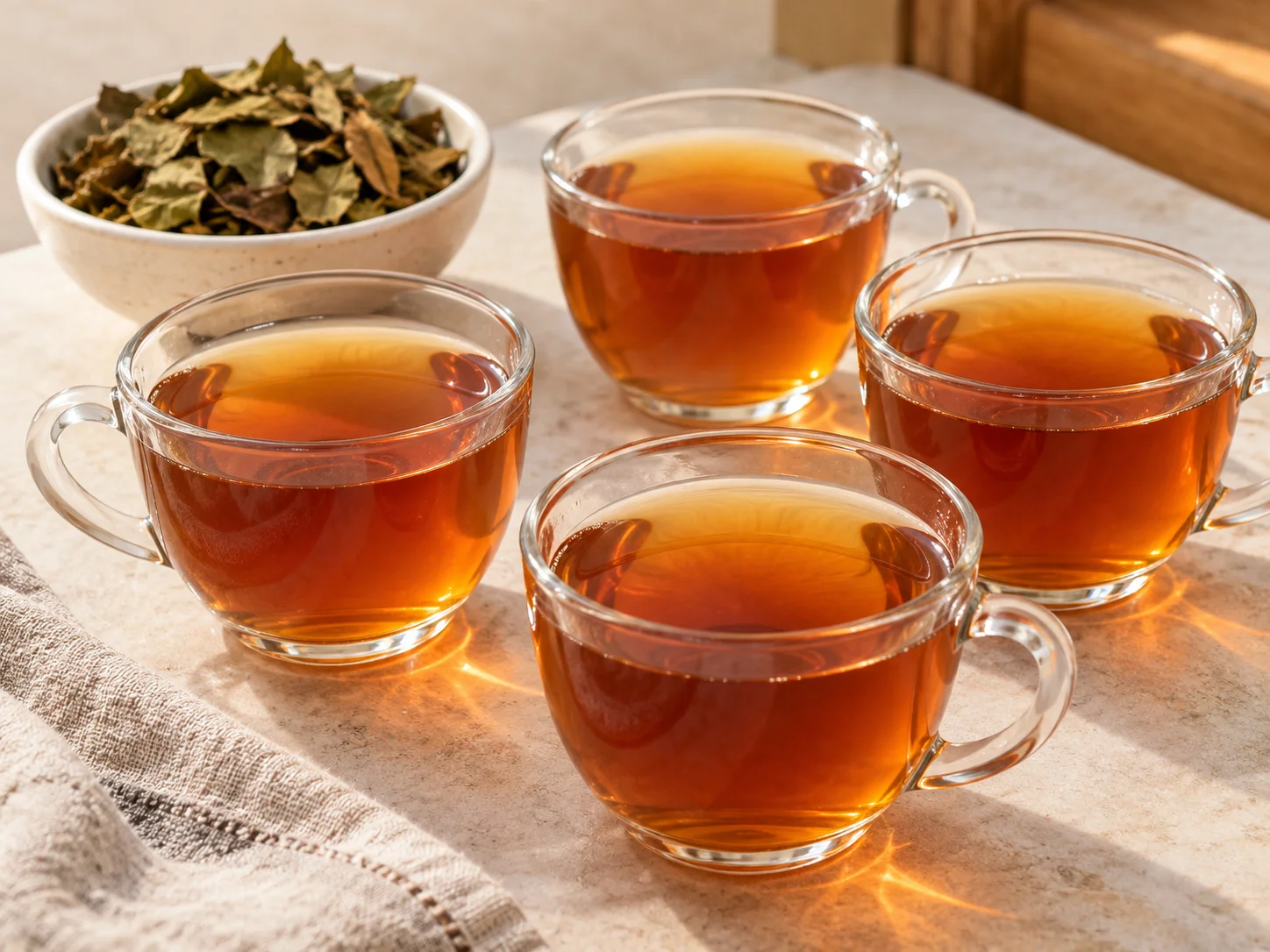
2.1. Harvesting and drying Harvesting is primarily done by women – sometimes ritually – at dawn, before the plant flowers. Leafy branches are picked, tied into bundles, and dried in the shade (to preserve the green color and active ingredients) or in the sun (faster but lower quality). 2.2. Storage and sale Once thoroughly dry, the bundles can be stored for several months away from humidity, or they are pulverized into powder, bagged, and packaged in sachets or jars for urban sale and export (to European and American cities for the diaspora). 2.3. Traditional preparation The classic preparation involves infusing (or even boiling) a few leaves or a handful of branches in water for 5 to 10 minutes. The decoction turns a greenish-brown, and the aroma becomes herbaceous, woody, slightly astringent, reminiscent of earth after rain. Traditionally, the herbal tea is consumed unsweetened, but it can be customized with lemon, mint, honey, ginger, cloves, or orange peel, depending on the season or taste.
3. CULINARY USES AND SOCIAL SCENARIOS
3.1. Dawn and Ramadan drink Kinkeliba is THE drink for breaking the fast during Ramadan throughout the Sahelian region of Africa: it refreshes, detoxifies, soothes the stomach, and prepares for the evening meal. It symbolizes patience, preparation for sharing, and purity of action. 3.2. Breakfast infusion In villages, kinkeliba accompanies the sunrise: the warm or lukewarm herbal tea is sipped, sometimes with “lakh” (millet porridge), local bread, flatbread, or fritters. It “opens the appetite” and prepares one for the heat and fieldwork. 3.3. Meal accompaniment and family snack Kinkeliba herbal tea is also drunk as a snack, at the market, as a “4 o'clock” treat with peanut paste, a mango, a millet pancake, or a local fruit. At celebrations (baptisms, weddings, funerals), it is always offered, in homage to tradition and to balance the abundance of heavier or sweeter dishes. 3.4. Healthy cuisine, decoctions, sorbets, and modernity Kinkeliba is also used mixed with bissap (hibiscus), ginger, in artisanal sorbets, natural cocktails, and sometimes even in syrups, jams, or accompanying sauces (especially in “healthy” restaurants in Dakar or Abidjan).
4. NUTRITIONAL, MEDICINAL VIRTUES, AND BENEFITS
4.1. Composition and micronutrient intake Kinkeliba is rich in polyphenols, flavonoids, tannins, phenolic acids (antioxidants), vitamins C, E, B2, B3, and minerals (potassium, magnesium, manganese, calcium, copper). It is caffeine-free and non-stimulating, so it can be consumed by everyone, at all ages. 4.2. Recognized therapeutic properties • Diuretic action: promotes renal elimination, detoxifies the body, recommended for people with hypertension, water retention, or mild liver insufficiency. • Hepatic depurative: traditionally used to “cleanse the liver,” support slow digestion, combat jaundice, and aid recovery from malaria or heavy medication. • Hypoglycemic, choleretic, hypotensive effect: documented by African pharmacopoeia and clinical trials. • “Rejuvenating” drink: combats fatigue, boosts vitality, alleviates mild feverish states (after flu or illness). • Anti-inflammatory, soothing action: useful for sore throats, oral inflammations, skin care (baths or poultices with the decoction). • Natural appetite and thirst suppressant, valuable during fasting, work in hot conditions, or periods of scarcity. 4.3. External decoction use Kinkeliba decoction is applied as an intimate wash, for dermatological care, baby baths, and even as compresses for ulcers, abscesses, or muscle pain (an ancestral remedy validated by traditional healers).
5. SOCIAL, CULTURAL, AND SYMBOLIC DIMENSION
5.1. Sign of hospitality, wisdom, and harmony The first cup of kinkeliba offered to a guest is a welcoming ritual, carrying blessings, purity of heart, and intergenerational respect. In Fula, Bambara, and Songhai societies, offering kinkeliba to an elder is an acknowledgment of their place, wisdom, and experience. 5.2. Female transmission, rural memory Knowing how to recognize good kinkeliba (fine, tender, unstained leaves), mastering the infusion, dosing according to needs (children, adults, convalescents), adjusting accompaniments (lemon zest, ginger, wild honey) – all this is part of the maternal legacy, the woman's role as “guardian of the household's health.” 5.3. Drink of community bond and sharing Drinking the herbal tea together (from the same bowl or teapot), at dawn or noon, under a tree or after returning from the fields, fosters solidarity, frames negotiations (“let's talk over kinkeliba”), opens the mind to listening, and pacifies.
6. KINKELIBA IN MODERNITY AND THE DIASPORA
6.1. Urban renaissance, organic sectors, short supply chains The return to “healthy eating,” the development of herbal tea markets, and the valorization of local knowledge have allowed kinkeliba to conquer cities, “healthy” restaurants, organic store chains, and pharmacies. It is now found packaged in sachets (infusion bags), premium loose leaf, labeled “fair trade,” and certified organic. 6.2. Diaspora and export Kinkeliba travels in suitcases, family parcels, on African e-commerce platforms, and in Afro-food stores in Europe and North America. It connects the diaspora to the taste of home, shared mornings, Ramadan, and village holidays. 6.3. Creativity and urban innovation “Herbal tea bars” are flourishing, offering mixed infusions (kinkeliba-hibiscus, kinkeliba-orange, kinkeliba-mint), kinkeliba ice creams and sorbets, and inspired Afro-cosmetic products (soaps, lotions).
7. LIMITATIONS, PRECAUTIONS, AND SUSTAINABLE ISSUES
• Wild over-harvesting can jeopardize the resource: the establishment of domestic plantations, local regulations, and good practices is essential. • Need for certification (organic, fair trade), education on responsible harvesting, and clean processing (avoiding dust, humidity, adulteration). • Kinkeliba is not a medicine to be used against medical advice in cases of serious pathologies (diabetes, liver issues). • Pay attention to storage to avoid mold, loss of flavor, and oxidation.
CONCLUSION Kinkeliba, a humble leaf from the Sahel, embodies the genius of African pharmacopoeia, the depth of rural sharing, the vibrancy of tradition, and the modernity of an African “superfood.” An infusion of hospitality, a drink of wisdom, a support for health, kinkeliba sprinkles its freshness into all rituals, ceremonies, and daily lives of West Africa. Its versatility, popularity, ecological, and economic role make it a cornerstone of African heritage, destined to play an increasing role both in family cuisine and on the global stage of well-being, conviviality, and natural nutrition. Drinking kinkeliba is to commune with the roots of the earth, the benevolence of home, the future of African societies, and the respect for a sustainable, healthy, and rooted way of life.
Where to find it
Look for the exact food-grade form required by the recipe at markets and specialist shops. Check the product name, ingredients, condition and storage instructions.
Explore further: Cooking tips · Food hygiene and safety advice.
In my books
Explore Senegalese cooking with Le Sénégal à table, my collection of 150 recipes, stories and traditions to share. This book is in French, by Alioune FALL.
In the kitchen : Kinkeliba
Recipes from the site to put your knowledge into practice:
Discover these cuisines at a restaurant
Explore our restaurant and caterer directories. Choose your destination and check the establishment’s menu to confirm which dishes are offered and available.
Continue exploring
Enjoy discovering ingredients and African cuisines? Join our newsletter. The illustrated PDF 10 sauces africaines incontournables is in French and is offered after confirming a subscription to the French or bilingual edition.