Mofo anana
Madagascar
Editorial collection: RecettesAfricaines.com · Publication director: Alioune FALL.
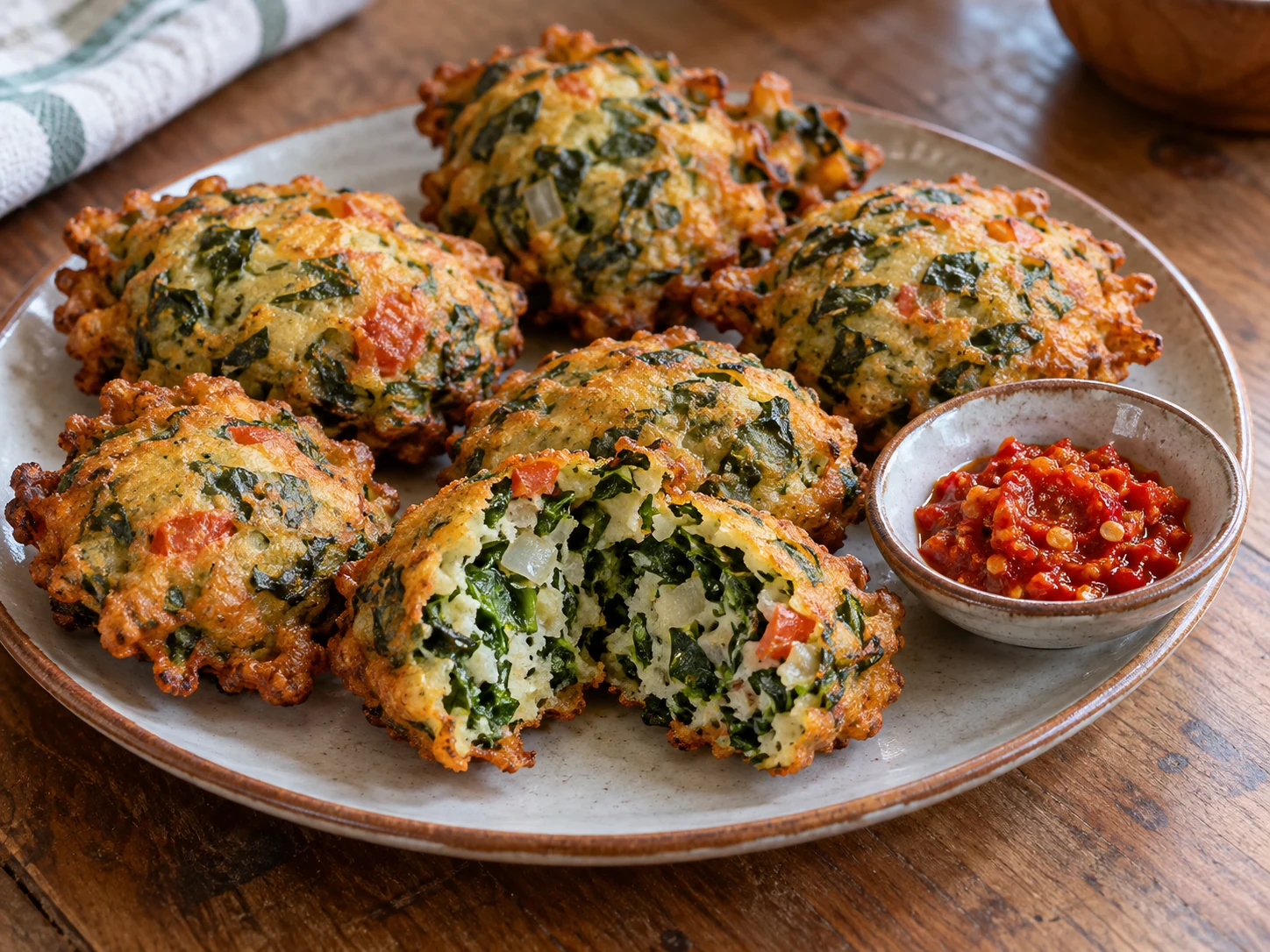
Leaf fritters within a broader family
Mofo anana is a Malagasy preparation of batter containing edible leaves, seasoned and fried in small portions. It belongs to the mofo family, which also includes breads and bites with quite different profiles. Leaves and a generally savoury orientation distinguish it from banana fritters or small rice cakes. It need not be a whole leaf simply dipped in batter: the greens may be divided and distributed through the mixture. The definition therefore combines batter and foliage, frying, and a format eaten in bites. Identifying those relationships gives more information than treating every green fritter as the same preparation or assuming that its shape reveals all of its ingredients.
Food evidence rather than an invented origin
A Madagascar food study available through CIRAD resources records mofo anana among savoury fritters eaten with meals or as snacks. Malagasy culinary contributions also document household versions. These accounts establish the preparation within food practices without naming an inventor or an exclusive place of origin. A survey or publication date does not necessarily mark the food's appearance. Practices differ with families and available products. The dictionary retains attributable information and distinguishes it from historical reconstruction requiring further proof. It does not fill uncertainty with a legend presented as fact. Situated accounts can explain a living preparation while leaving legitimate questions about its earlier history unresolved.
Anana does not identify one plant
In this culinary context, foliage should not automatically be reduced to one botanical species. Brèdes, a term used in the region's French-language food vocabulary, also covers several leafy vegetables. A precise entry should name the plant when known rather than infer it from green colour in a photograph. Leaf size, thickness and any stems affect the preparation. Substitution with another leafy vegetable should be identified as such. That matters for flavour and avoids encouraging collection or consumption of a misidentified plant. A fritter photograph is never an adequate botanical guide. The culinary name provides a context, but cannot replace reliable identification of the leaves actually used.
Distributing greens through batter
How leaves are divided affects their presence in each bite. Fine chopping distributes them more widely; larger fragments retain a recognisable texture and may alter how the coating holds together. Leaves also supply moisture, changing consistency as batter stands. The cook consequently needs to understand the relationship between the materials rather than treat foliage as decoration without technical effect. Flour and liquids determine another part of that relationship. Household versions may use different mixtures without one ratio being imposed by the entry. The linked recipe specifies one realisation; the dictionary explains why variations occur. Both the preparation of the greens and the properties of the batter contribute to the finished structure.
Shaping portions and controlling frying
A thick portion does not develop at the same rate as a thinner bite. Heat acts quickly on the surface while the centre needs more time to lose the character of raw batter. Shape therefore depends on scooping, mixture consistency and how the leaves behave. An irregular appearance may simply reflect handmade shaping. Frying firms the surface and develops browned notes, without removing the need for coherent cooking inside. Detailed practical references belong in the recipe. The entry highlights something a photograph may not show: the balance between size, moisture in the greens and batter thickness. Those relationships explain why similar-looking fritters may differ in their centres and surface textures.
Leaf flavours and fritter texture
Mofo anana combines cooked-batter flavour with that of the chosen leaves. The vegetal register may be mild, herbal or slightly bitter, depending on the plant; it should not be described identically in every version. Aromatics and chilli may complement the mixture, with variable intensity. A golden surface contrasts with a softer interior where leaves remain perceptible. Internal moisture may gradually soften the crust after cooking. This explains why a bite pictured at serving and another eaten later do not necessarily feel identical. A useful description records those contrasts without promising permanent, uniform crispness. It also separates the flavour of the leaves from any sauce added alongside them.
A savoury bite and its accompaniments
Fritters may be served alone, with sauce or within a larger meal. A chilli condiment adds another dimension but should not be confused with the fritter's compulsory composition. The snack role described in sources emphasises a format easy to take and share. It does not impose an hour or an identical circumstance on every Malagasy household. Portion sizes and accompaniments depend on the occasion. Separating the food from its table setting helps explain what defines the term and what is a presentation choice. A photograph with a bowl of sauce illustrates a possibility rather than an exhaustive cultural rule. The example remains useful without becoming a prescription for every serving.
Comparisons with mofo gasy and mofo akondro
Mofo akondro centres banana and generally has a sweet orientation, though formulations vary. Mofo gasy involves other batter and cooking techniques, often with rice and a hollowed pan. Mofo anana is distinguished here by incorporating leaves and frying savoury portions. These relationships make the wider mofo family understandable without erasing individual names. Vegetable fritters occur in other cuisines; technical resemblance does not automatically make them synonyms for the Malagasy preparation. Precise comparison follows the main ingredient, cutting, batter and serving rather than renaming every fried food after the first familiar example. The shared principle of frying can illuminate differences instead of making them disappear.
Recognising the limits of an illustration
A suitable image shows leaf fragments within the fritter or in a cut portion, alongside texture consistent with fried batter. It cannot always identify the plant or demonstrate every ingredient. Credit should specify personal photography or generated illustration, avoiding presentation of an atmospheric image as ethnographic observation. When comparing versions, note visible greens, thickness and browning, then consult actual composition. Flour, eggs or milk, where used, determine allergen questions. The name mofo anana guarantees neither their presence nor absence. A useful illustration supports recognition while retaining these limits, rather than inviting readers to infer composition or botanical identity from visual appearance alone.
Continuing the exploration without fixing practice in place
The linked recipe gives a concrete example, while references locate the food in culinary testimony and a food survey. Their roles complement each other. Documentation can grow with better-identified leaf names, attributed household uses and precise images without arbitrarily changing the term's identity. Skill lies as much in judging batter and greens as in the final frying. Describing these relationships explains a living cuisine and its adaptations. This entry replaces neither cooks' knowledge nor reliable botanical identification. It provides ways to read, compare and transmit information while avoiding copied recipes and manufactured historical certainty. Future evidence can refine the description without requiring a claim that one version has always been universal.
Explore further
Sources and review
Consulted and reviewed on 19 November 2026.