Tamarind
East Africa/Madagascar
Understanding : Tamarind
INTRODUCTION
Where to find it
Look for tamarind pods or blocks of food-grade pulp. Check for seeds, added sugar and concentration: concentrated paste needs a different quantity from plain pulp.
Explore further: Cooking tips · Food hygiene and safety advice.
Search Amazon.fr — affiliate link →
Check availability and delivery on Amazon.fr. Compare ingredients, packaging and sellers.
As an Amazon Associate I earn from qualifying purchases.
History and uses
Tamarind (Tamarindus indica), nicknamed "date of India" in reference to its Arabic etymology (tamr hindī), embodies one of the most distinctive tangy flavors in African cuisine — from the Swahili coasts to West Africa, from Madagascar to the Maghreb. Behind the modesty of its brown pod and dark pulp, tamarind brings together an immense diversity of culinary, medicinal, ritual, and social uses. It enlivens popular cuisine, accompanies celebrations, heals, refreshes, inspires creativity, and symbolizes both African roots and centuries-old openness to India, the East, and the world. At the crossroads of botanical history, trans-Saharan and trans-oceanic trade, family traditions, and contemporary health and identity issues, tamarind has established itself as a central "acidifier" in African culinary heritage — used in juices, sauces, confectionery, condiments, pharmacopoeia, street food, and trendy gastronomy. Its sensory prominence, accessibility, and versatility make it a flagship fruit of African cuisines, blending the plant world with oral and written traditions. This detailed text explores the origin, cultivation, harvesting, processing, major recipes, nutritional value, symbolism, social importance, and modern challenges of tamarind in African cuisine and culture.
1. ORIGIN, BOTANY, AND SPREAD OF TAMARIND IN AFRICA
1.1. Botanical Description Tamarind (Tamarindus indica) is a tree of the Fabaceae family, primarily originating from tropical East Africa (probably Sudan, the Sudano-Sahelian zone), but naturalized very early in the Indian subcontinent and Madagascar. It reaches 10 to 20 meters in height, its foliage is evergreen, finely cut, its flowers are pale yellow, and it produces pods 10 to 20 cm long, covered with a woody shell, housing a dark pulp and shiny black seeds. Tamarind pulp is simultaneously tangy, sweet, and complex, composed of tartaric, malic, citric acids, sugar, pectin, fiber, minerals, and powerful aromatic essences specific to the species. The flesh, used fresh or dried, is the most exploited part. 1.2. History, Domestication, and Exchanges Tamarind is undoubtedly one of the first domesticated trees in Africa. Ancient texts, excavations, and testimonies report its use in Egypt, Nubia, Ethiopia, in the Nile Valley since the Iron Age, and in West African kingdoms in medieval times. The Arabs call it "tamr hindī" (Indian date), the Persians spread it to India and Southeast Asia, the Swahili world (Zanzibar, Comoros, Mozambique) and Malagasy navigators ensured exchanges throughout the Indian Ocean. In Africa, the tamarind tree is omnipresent in the landscape: in the markets of Mali, on the outskirts of Senegalese villages, in family courtyards in Benin, Niger, Nigeria, in the avenues of Bamako, Ouagadougou, Abidjan, or Antananarivo. It is planted along roads, near huts, a symbol of shade and freshness, often a totem of social connection.
2. PRODUCTION, HARVEST, AND PROCESSING
2.1. Cultivation and Adaptation • Hardy tree: it adapts from humid tropical zones to drier Sahelian zones. It tolerates heat and resists drought while benefiting from rainy seasons. • Productivity: an adult tree yields 100 to 500 kg of fruit per year depending on the variety, age, and region. • Propagation: by seed, often by stump shoots or cuttings. 2.2. Harvest and Preparation • Period: depending on the region, harvesting takes place from December to June, with a peak during the hot season. • Method: mature pods dry and partially open; they are harvested by hand, beaten, or picked. • Processing: the shell is opened to extract the pulp, which can be shelled, deseeded, sometimes ground, dried, compressed (into “bricks” or balls sold in the market). • Preservation: fresh pulp (with added sugar or salt) can be kept for months at room temperature.
3. CULINARY USES: RICHNESS AND DIVERSITY
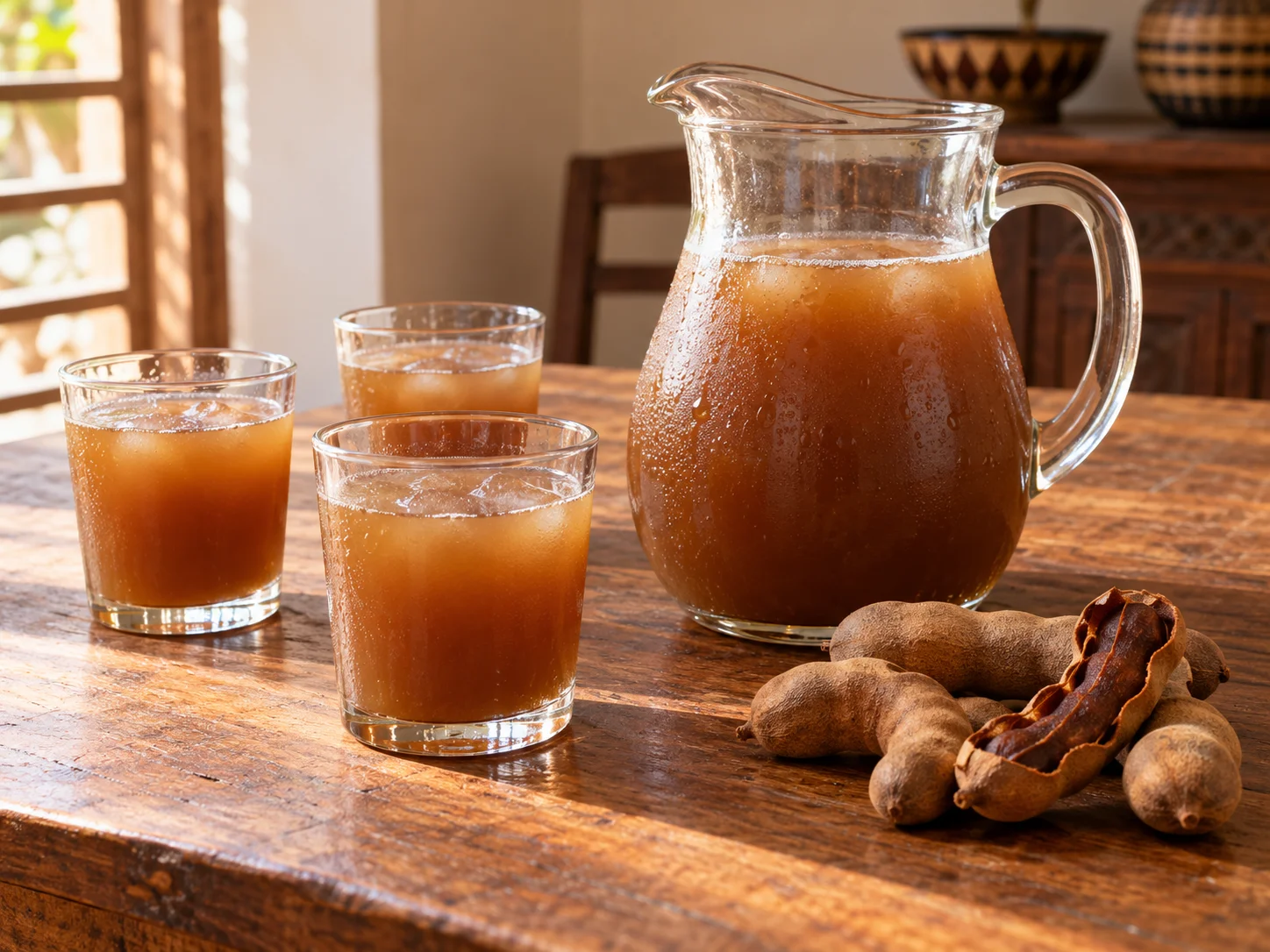
3.1. Drinks and Refreshments • Tamarind juice: throughout the Sahel (Mali, Burkina Faso, Niger, Senegal), sweet tamarind juice (or “daléchi”, “dabileni”, “jus de dah”, “jus d’arada”) is essential as a street drink, sold in stations, schools, during ceremonies, or for breaking the fast (Ramadan). • Preparation: the pulp is infused in cold or boiled water, pressed, filtered, sweetened (sugar, honey), sometimes flavored with mint, ginger, lemon, vanilla, hibiscus (bissap). • Sometimes slightly fermented: base for sparkling or slightly alcoholic drinks (mild beer) in Benin, Mali, Burkina, Nigeria. 3.2. Sauces, Soups, Condiments • Tamarind sauce: a key element in Senegalese cuisine (thiéboudienne, yassa fish, mafé), Malian (sour soups, couscous, stews), Beninese, Nigerian, and Cameroonian cuisine. • Role: acidifier, thickener, flavor enhancer (umami), used to counterbalance the richness of dishes (peanut, palm oil). • Preparation: dissolved and filtered pulp, added during cooking to flavor the sauce, enhance leafy greens, and elevate stews. • Accompaniment: skewers, grilled fish, crabs, steamed vegetables. 3.3. Confectionery and Snacks • Syrups, fruit pastes, candies: tamarind paste rolled with sugar, chili, ginger, sold in mini-sticks throughout the Gulf of Guinea and the Sahel, popular with children. • In Senegal, Mali, Guinea, Cameroon, “grandmother’s sweets” highlight pure paste, with a tangy and spicy taste. 3.4. Street Food and Contemporary Cuisine • Tamarind in street food: in “chop bars” and markets, grilled fish, meatballs, fritters, vegetable sticks, or sweet fritters are topped with a tamarind sauce, often spicy. • Afro-fusion cuisine: in vinaigrettes, sweet and sour reductions for grilled vegetables, meat glazes, dips for modern finger food, bases for grilling. 3.5. In World Gastronomy • Indian influence: the Gujarati or Tamil community in East Africa (Kenya, Tanzania, Uganda, Madagascar, Mozambique, Comoros) cooks tamarind in sambhar, dal, chutneys, curries, sauces for samosas. • Middle Eastern and Maghrebi inspirations: tagines, sauces for couscous, shorbas, briouates sometimes use imported tamarind, a testament to trans-Saharan circulation. • Diaspora and “Afrofusion” innovation: tamarind mousse, ice creams, cocktails, tamarind ketchup, dessert sauces, tangy vinaigrettes.
In my books

Explore Senegalese cooking with Le Sénégal à table, my collection of 150 recipes, stories and traditions to share. This book is in French, by Alioune FALL.
Explore further
4. SOCIAL, SYMBOLIC, AND HERITAGE PLACE
4.1. Totem Tree, Shade, and Memory • The tamarind tree is frequently a palaver tree, a meeting point or community ceremony site (peace negotiations, women's meetings, village market, picnics, initiation places). • Tree of beneficial shade, of coolness in the dry season, it signifies abundance, transmission. • Large families plant a tamarind tree to celebrate a birth, the construction of a hut, protection against calamities (storms, drought…). 4.2. Transmission, Craftsmanship, Local Economy • The gathering, preparation of pulp and syrups, making of candies, and packaging are spaces for female transmission, seasonal work shared by all ages. • Structuring market: “tamarind women” are female entrepreneurs, vendors, itinerant farmers. Goods consumed locally, shipped to the diaspora, resold in Afro grocery stores, organic supermarkets in the West. 4.3. Offering, Custom, and Rite • Tamarind is sometimes used as an offering during traditional animist and Muslim ceremonies (rain ceremonies, ancestor worship, funerals). • It is associated with welcome and hospitality (offering a fresh juice as a sign of respect).
5. NUTRITIONAL VALUE AND MEDICINAL VIRTUES
5.1. Composition • Rich in organic acids: tartaric, citric, malic (natural acidity). • Natural sugars (glucose, fructose). • Fiber, pectin (satiety, transit). • Vitamins: C, B1, B2, B3, B6 (metabolism, antioxidants). • Minerals: calcium, potassium, magnesium, phosphorus, iron, copper. • Phytonutrients (polyphenols, flavonoids). 5.2. Health Benefits • Digestive: facilitates digestion, activates transit, relieves constipation (mild laxative). • Antioxidant and cardiovascular protector. • Refreshing and thirst-quenching: ideal in hot weather, during Ramadan. • Beneficial for blood sugar (moderate glycemic index, slows fat storage). 5.3. In Traditional Medicine • Macerations, infusions, decoctions of tamarind are used against fever, colds, digestive disorders, certain inflammations. • Leaves are consumed as herbal teas, seeds are sometimes roasted, integrated into local remedies.
6. MODERNITY, DIASPORA, INNOVATION
6.1. Diaspora and Globalization • Import-export of tamarind pulp blocks, ready-made juices, candies, syrups, in Africa, Europe, Americas, Asia. • Entry into “healthy” cuisine, flagship ingredients for brunches, smoothies, cocktails, vegan and raw food desserts. 6.2. Creative Gastronomy and Afro-fusion • Jellies, sorbets, jams, vinaigrettes, chutney sauces, macarons or cheesecakes flavored with tamarind. • Pairing with chocolate, caramel, exotic fruits, or white/smoked meats. 6.3. Agricultural Issues and Sustainability • Tamarind's resilience to climate change, importance in agroforestry (fertilizing tree, nitrogen-fixing, soil protection). • Promotion of short supply chains, organic labeling, fight against deforestation.
7. LIMITATIONS, CHALLENGES, AND PERSPECTIVES
• Fluctuation in availability depending on the season, poorly mechanized harvesting. • Risk of standardization (overly sweet syrups, industrial candies, loss of authentic taste). • Need to promote local/artisanal sectors (fair prices, support for producers). • Preservation of varietal diversity, documentation of “indigenous” uses.
CONCLUSION Tamarind stands out as one of the great faces of African taste: a fruit of history, resilience, culinary creativity, and modernity. It symbolizes the sensuality of acidity, the memory of sharing under the tree, the innovation of cooks, the strength of an agricultural heritage. Marked by generosity, celebration, health, and cultural blending, it dresses African cuisine with a scent of childhood, future, and belonging to the world. Preserving, transmitting, transforming tamarind also means guaranteeing Africa a powerful, inventive, supportive, plural gastronomy — a promise for the table, health, identity, and food sovereignty of today and tomorrow.
In the kitchen : Tamarind
Three recipes from the site to put your knowledge into practice:
Discover these cuisines at a restaurant
Explore our restaurant and caterer directories. Choose your destination and check the establishment’s menu to confirm which dishes are offered and available.
Continue exploring
Enjoy discovering ingredients and African cuisines? Join our newsletter. The illustrated PDF 10 sauces africaines incontournables is in French and is offered after confirming a subscription to the French or bilingual edition.