Flavoring (Aromatiser)
From the French “aromatiser,” derived from the Ancient Greek “arôma” (fragrance, spice). The French word describes the action of adding an aroma, but the culinary gesture is universal and does not exclusively originate from this etymology.
Editorial collection: RecettesAfricaines.com · Publication director: Alioune FALL.
Definition and Scope
Flavoring involves enriching a food preparation by incorporating substances that release volatile compounds perceived as aromas. This process aims to modify or complement the sensory profile of a dish, without necessarily altering its texture or fundamental structure. Flavoring can be carried out at different stages of cooking: at the beginning for slow infusion of flavors, in the middle for gradual integration, or at the end for a more vibrant and fresh aromatic impact. It is a fundamental technique that goes beyond the simple addition of ingredients; it implies an understanding of flavor synergy and how aromas develop and transform under the effect of heat or time. The goal is not just to add taste, but to create a harmonious and balanced olfactory and gustatory experience. The scope of this technique is vast, encompassing the use of fresh, dried, whole, ground ingredients, or in liquid form (extracts, culinary essential oils).
Desired Outcome
The ideal result of flavoring is a preparation whose aromatic profile is enriched, balanced, and complex, without any single aroma excessively dominating or masking the intrinsic flavors of the main ingredients. The aim is harmony, where added aromas complement and enhance the dish, rather than radically transforming it. Flavoring should bring depth of flavor, a distinctive note, or a touch of freshness that awakens the senses. For example, in a broth, the addition of whole spices should infuse a subtle warmth and earthy notes without making the liquid harsh or overly pungent. In a pastry, a citrus zest should provide a fragrant vibrancy that balances sweetness without bitterness. Success is measured by the perception of a coherent and pleasant whole, where each aromatic component contributes to the overall gustatory experience without being intrusive.
Equipment and Product Selection
The necessary equipment is often minimal: a spoon for measuring, a mortar and pestle for grinding, or a knife for chopping. The choice of products is crucial. Flavorings can be fresh herbs (parsley, cilantro, mint), dried herbs (oregano, thyme, bay leaf), whole spices (cloves, cinnamon sticks, cardamom, peppercorns) or ground spices (cumin, paprika, turmeric), aromatic vegetables (onion, garlic, ginger, celery), citrus fruits (lemon zest, orange zest), flowers (orange blossom water, rose water), or extracts (vanilla, almond). The quality of the flavorings is paramount: fresh and vibrant herbs, freshly ground whole spices, untreated citrus zests. Whole spices release their aromas more slowly and complexly than ground spices, which offer rapid and intense diffusion. For a broth, whole spices like cardamom and fresh ginger are preferable for a gentle and prolonged infusion. For a finishing touch, finely chopped fresh herbs or grated zest provide a lively and volatile note.
Interpreting the Gesture
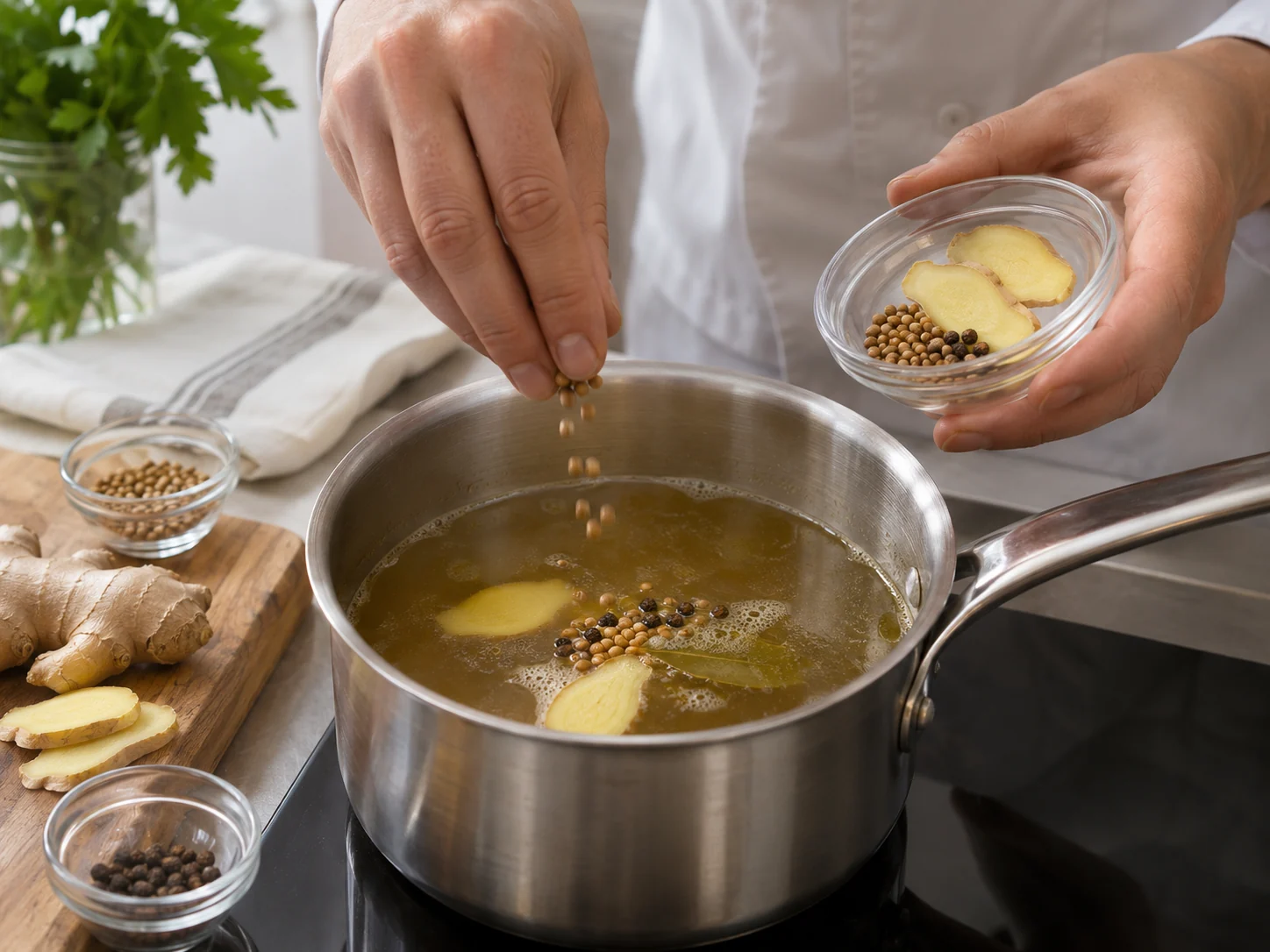
The gesture of flavoring is often simple in appearance, but it is guided by intention and knowledge of the ingredients. It can involve sprinkling ground spices, incorporating chopped herbs, grating zest, or allowing whole aromatics to infuse. The action of adding spice seeds and ginger to a broth, as in the illustration, is an example of interpreting the gesture. It is not a violent or rapid gesture, but rather a measured and intentional addition. The hand adding the flavorings must be precise, dosing the quantity to avoid excess. The gesture may be accompanied by a slight agitation or mixing to ensure homogeneous distribution of aromas. In the case of an infusion, the gesture is passive after the initial addition, allowing time and heat to do their work. Interpreting the gesture also involves observing the preparation: the color, texture, and especially the emerging smell, which are signs that the aromas are beginning to diffuse.
Observation Criteria
To evaluate the effectiveness of flavoring, several criteria can be observed. The first is olfaction: the aroma must be perceptible, pleasant, and in harmony with the dish. It should not be too weak to be imperceptible, nor too strong to be overwhelming. The second criterion is taste: flavors must be balanced, with added aromas blending harmoniously with the base flavors. There should be no undesirable bitterness, no chemical or artificial notes. Persistence on the palate is also an indicator: a good aroma leaves a pleasant and lasting impression. Finally, the visual aspect can also play a role, especially with fresh herbs that add color, or spices that slightly tint the preparation. For the illustrated broth, one would observe if the scent of spices and ginger diffuses gradually, creating an aromatic base without being too pronounced, and if the liquid retains its clarity while acquiring an olfactory depth.
Educational Applications in Various African Cuisines
Flavoring is a central technique in many African cuisines, where spices, herbs, and aromatic vegetables are used with mastery. For example, in West African cuisine, the use of chilies, onions, garlic, ginger, and bay leaves is common for flavoring sauces and stews. An educational example could be the development of an aromatic base for a 'mafé' (peanut butter-based dish): onions, garlic, and chopped ginger would be gently sautéed to release their aromas before adding other ingredients, thus creating a flavorful foundation. In Ethiopian cuisine, 'berbere,' a complex spice blend, is used to flavor many dishes. An exercise would consist of infusing this blend in hot oil to enhance its fragrances before incorporating it into a preparation. In North Africa, spices like cumin, coriander, paprika, and saffron are essential. One could demonstrate how to flavor couscous by infusing whole spices in the vegetable cooking broth, or by rubbing spices onto meat before simmering it. These examples demonstrate how flavoring is adapted to regional specificities and local ingredients, always with the aim of enriching the sensory profile of dishes.
Distinctions from Similar Gestures
It is important to distinguish flavoring from similar culinary gestures. Flavoring focuses on imparting fragrance and taste, without necessarily altering the main structure or function of the ingredient. It differs from seasoning, which primarily aims to adjust taste (salty, sweet, sour, bitter) and balance flavors with elements like salt, sugar, or vinegar. Although seasoning may include aromatics, its primary objective is the balance of fundamental flavors. Flavoring is also different from coloring, even if some spices (like turmeric or paprika) provide both color and aroma. Coloring primarily aims for visual appeal. Finally, it differs from marinating, which involves prolonged immersion in a flavored and often acidic liquid, intended to tenderize and deeply flavor, thus altering the texture and composition of the food. Flavoring can be a step in a marinade, but it is a more general and less intrusive technique.
Errors and Corrections
Common errors in flavoring include over-dosing, under-dosing, and poor timing. Over-dosing can make the dish cloying, bitter, or too pungent, masking the original flavors. Correction is difficult, but one can sometimes dilute the preparation with a neutral liquid or add mild ingredients to balance it. Under-dosing makes the dish bland and uninteresting; correction is simpler, simply add more flavorings, taking into account the time needed for them to diffuse their flavors. Poor timing is a frequent error: adding fresh herbs too early can make them lose their vibrancy, while adding whole spices too late will not give them enough time to infuse. For fresh herbs, it is often best to add them at the end of cooking or at the time of serving. For whole spices, the beginning of cooking is ideal. Another error is not toasting whole spices before grinding or infusing them, which helps release and intensify their aromas. If spices are bitter, it is often because they have burned or are of poor quality; in this case, one must start over.
Variations and Adaptation
Flavoring offers a multitude of variations and adaptations depending on ingredients, cultures, and techniques. One can flavor by infusion (soaking aromatics in a hot or cold liquid), by maceration (leaving aromatics in a liquid, often alcoholic, at room temperature), by smoking (exposing food to the smoke of aromatic ingredients), or by direct contact (rubbing spices on meat). Adaptation depends on the food matrix: a liquid (broth, sauce) will allow rapid diffusion, while a solid (meat, vegetable) will require more time or a more intense technique. For example, to flavor an oil, one can infuse herbs or spices cold for several days, or heat them gently for faster diffusion. For a dessert, one can use citrus zests, vanilla extracts, or floral waters. The key is to understand how aromas behave with heat, time, and other ingredients to choose the most appropriate method and achieve the desired result.
My Advice
My main advice for flavoring is to always taste and proceed in small increments. Aromas develop and transform with time and heat. What may seem subtle at first can become powerful after a few minutes of cooking or resting. Start with a small amount of flavorings, let them infuse or diffuse, then taste. If the aromatic profile is not pronounced enough, add a little more and repeat the process. It is much easier to add flavors than to remove them. Do not hesitate to experiment with combinations of flavorings you are not used to using, but do so in a controlled manner. The quality of the flavorings is also paramount: fresh, whole spices, vibrant herbs, untreated citrus zests will make all the difference. Finally, remember that flavoring is an art that requires patience and observation. Trust your nose and your palate to guide your choices.
Sources and further reading
2026-11-19