Season (Assaisonner)
French
Editorial collection: RecettesAfricaines.com · Publication director: Alioune FALL.
Definition and Scope
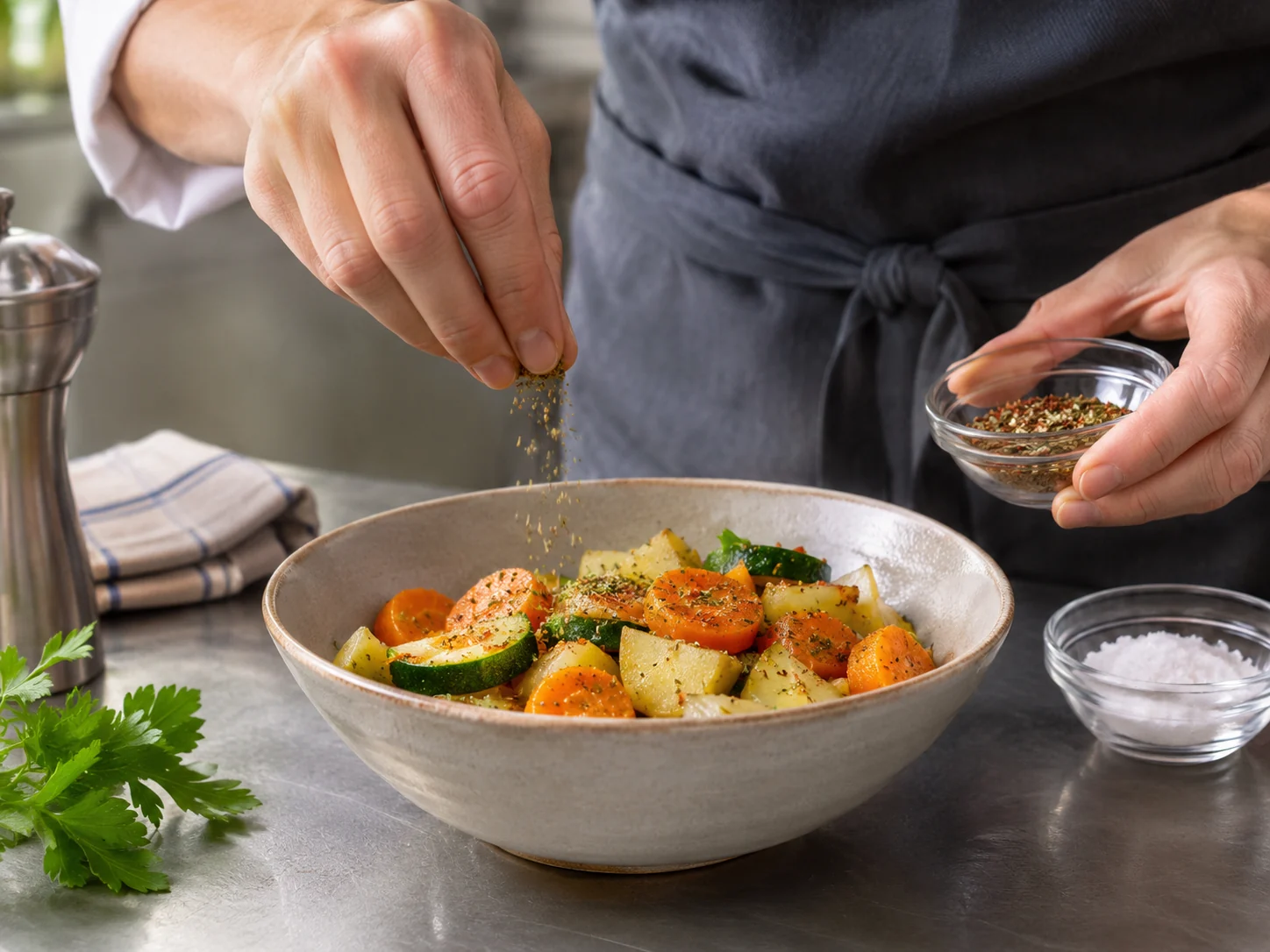
Seasoning involves incorporating flavorful elements into a culinary preparation to modify or enhance its gustatory qualities. This action is not limited to adding salt and pepper but encompasses a vast range of ingredients such as fresh or dried herbs, spices, condiments (mustard, vinegar, fermented sauces), flavored fats (infused oils), and even certain sugars or acids (lemon juice, tamarind) when used to balance flavors. Seasoning can occur at different stages of cooking: at the beginning to infuse flavors, during the process for adjustment, or at the end for a final touch. It is a dynamic and iterative process, often guided by tasting.
Desired Outcome
The primary objective of seasoning is to achieve a harmonious balance of flavors, where each component contributes without excessively dominating. A well-seasoned dish should be flavorful, neither bland nor overpowering, and should highlight the main ingredients. Seasoning aims to intensify natural flavors, introduce new gustatory dimensions (acidity, umami, pungency, controlled bitterness), and create a more complex and satisfying sensory experience. It can also serve to mask undesirable notes or to bind flavors together, making the dish more coherent and pleasant on the palate. The ideal result is a sensation of fullness and gustatory accuracy.
Equipment and Product Selection
The equipment needed for seasoning is minimal: measuring spoons, tongs, or simply fingers for precise application. The choice of products is crucial. For salt, one can opt for fine salt, fleur de sel, grey sea salt, or flavored salts. Spices must be of good quality, ideally freshly ground to maximize their aroma. Aromatic herbs, whether fresh or dried, should be selected for their fragrance and compatibility with other ingredients. Condiments like vinegars, olive oils, fish sauces, or chili pastes should be chosen based on their specific flavor profile and the desired effect. The freshness and quality of the seasonings directly impact the final taste of the dish.
Understanding the Action
The act of seasoning is often intuitive, but it relies on careful observation. It involves taking a small amount of seasoning, distributing it evenly over or into the preparation, then mixing if necessary. For powders like spices or salt, the action is often a pinch or a light sprinkle. For liquids, it is a drizzle or a drop. The important thing is initial parsimony: it is always easier to add than to remove seasoning. The action must be controlled and thoughtful, avoiding excess. It is often accompanied by tasting after each addition to evaluate the impact and decide on the next step.
Observation Criteria
To evaluate seasoning, several criteria must be observed. The first is the balance of flavors: no single flavor should overpower the others. Salt should enhance without making the dish salty. Pungency should be present but tolerable. Acidity should brighten without souring. The aroma should be perceptible and pleasant. Texture can also be affected; for example, salt can help extract water from vegetables. The color of certain seasonings (turmeric, paprika) can also contribute to the dish's aesthetics. Finally, persistence on the palate is a good indicator: good seasoning leaves a pleasant and lasting impression, without an unpleasant aftertaste.
Pedagogical Applications in Various African Cuisines
In African cuisines, seasoning is fundamental and diverse. For example, for a West African vegetable or meat stew, one might start by sautéing onions, garlic, and ginger, then adding fresh or dried chilies, grains of paradise (poivre de Guinée), and bouillon cubes for a flavorful base. For a North African dish, such as a tagine, seasoning would often include a spice blend like ras el hanout, saffron, cumin, coriander, and fresh parsley, with a balance between sweet and savory notes. In East Africa, for a dish like 'sukuma wiki' (collard greens), one might use garlic, tomatoes, and a little chili, adjusting salt and pepper. These pedagogical examples demonstrate how seasoning profiles vary considerably by region and dish, but the principle of balancing and enhancing flavors remains constant.
Distinctions from Related Actions
It is important to distinguish seasoning from other culinary actions. Seasoning is not marinating, although both involve adding flavors. Marinating is a prolonged soaking process to tenderize and flavor, while seasoning is a more immediate adjustment. It is also not 'sauce preparation' per se, even if a sauce is seasoned. Seasoning is a specific or iterative act of adjustment, whereas sauce preparation is a process of cooking and reduction. Finally, seasoning differs from 'garnishing': a garnish is a visible and textured addition, often for presentation, whereas seasoning is integrated to modify the intrinsic taste of the dish, even if it can sometimes be visible (fresh herbs).
Errors and Corrections
An overly salty dish is not automatically corrected by adding lemon: acid changes flavour perception but does not remove salt. A potato is not a selective filter that absorbs only salt either. Where correction is possible, increase the proportion of compatible unsalted ingredients, or divide the preparation and complete each portion separately. This dilution also changes consistency and therefore requires further adjustment. Excess chilli does not simply disappear after adding a spoonful of oil. A mild accompaniment or lightly seasoned sauce can make serving more pleasant without cancelling the heat already present. The best prevention is to taste a small cooked portion and add seasonings gradually, especially after a reduction that concentrates flavours.
Variations and Adaptation
Seasoning is a highly adaptable action. There are infinite regional and personal variations. For example, salad seasoning can range from a simple vinaigrette to a more complex dressing with herbs and spices. For slow cooking, initial seasoning can be milder, as flavors will develop and concentrate. For quick dishes, a more pronounced seasoning from the start may be necessary. Adaptation also occurs based on dietary restrictions (salt-free, chili-free) or individual preferences. Experimentation is encouraged, starting with small quantities and adjusting gradually to discover new flavor combinations.
My Advice
My main advice for seasoning is to always taste, taste, and taste again. Never rely solely on your intuition without verifying the result. Start with small amounts of seasoning, especially for salt and powerful spices. Taste after each addition and mix well so that the flavors are evenly distributed. Remember that flavors evolve during cooking: a reducing sauce will concentrate its salt and aromas, so a final readjustment is often necessary. Seasoning is an art that refines with practice and attention to detail. Do not hesitate to experiment with different combinations of herbs and spices to discover what works best for you and for the dish you are preparing.
Sources and further reading
2026-11-19