Barding (Barder)
French
Editorial collection: RecettesAfricaines.com · Publication director: Alioune FALL.
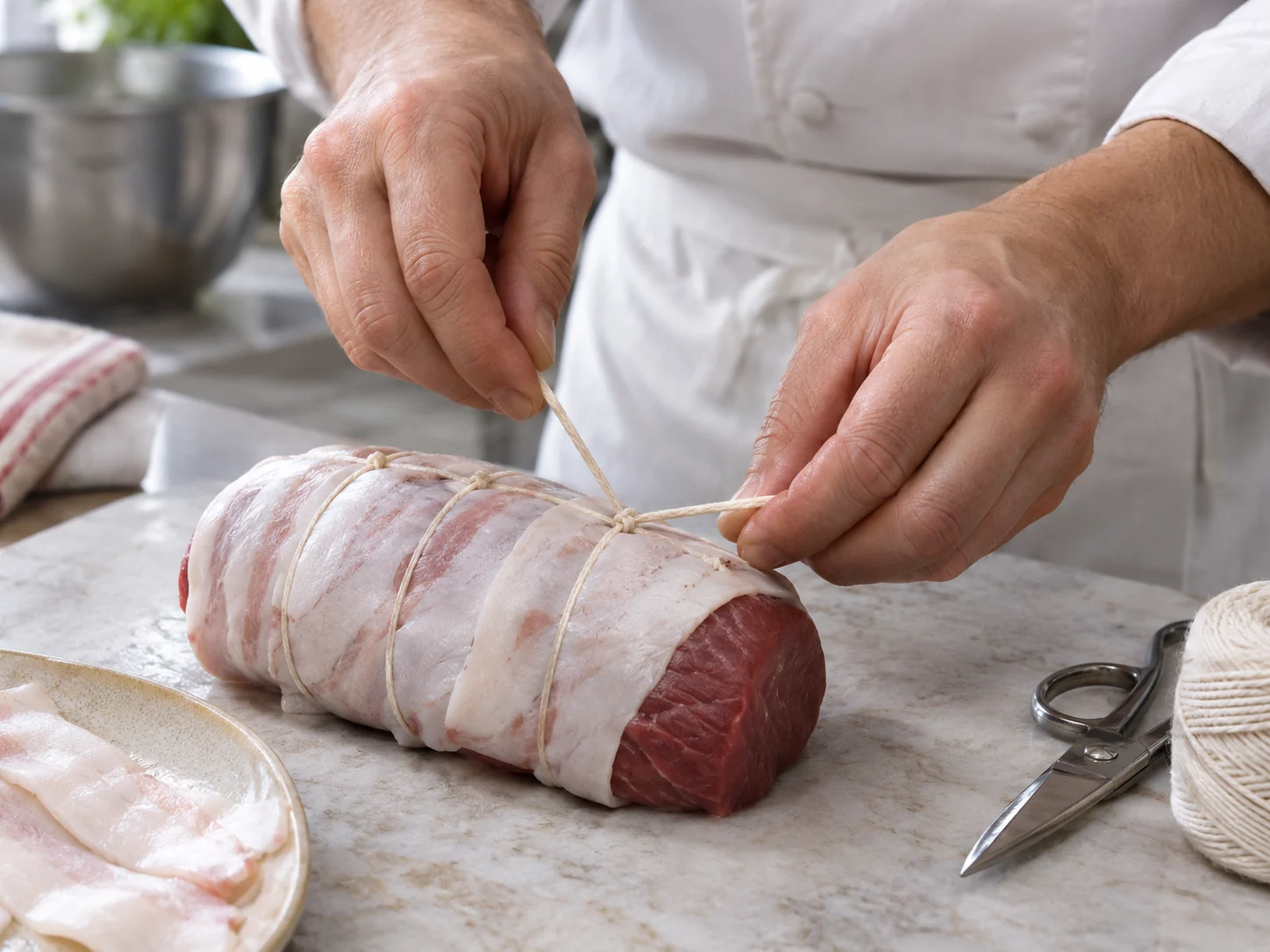
Definition and Scope
To bard is to place a thin sheet of fat around a piece of food intended for cooking, securing it with kitchen twine if necessary. The fat stays outside: it covers the area intended for protection and is neither a stuffing nor an ingredient inserted into the flesh. In classical terminology, the covering is generally pork backfat. If another animal fat is used, its nature should be stated clearly. The word therefore describes a specific arrangement, particularly associated with lean cuts intended for roasting. Oil brushed on the surface, a leaf parcel or a breadcrumb coating are different techniques, even when they also change how food is exposed to heat.
Desired Outcome
The covering fat can soften and melt during cooking, depositing fat on the outside of the piece. It does not hydrate it: fat does not add water to the flesh. Nor should it be imagined as a perfectly sealed wrapper retaining all the juices. The result depends on the covering's thickness, the cut and the way cooking is managed. Overcooked meat does not become tender again through barding alone. The covering may also slow browning on the area it masks. The aim is therefore appropriate protection and a measured flavour contribution, while observing the covering's texture, the appearance of the meat and the juices in the pan separately.
Equipment and Product Selection
The equipment consists of a stable work surface, the piece to cook, a pliable sheet of fat and kitchen twine suitable for food contact. A knife can trim the covering to size, but there is no need to impose one numerical thickness on every food. The sheet should follow the piece's shape without tearing or forming an unnecessarily bulky layer. The nature of the fat matters as much as its flexibility: it affects flavour, melting and the diners' food choices. Substituting fats therefore requires observing their actual behaviour. A vegetable paste, leaf or melted fat does not automatically replace a structured sheet of fat; name the adaptation precisely.
Execution of the Technique
The barding technique begins with the preparation of the food item, which should be clean and dry. Next, the slices of fat are arranged on the surface of the piece, overlapping slightly to ensure complete coverage. It is important not to leave any uncovered areas, especially on the leanest parts or those most exposed to heat. Once the fat is positioned, the piece is tied with twine. The trussing must be regular and tight enough to hold the barde in place throughout the cooking process, but not to the point of deforming the piece or excessively compressing the flesh. The knots should be strong and easy to untie after cooking. The technique is precise and requires dexterity to harmoniously wrap the piece.
Observation Criteria
Several criteria allow for evaluating the quality of barding. Firstly, coverage: the barde must uniformly envelop the piece, leaving no bare areas. Secondly, hold: the trussing must be effective; the barde should not slip or detach during handling or cooking. Thirdly, fat thickness: slices that are too thick risk not melting completely or making the piece too greasy, while slices that are too thin might dry out too quickly. Fourthly, general appearance: well-executed barding gives a harmonious shape to the piece, facilitating uniform cooking. After cooking, the barde should have partially melted, leaving a golden and appetizing surface, and the flesh should be visibly juicy.
Pedagogical Applications in Various African Cuisines
To teach this technique in a workshop on African cuisines, one can compare a small roasting cut and discuss ingredient choices. This is a teaching exercise: it does not establish barding as belonging to a particular country, community or traditional recipe. Begin by naming the cut, fat and covered area, then observe how the sheet stays in place before cooking and how it changes afterwards. Another session can compare this arrangement with cooking in a banana leaf while keeping the two names distinct: a leaf wrapper is not a sheet of covering fat. The distinction helps transmit clear vocabulary without conflating procedures that share only some functions.
Distinctions from Similar Techniques
Barding places fat on the outside, whereas larding inserts strips of fat into the piece. This difference in position changes the arrangement and each technique's role; it does not mean that either one adds water inside the flesh. Stuffing fills a cavity or wrapper with another preparation. Trussing holds a shape: a piece can be tied without being barded, or a few ties can hold a sheet of fat. Breading adds breadcrumbs or another dry coating. Cooking in a parcel uses a separate wrapper. Naming these operations individually explains how they can be combined in a recipe instead of treating them as synonyms.
Errors and Corrections
A common error is not covering the piece sufficiently, leaving lean areas exposed that risk drying out. The correction involves ensuring that the fat slices overlap slightly and cover the entire surface. Another error is loose trussing, leading to the barde slipping during cooking; in this case, it is necessary to re-tie more firmly. Conversely, overly tight trussing can deform the piece or prevent the fat from melting uniformly. The thickness of the fat is also a source of error: slices that are too thick can make the piece too greasy and prevent good browning of the skin or surface; they should then be thinned. If the fat is too thin, it can dry out too quickly; one can then layer two thin layers or choose a thicker fat.
Variations and Adaptation
The extent of the covering can vary with the cut and the area intended for protection. An entire bird does not automatically need wrapping: a selected area may be covered if the recipe calls for it. The choice should fit the cooking method and desired browning. A covering masks part of the surface; if it is later removed, observe the removal and subsequent browning rather than assume one duration suits every piece. When comparing two trials, change only one variable, such as the covered area or the sheet's dimensions. Differences in how the covering holds, the fat deposited and the final appearance can then be described more precisely.
My Advice
For successful barding, I advise you to always choose good quality, fresh, and firm fat. Ensure that your fat slices are of uniform thickness for even melting. When trussing, take the time to distribute the twine turns well, making sure they are parallel and tight enough to hold the barde without excessively compressing the flesh. Do not hesitate to remove the barde at the end of cooking if you wish to obtain a crispier and more golden skin or surface, by slightly increasing the oven temperature for the last few minutes. The fat will have already fulfilled its protective and aromatic role. Remember to collect the melted fat in the roasting pan: it can serve as a base for a sauce or to baste the piece during serving, adding an extra touch of flavor.
Sources and further reading
vitrinelinguistique.oqlf.gouv.qc.ca
2026-11-19