Beat (Battre)
From Vulgar Latin *battĕre, an alteration of Classical Latin *battuĕre, meaning "to strike, to beat."
Editorial collection: RecettesAfricaines.com · Publication director: Alioune FALL.
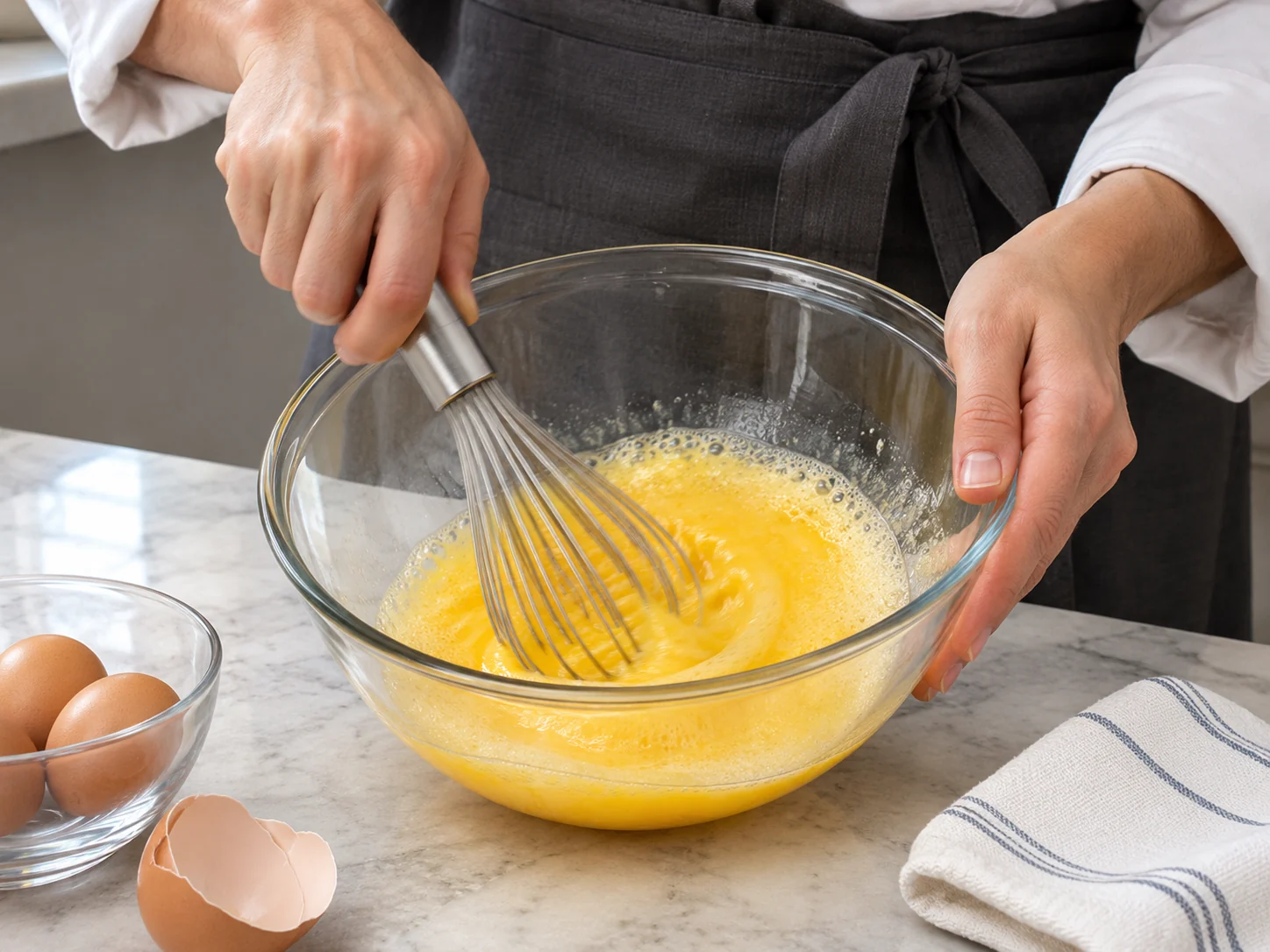
Definition and Scope
The culinary action of beating involves subjecting a preparation to rapid and repeated agitation. This mechanical action serves several distinct purposes: to homogenize ingredients, dissolve solid elements in a liquid, smooth a texture by eliminating lumps, or incorporate air to increase volume and lighten consistency. It is a fundamental technique applicable to a vast range of preparations, from the simplest to the most complex. Beating can be performed manually with a whisk, fork, or spatula, or mechanically using an electric mixer or food processor. The intensity, duration, and type of tool employed are determined by the nature of the ingredients and the desired final result. This action is distinguished from simple mixing by its energy and its specific aim of altering structure or aeration.
Desired Outcome
The expected outcome of beating is directly linked to the initial objective. If eggs are beaten for an omelet, the goal is to obtain a homogeneous mixture of yolks and whites, with a slight incorporation of air for a fluffier texture. For pancake batter, beating aims to smooth the preparation, eliminate flour lumps, and ensure an even distribution of ingredients. In the case of whipped cream or egg whites, the objective is to incorporate as much air as possible to create a stable, light, and voluminous structure. For a vinaigrette, beating helps to emulsify fats and aqueous liquids, creating a temporary bond that prevents immediate separation. Each application of beating is therefore oriented towards a specific transformation of the preparation's texture, consistency, or homogeneity.
Equipment and Product Selection
The choice of equipment is crucial for effective beating. A manual whisk, with its flexible metal wires, is ideal for incorporating air or smoothing small quantities. Balloon whisks are perfect for egg whites or creams, while flat whisks are more suited for sauces or roux. For larger volumes or thicker preparations, an electric mixer or stand mixer offers power and regularity impossible to achieve manually. The choice of products also influences the action: fresh eggs will whip better than older eggs. Ingredient temperature is also a key factor; for example, egg whites at room temperature whip more easily and quickly than cold whites. For creams, very cold heavy cream is essential to obtain firm whipped cream. The quality of the basic ingredients directly impacts the ability to achieve the desired result through beating.
Understanding the Motion
The beating motion is characterized by a rapid and ample movement, often circular or in a figure-eight, which agitates the preparation from the bottom to the surface of the container. The effectiveness of beating lies in the ability to create a continuous movement that stirs the entire mass. To incorporate air, the whisk should be lifted slightly with each pass, allowing air to enter the preparation. To smooth, the movement should be more regular and in constant contact with the bottom and sides of the bowl, to break up any lumps. The speed and force applied vary: gentle beating to mix eggs without over-aerating them, energetic beating to whip egg whites. Visual observation of texture and consistency is the primary indicator of the motion's progression. The sound produced by the whisk can also provide indications about the preparation's density.
Observation Criteria
Several criteria allow for evaluating the effectiveness of beating and anticipating the result. Texture is paramount: a preparation beaten to be smooth should have no lumps. For an emulsion, the absence of phase separation is a sign of success. Volume is a key indicator for aerated preparations: egg whites or whipped cream should double or even triple in volume. Color can also change, becoming paler as air is incorporated. Consistency is another criterion: a preparation that thickens, becomes firmer, or forms peaks (for egg whites) indicates that beating is successful. Finally, shine can be a sign of a good emulsion or a smooth texture. Careful observation of these elements allows for adjusting the motion and knowing when to stop beating to avoid overworking the preparation, which could alter its quality.
Educational Applications in Diverse African Cuisines
The action of beating, though often associated with Western pastry, finds diverse applications in African cuisines. For example, in preparing certain light sauces or thickened porridges, beating helps achieve a homogeneous and lump-free consistency. In the preparation of fermented beverages or curdled milks, a light beating can help mix ferments or smooth the texture before consumption. For fritter or pancake batters, beating the dough can incorporate air, making the fried product lighter and airier. A pedagogical example could be the preparation of millet or rice fritter batter: vigorously beating the batter after adding water or plant milk helps develop gluten (if present) and incorporates air, contributing to a softer texture after cooking. Another example is the beating of certain cooked and mashed vegetables or legumes to obtain a very smooth and homogeneous puree, as for some preparations based on beans or sweet potatoes, where a fine texture is desired. These applications demonstrate the versatility of the action beyond stereotypical culinary contexts.
Distinctions from Similar Actions
The action of beating is distinct from several similar culinary actions. 'Mixing' is generally less energetic and primarily aims to combine ingredients without necessarily modifying their texture or significantly incorporating air. 'Stirring' is a gentler, continuous movement, often used to prevent a preparation from sticking to the bottom of a pan or to maintain homogeneity without seeking aeration. 'Whipping' is very close to beating, but it is often specifically associated with intense air incorporation, as for egg whites or whipped cream, and implies the use of a whisk. 'Kneading' is a more physical and compressive action, applied to doughs to develop gluten and create an elastic structure, without the primary objective of aeration or liquid smoothing. Finally, 'emulsifying' is a result of beating, but the term describes the formation of a stable dispersion of two immiscible liquids, while 'beating' is the mechanical action that leads to it.
Errors and Corrections
Several common errors can compromise the success of beating. One of the most frequent is not beating enough, which results in a non-homogeneous preparation, lumps, or a lack of volume. The correction consists of prolonging the beating, increasing intensity if necessary. Conversely, excessive beating can be detrimental: over-beaten egg whites become dry and grainy, over-beaten whipped cream turns into butter. In these cases, it is often difficult to reverse the damage; it is preferable to stop as soon as the desired result is achieved. Another error is using unsuitable equipment, such as a small whisk for a large quantity, or a manual mixer for a very thick batter. The correction involves choosing the appropriate tool. Finally, ingredient temperature is often neglected: cold egg whites or lukewarm cream will not whip correctly. The solution is to ensure that ingredients are at the right temperature before starting to beat.
Variations and Adaptation
The action of beating adapts to a multitude of situations. The speed and amplitude of the movement are the main variables. For a delicate preparation that should not be overly aerated, such as a liaison based on egg yolks, the beating will be gentle and regular. To incorporate maximum air, as for mousses or soufflés, the beating will be rapid and energetic, with movements that lift the preparation. The tool can also be adapted: a fork for a small quantity of eggs, a whisk for sauces, an electric mixer for heavy batters. Beating techniques can also vary according to culinary cultures. For example, some traditional preparations may be beaten with specific wooden utensils or pestles to obtain a particular texture, different from that obtained with a metal whisk. Adaptation is therefore constant, depending on the ingredients, the available tool, and the desired textual result.
My Advice
To master the action of beating, the key is careful observation of the preparation. Do not rely solely on duration or a fixed recipe, as each ingredient and context can influence the process. Learn to recognize the visual and tactile signs that indicate you have reached the right stage: the disappearance of lumps, the increase in volume, the change in color, the thickening, or the formation of peaks. For aerated preparations, start gently and gradually increase speed to incorporate air in a controlled manner. Do not hesitate to taste or touch the preparation (if appropriate) to assess its texture. Regular practice will allow you to develop intuition and precision that will transform this simple action into a powerful tool for improving the quality of your dishes.
Sources and further reading
2026-11-19