To butter (Beurrer)
French
Editorial collection: RecettesAfricaines.com · Publication director: Alioune FALL.
Definition and Scope
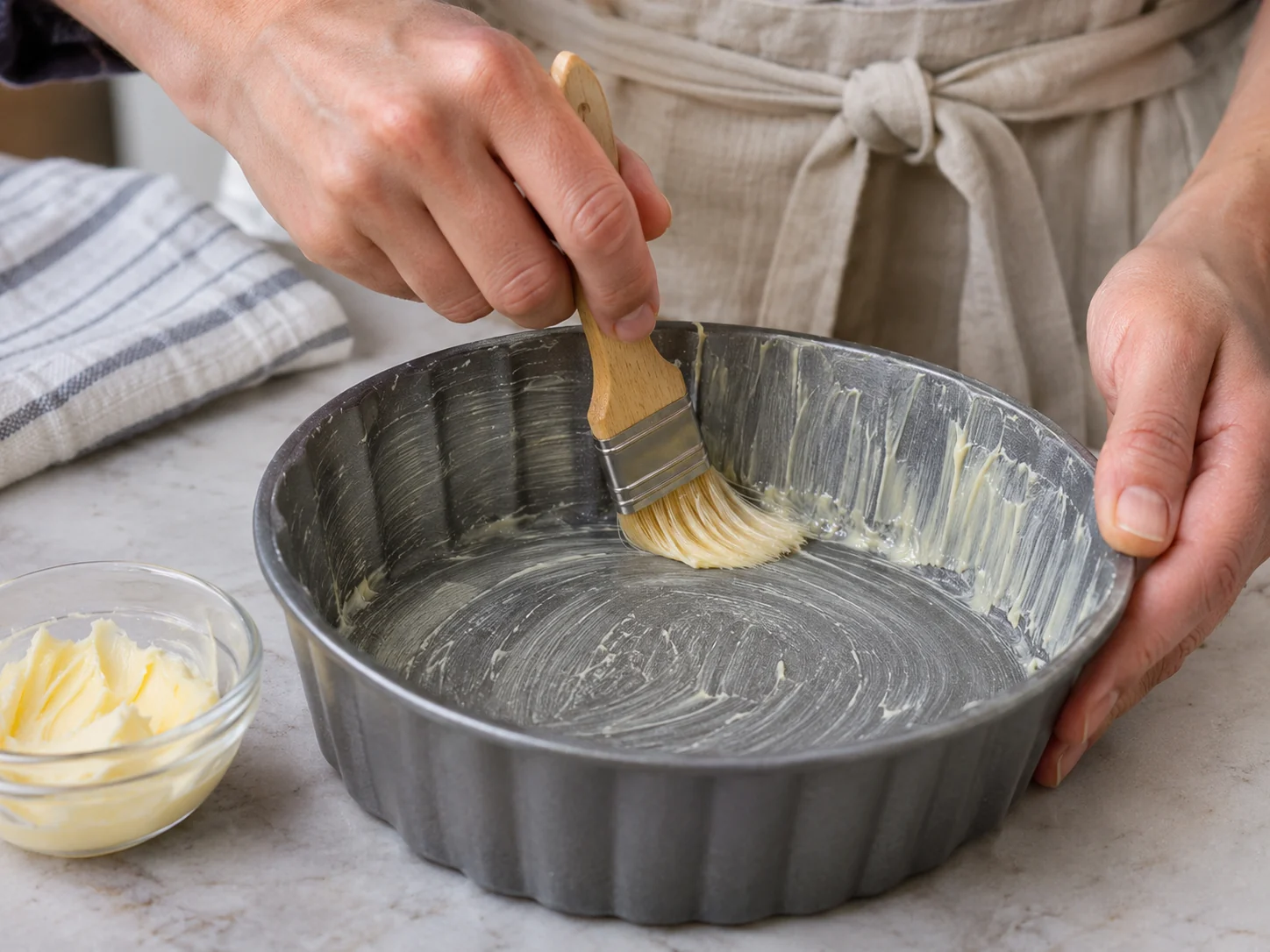
The term "to butter" (beurrer) refers to the action of applying a thin layer of butter, typically softened, onto a cooking surface or inside a container intended for baking or cooking. This technique is fundamental in pastry and cooking to create a non-stick barrier. It is not limited to cake molds but extends to baking sheets, parchment paper, frying pans, and sometimes even certain utensils to prevent sticky preparations from adhering. The primary objective is to facilitate the release of cooked preparations and ensure homogeneous cooking, preventing food from burning or sticking to the bottom and sides. The butter used must be of good quality and at the correct temperature for effective application.
Desired Outcome
The ideal outcome of buttering is a surface entirely covered with a thin and uniform film of butter, without excess or missed areas. For a mold, this means that every corner, every edge, and every internal wall is coated. This uniformity is crucial to ensure that the preparation bakes without sticking and can be unmolded without tearing or breaking. A layer of butter that is too thick can melt and accumulate at the bottom of the mold, creating an undesirable greasy crust or altering the texture of the preparation's base. A layer that is too thin or areas that are not buttered will lead to partial adhesion, making unmolding difficult and potentially destructive to the food's shape.
Equipment and Product Selection
To butter effectively, basic equipment includes a pastry brush, a piece of absorbent paper, or even your fingers. The choice of butter is important: unsalted, sweet butter is generally preferred in pastry to avoid interfering with flavors. The butter should be at room temperature, softened but not melted. Butter that is too cold will be difficult to spread evenly, while melted butter risks accumulating and not adhering properly to the walls. For molds with complex reliefs, a brush is essential to reach all the details. For flat surfaces, a piece of absorbent paper soaked in butter can be faster and more efficient. The use of clarified butter can be considered for higher temperature cooking, as it has a higher smoke point, but it is less common for simple mold buttering.
Understanding the Technique
The act of buttering begins by taking a small amount of softened butter. With a brush, it involves regular, overlapping strokes to cover the entire surface. For a mold, one often starts with the bottom, spreading the butter from the center outwards, then moving up along the sides in a spiral or vertical lines, ensuring all corners are well covered. The goal is to deposit a visible but not excessive layer. The motion should be firm but delicate, so as not to remove butter already applied. It is important to visually check that all areas are well coated, tilting the mold to the light if necessary. For baking sheets, back-and-forth or circular motions are appropriate. The regularity of the motion is key to successful buttering.
Observation Criteria
Successful buttering is characterized by several observable criteria. Firstly, the buttered surface should have a slightly shiny and uniform appearance, without dull or uncovered areas. Secondly, there should be no visible excess butter, such as puddles or accumulations in the corners. A layer that is too thick can be gently wiped away with absorbent paper. Thirdly, the butter must adhere firmly to the surface, without running or detaching. If the butter is too melted, it will not hold properly. Finally, for molds, all nooks, crannies, and details of the shape must be accessible and covered. Careful visual inspection is essential before pouring in the preparation.
Educational Applications in Various African Cuisines
While butter as we know it may not always be the primary ingredient in all African cuisines, the principle of coating a surface to prevent sticking is universal. For educational purposes, the concept of buttering can be illustrated using local fats. For example, when preparing flatbreads or pancakes on a baking sheet or in a frying pan, one could coat the surface with a thin layer of refined palm oil, groundnut oil, or clarified shea butter (for regions where it is used in cooking). The objective would be to observe how these fats, applied similarly to butter, create a non-stick barrier for preparations like Ethiopian 'injera' (on an oiled 'mitad') or East African 'chapati'. The teaching would focus on the technique of uniform application and understanding the role of the fat, regardless of its specific nature.
Distinctions from Similar Techniques
Buttering (beurrage) is distinct from similar techniques such as greasing or flouring. Greasing is a more generic term that includes the use of other fats (oils, margarines) for the same non-stick purpose. Buttering specifically refers to the use of butter. Flour dusting (farinage), often combined with buttering (referred to as 'butter and flour'), consists of sprinkling a thin layer of flour over the buttered surface. The flour adheres to the butter and creates an additional layer that enhances the non-stick effect, particularly useful for delicate cakes or complex molds. 'Chemisage' is a more elaborate technique that involves lining a mold with a thin layer of an ingredient (such as sugar, cocoa, or dried fruits) that adheres to the butter, adding both non-stick protection and an additional texture or flavor to the outer crust of the preparation.
Errors and Corrections
Common errors when buttering include using butter that is too cold or too hot. If the butter is too cold, it will be difficult to spread and will leave lumps or uncovered areas. The correction is to allow the butter to soften at room temperature. If the butter is too hot or melted, it will run and accumulate at the bottom of the mold, creating an excessively greasy layer. In this case, the butter should be allowed to cool slightly to regain a creamier consistency. Another error is forgetting areas, particularly the corners or the upper edges of molds. Careful visual inspection is the best correction. Finally, a layer of butter that is too thick can be corrected by gently wiping it with absorbent paper, being careful not to remove the entire protective layer.
Variations and Adaptation
Buttering can be adapted depending on the type of preparation and the desired result. For very delicate preparations or those prone to sticking, buttering can be combined with flour dusting: after buttering the mold, a thin layer of flour is sprinkled in, then the mold is tapped to ensure the flour adheres everywhere, and any excess is removed. For chocolate cakes, flour can be replaced with cocoa powder to avoid white marks. For muffin tins or paper liners, a light buttering before inserting the liners can aid in baking and unmolding. In some cases, especially for high-temperature cooking, clarified butter or a neutral vegetable oil can be used to grease the surface, although this falls outside the strict definition of 'buttering' but respects the non-stick principle.
My Advice
My advice for perfect buttering is to always work with butter at the right consistency: pliable, but not liquid. Take the time to thoroughly cover every square millimeter of the surface, paying particular attention to corners and crevices. For molds with complex patterns, do not hesitate to use a fine brush and make several cross-hatching passes. Once buttering is complete, if you have any doubt about uniformity, run a clean finger or a small piece of absorbent paper to check for butter everywhere. Meticulous buttering is the first step towards flawless unmolding and an impeccable presentation of your culinary creations. It's a small gesture that makes all the difference in the final result.
Sources and further reading
2026-11-19