Bouquet Garni
French
Editorial collection: RecettesAfricaines.com · Publication director: Alioune FALL.
Definition and Scope
The bouquet garni is a simple yet essential preparation in cooking, consisting of assembling and tying together fresh or dried aromatic herbs. Its primary role is to infuse flavors into cooking liquids such as broths, sauces, soups, stews, or marinades. The objective is to enrich the aromatic profile of the dish without the herbs dispersing and requiring tedious straining. Once its infusion role is complete, the bouquet is removed, leaving a flavored preparation whose clarity also depends on other ingredients. It distinguishes itself from other flavoring methods by its temporary nature and ease of removal. It is not an ingredient to be consumed directly, but a tool for flavor extraction.
Desired Outcome
The expected outcome of a bouquet garni is a subtle and balanced aromatic infusion. The flavors of the herbs should blend harmoniously into the liquid, without dominating other ingredients, but complementing them. The aim is to achieve depth of taste, olfactory complexity, and a pleasant persistence on the palate. The goal is to limit dispersed herb fragments, without expecting the bouquet to clarify the liquid, which is particularly important for clear broths or refined sauces. The bouquet garni contributes to the roundness of flavors and the culinary identity of the dish, acting as a natural enhancer without the addition of salt or thickener. It allows for building a solid aromatic base for many preparations.
Equipment and Product Selection
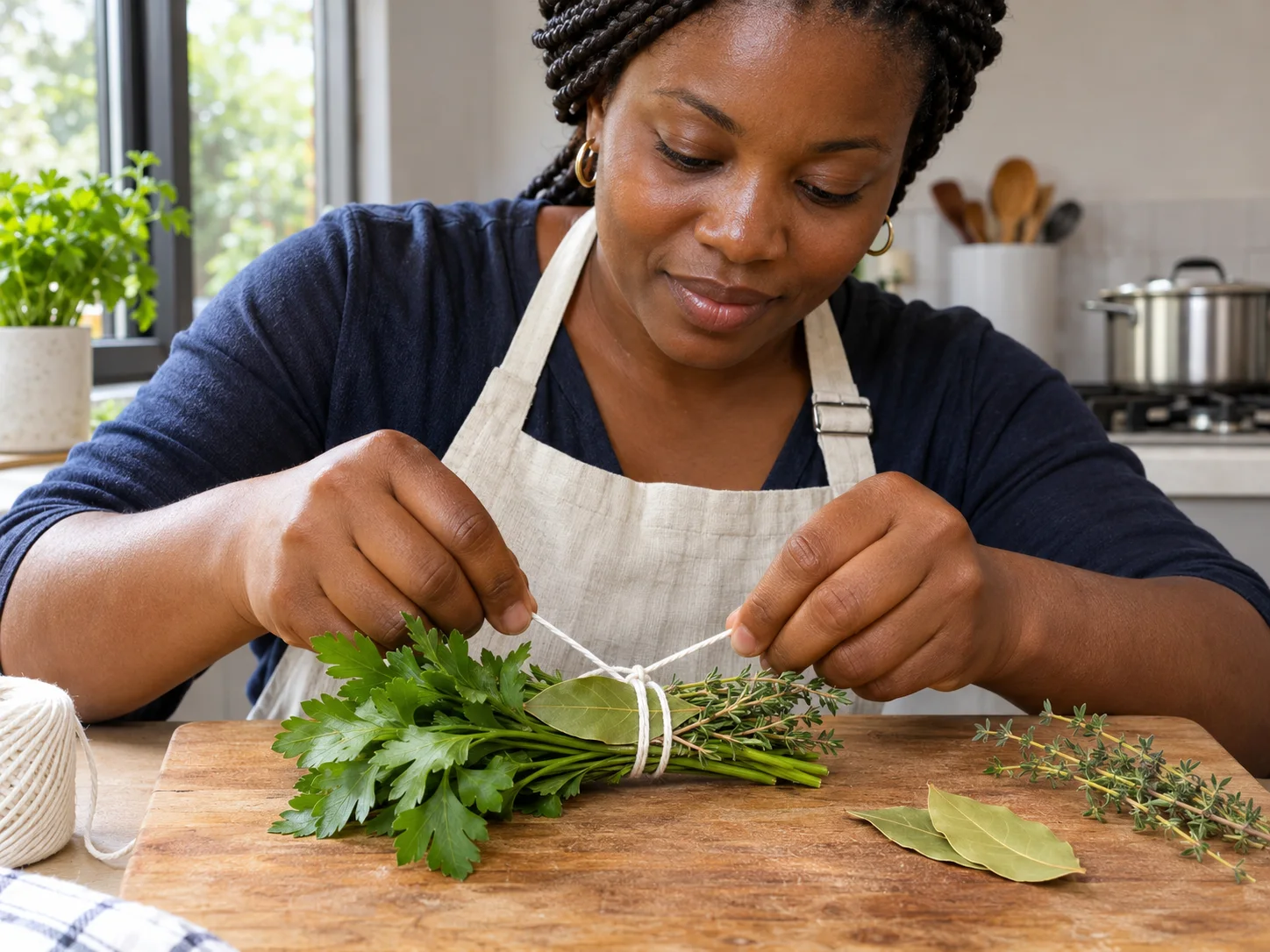
To make a bouquet garni, minimal equipment is needed: heat-resistant kitchen twine is essential. This twine must be long enough to easily retrieve the bouquet at the end of cooking. Regarding herbs, a common example includes thyme, bay leaf, and parsley stems. Thyme, whether fresh in sprigs or dried, brings a woody and slightly lemony note. Bay leaf, typically used as dried leaves, offers a camphoraceous and spicy flavor. Parsley stems, often overlooked, are rich in fresh, herbaceous aromas and lend themselves well to prolonged cooking. Other herbs like rosemary, oregano, savory, or even aromatic vegetables such as leek whites or a celery stalk can be incorporated depending on the desired flavor profile. It is crucial to choose fresh, good-quality herbs for optimal aroma. Dried herbs can be used, but their aromatic power is often more concentrated, requiring an adjustment in quantities.
Understanding the Technique
The technique of making a bouquet garni is simple and methodical. It involves gathering the chosen herbs into a small bundle. More robust herbs like sprigs of thyme or bay leaves are generally placed in the center or at the base of the bouquet. Softer parsley stems can wrap around them or be added to the sides. Once the herbs are grouped, the kitchen twine is wrapped firmly around their base, then tied securely to keep the bundle compact. It is important that the knot is tight to prevent the herbs from detaching during cooking. One end of the twine should remain free and long enough to extend out of the cooking vessel, thus facilitating the removal of the bouquet without having to dip hands or utensils into the hot liquid. The free part of the twine must be kept away from a flame or a hot burner. Small leaves may still detach: one should check the bouquet and remove any visible debris with an appropriate utensil.
Observation Criteria
Several criteria allow for evaluating the proper execution and effectiveness of a bouquet garni. Firstly, the solidity of the tie: the bouquet must remain intact throughout cooking, without any herbs escaping. Secondly, its size and compactness: a bouquet that is too loose or too voluminous can be difficult to handle or immerse correctly. It must be compact enough to infuse effectively without taking up too much space. Thirdly, the quality of the infusion: the cooking liquid should be impregnated with the aromas of the herbs in a balanced manner, without an excessively bitter or herbaceous taste. Fourthly, ease of removal: the twine must be accessible and allow the bouquet to be removed effortlessly and without risk of burns. Finally, the absence of residues: after removal, the liquid should be free of herb fragments, a sign that the bouquet has effectively contained its components.
Educational Applications in Various African Cuisines
Although the term 'bouquet garni' is of French origin, the principle of infusing tied aromatics to flavor dishes can be adapted to different preparations, without implying a practice shared by all African cuisines. For example, for a West African meat or fish stew, one could create a bouquet garni with bay leaves, flat parsley stems, and a few sprigs of thyme, to infuse an aromatic base before adding more intense spices. In an East African context, for a vegetable broth or a light soup, a bouquet might include coriander leaves (stems), thinly sliced fresh ginger, and celery leaves, bringing fresh and pungent notes. For a North African dish, such as a vegetable tagine, one could tie together sprigs of fresh coriander, parsley, and a few mint leaves for a delicate infusion. These pedagogical examples show how the concept can be used to introduce local flavors without altering the final texture of the dish, without presenting these assemblages as uniform profiles of entire regions.
Distinctions from Similar Techniques
It is important to distinguish the bouquet garni from similar flavoring techniques. An aromatic sachet, for instance, uses a permeable fabric (such as cheesecloth or an empty tea bag) to contain powdered spices, seeds, or very fine herbs that might escape a classic bouquet garni. The sachet is particularly useful for small seeds. Very fine powders can pass through a too-loose fabric: one must check the mesh and the result in the liquid. Chopped aromatics, on the other hand, are directly incorporated into the dish and are intended to be consumed. They provide not only flavor but also texture and color. The bouquet garni, however, is designed to be removed. Finally, direct infusion of loose herbs, without tying them, requires a subsequent straining step, which is not the case with a well-tied bouquet garni. Each method has its specific utility depending on the type of aromatic and the desired outcome.
Errors and Corrections
Several common errors can compromise the effectiveness of a bouquet garni. A loose tie is a frequent mistake, leading to the dispersion of herbs in the liquid. The correction involves ensuring the knot is tight and the twine is wrapped multiple times. Another error is using herbs that are too old or of poor quality, which results in a weak or unpleasant aroma. One should prioritize fresh and vibrant herbs. Forgetting to leave an end of twine extending from the vessel makes removal difficult and potentially dangerous; it is essential to always provide sufficient length. Finally, confusing the bouquet garni with a thickener or a salty seasoning is a misunderstanding. The bouquet garni does not thicken a sauce and does not replace salt; its role is purely aromatic. If the dish lacks flavor after the bouquet is removed, it is a sign that the seasoning needs to be adjusted or other aromatics considered.
Variations and Adaptation
The composition of the bouquet garni is far from fixed and can be infinitely adapted according to preferences and dishes. Beyond the classic trio of thyme-bay leaf-parsley, one can explore variations. For more Mediterranean flavors, the addition of rosemary or oregano is relevant. For an aniseed touch, a few sprigs of wild fennel can be included. In poultry broths, a celery stalk or a piece of leek white can enrich the aromatic profile. For a different aromatic exercise, lemongrass stalks or kaffir lime leaves can be gathered in a suitable food-grade sachet. It is also possible to incorporate whole, lightly crushed garlic cloves, or black peppercorns. Adaptation can also concern the form: for very fine herbs or spices, the bouquet can be wrapped in a blanched leek leaf before tying it, or a small piece of cheesecloth can be used. The essential thing is to maintain the integrity of the bundle for easy removal.
My Advice
My advice is not to underestimate the impact of a well-thought-out bouquet garni. Take the time to select quality herbs and tie them securely. Consider the cooking time: robust herbs like bay leaf and thyme withstand long cooking times well, while more delicate herbs like parsley or cilantro can be added later to the bouquet, or even halfway through cooking, to preserve their fresh aromas. Do not hesitate to experiment with different herb combinations to discover new depths of flavor. A bouquet garni is a minimal investment in time for a maximum gain in taste and clarity of your preparation. It is a simple tool that elevates the quality of many liquid dishes, allowing for the comparison of several aromatic assemblages and choosing the one that suits the dish.
Sources and further reading
2026-11-19
References accessed on 19 November 2026 : AdT-Recettes — Bouquet garni (mai 2015) · Ducros — Bouquet garni à la provençale