Chiffonade
French
Editorial collection: RecettesAfricaines.com · Publication director: Alioune FALL.
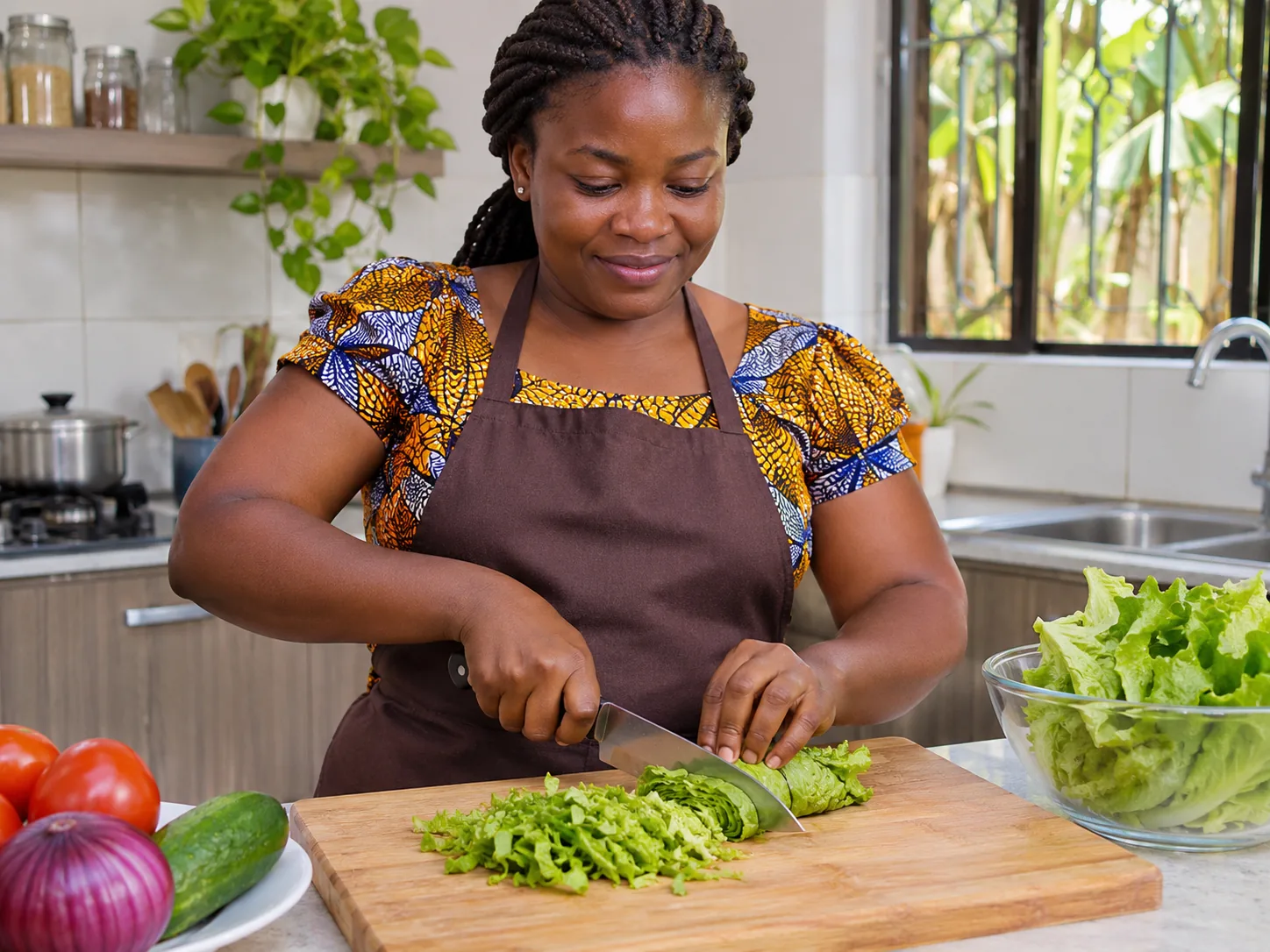
Definition and Scope
Chiffonade is a culinary cutting technique that involves transforming leaves, typically leafy vegetables or large-leafed aromatic herbs, into fine strips. The gesture often involves stacking several leaves, gently rolling them into a flexible cylinder, then thinly slicing them crosswise with a well-sharpened knife. The objective is to obtain regular and fine strips without tearing or bruising the plant fibers. This method is primarily applied to tender leaves such as lettuce, sorrel, spinach, basil, or mint, but can be adapted to more robust leaves after adequate preparation. Chiffonade is distinguished by the fineness and regularity of the strips, which influence both the mouthfeel and the aesthetic of the dish. It is not a coarse chopping technique nor a method for cutting firm vegetables into sticks.
Desired Result
The ideal result of a chiffonade is a collection of uniformly thin, light, and airy leaf strips. These strips must maintain their structural integrity, without being crushed or blackened by clumsy cutting. The fineness of the cut allows for better integration of the leaves into preparations, whether consumed raw in a salad, or cooked and melted into sauces or garnishes. A successful chiffonade offers a delicate texture that melts in the mouth or blends harmoniously with other ingredients, without providing an excessive chewing sensation or tough fibers. Visually, the strips should be distinct and exhibit a vibrant color, a sign of a clean cut that has minimized oxidation. Uniformity is also crucial for even cooking and a neat presentation.
Equipment and Product Selection
To achieve a quality chiffonade, the choice of equipment is paramount. A chef's knife or a santoku knife, with a long and very sharp blade, is essential. A dull blade would crush the leaves rather than cut them cleanly, leading to rapid blackening and an unpleasant texture. A stable and clean cutting board is also necessary to ensure safety and precision of the gesture. Regarding the products, prioritize fresh, crisp, and blemish-free leaves. For lettuces, choose varieties with flexible and broad leaves. For herbs, opt for sprigs with intact leaves. It is crucial to wash the leaves thoroughly and dry them perfectly before cutting. Residual moisture can cause the leaves to slip during rolling and cutting, making the gesture less precise and potentially dangerous. For thicker leaves or those with pronounced ribs, such as certain varieties of cabbage or spinach, it is recommended to remove the large ribs before proceeding with the chiffonade, to ensure the uniformity and tenderness of the strips.
Understanding the Gesture
The chiffonade gesture breaks down into several key steps. First, leaf preparation: meticulous washing, draining, and drying. Second, stacking: arrange the leaves one on top of the other, aligning them carefully. The number of stacked leaves depends on their thickness and the flexibility of the roll desired. Third, rolling: roll the leaves tightly but without crushing them, to form a compact and regular cylinder. This roll must be firm enough not to unravel, but flexible enough to allow for a clean cut. Fourth, cutting: place the roll on the cutting board and, with the well-sharpened knife, thinly slice the roll into perpendicular sections. The knife movement should be fluid and continuous, in a single pass if possible, to avoid sawing the leaves. The fingers of the hand holding the roll should be curled into a claw shape, thus protecting the knuckles from the blade's edge. Regularity of pressure and movement is essential to obtain uniform strips.
Observation Criteria
To evaluate the success of a chiffonade, several criteria can be observed. The fineness of the strips is the primary indicator: their width should be appropriate for the leaf and the preparation, without systematically aiming for maximum thinness. The regularity of the cut is also crucial; all strips should have a similar width. The absence of bruising or blackening on the edges of the leaves indicates a clean cut and a well-sharpened knife. The strips should be distinct and not form a stuck-together or crushed mass. The mouthfeel should be delicate and non-fibrous. Visually, a successful chiffonade presents a light and airy appearance, with vibrant and uniform colors. If the strips are uneven in size, crushed, or have dark edges, this indicates a lack of precision in the gesture, a dull knife, or insufficient leaf preparation (too wet, for example).
Pedagogical Applications in Various African Cuisines
The chiffonade technique, although its name is of French origin, can be pedagogically applied to many leaves used in various African cuisines, to illustrate the principle of fine and regular cutting. For example, for green cabbage leaves, often used in stews or side dishes, chiffonade would allow for obtaining thin strips that cook faster and integrate better into sauces. In a learning context, one could demonstrate how a chiffonade of cabbage leaves can be prepared for a dish like 'Sukuma Wiki' (an East African cabbage and greens dish), where the fineness of the cut contributes to the final tenderness. Another exercise can employ basil or lettuce, two easy-to-observe products. For leafy vegetables intended to be cooked, the strip size does not change the preparation and cooking requirements specific to the species. Therefore, the raw use of lettuce is not transposed to all leaves. The botanical choice of the plant and the cutting gesture are two different questions. It is important to note that these examples are pedagogical applications of the technique and not attributions of origin or canonical recipes. Chiffonade is a cutting method that can enrich the texture and presentation of many leaf-based dishes, regardless of their cultural origin.
Distinctions from Similar Gestures
It is important to distinguish chiffonade from similar cutting techniques to avoid confusion. Chiffonade differs from mincing by the regularity and length of the strips. A mince is a much finer and more irregular cut, where ingredients are reduced to small fragments, often without a defined shape. Chiffonade is also not a julienne; julienne generally applies to firm vegetables (carrots, celery, potatoes) and produces sticks of square or rectangular cross-section, while chiffonade specifically concerns leaves and yields flexible strips. Finally, the brunoise cut, which consists of very small dice, is even further removed from chiffonade. The specificity of chiffonade lies in its application to leaves, the fineness of the strips, and the prior rolling method, which are distinct characteristics from these other cutting techniques.
Errors and Corrections
Several common errors can compromise the success of a chiffonade. Using a dull knife is the most frequent mistake: it crushes the leaves instead of cutting them, causing rapid blackening and a soft texture. The correction is simple: always use a perfectly sharpened knife. Another error is not drying the leaves sufficiently after washing; moisture makes the leaves slippery and difficult to roll and cut precisely. The solution is meticulous drying, ideally with a salad spinner or a clean towel. Rolling the leaves too loosely or too tightly can also pose a problem. A roll that is too loose unravels, while a roll that is too tight crushes the central leaves. The right balance must be found for a firm but flexible roll. Finally, a hesitant or 'sawing' cutting motion tears the fibers. The movement should be fluid and continuous, pulling or pushing the blade along its entire length. By identifying these errors and applying the appropriate corrections, the quality of the chiffonade can be significantly improved.
Variations and Adaptation
Although the basic technique remains the same, chiffonade can be adapted according to the type of leaves and culinary use. For very tender leaves like lettuce or basil, a very fine chiffonade is preferred for raw consumption in salads or as a garnish. For more robust leaves like green cabbage or certain spinach varieties, a slightly wider chiffonade may be acceptable, especially if the leaves are intended to be cooked and melted. Chiffonade can be performed with or without prior rolling. Rolling is ideal for obtaining very uniform strips and for processing large quantities of leaves quickly. However, for a few aromatic herb leaves, a direct cut into fine strips may suffice. Adaptation also lies in the destination of the product: a chiffonade intended to be melted into a sauce does not require the same visual perfection as a chiffonade intended to garnish a raw dish.
My Advice
My advice for an impeccable chiffonade is to always prioritize knife quality and leaf preparation. A well-sharpened knife is your best ally; take the time to sharpen it or have it sharpened regularly. Next, the cleanliness and perfect drying of the leaves are non-negotiable. Excessive moisture can cause the leaves to slip; careful draining facilitates their hold. When rolling the leaves, be delicate but firm. Imagine you are rolling a flexible rug, not a log. Finally, when cutting, let the weight of the knife do the work and use a fluid rocking motion rather than excessive pressure. Practice makes the gesture safer and more precise. Do not hesitate to practice with inexpensive lettuce leaves to master the technique before moving on to more precious herbs. Patience and precision are the keys to a successful chiffonade that will bring the chosen texture to your preparations.
Sources and further reading
2026-11-19