Chiqueter (to crimp/notch)
French
Editorial collection: RecettesAfricaines.com · Publication director: Alioune FALL.
Definition and Scope
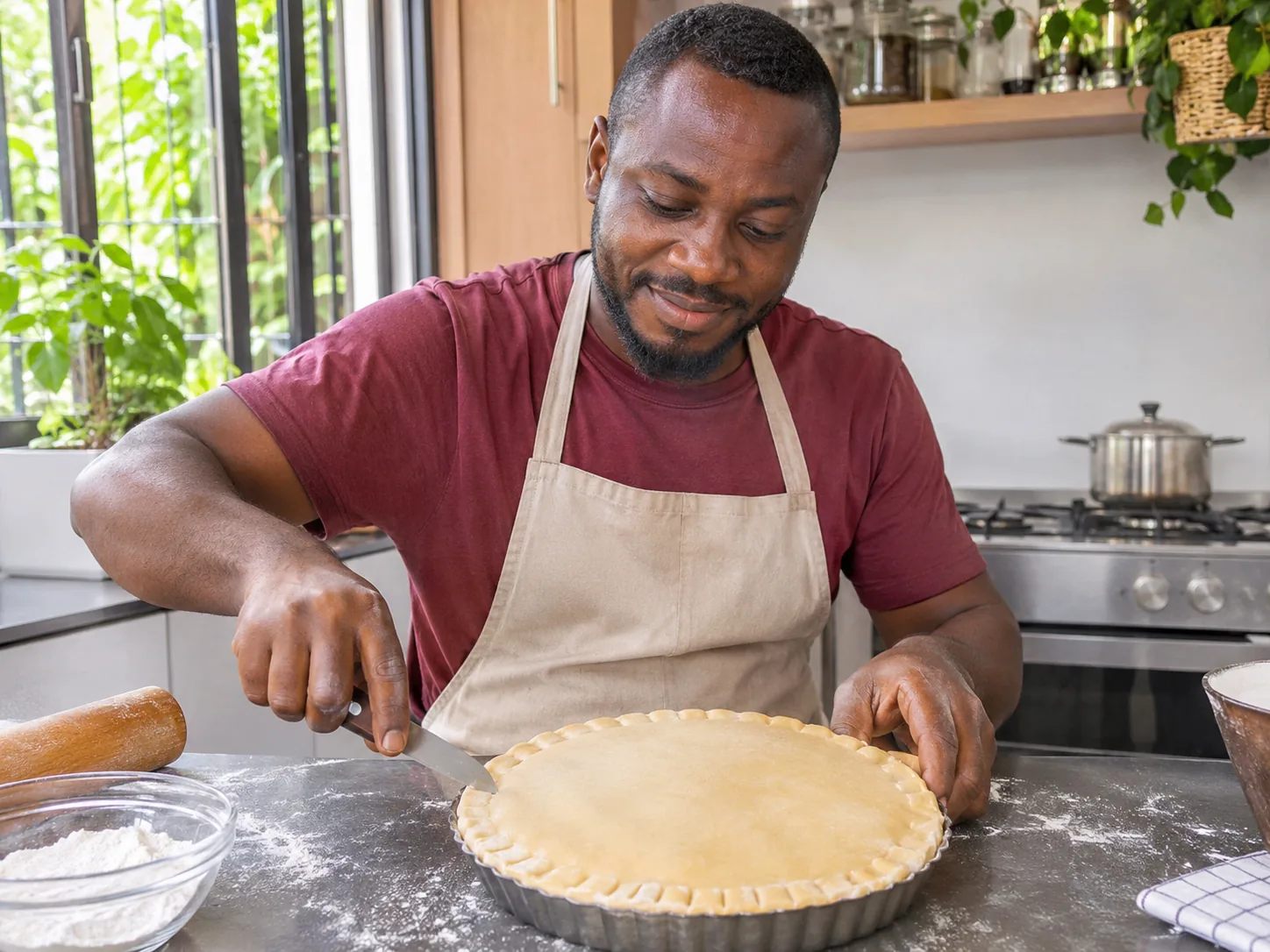
Chiquetage (crimping or notching) is a culinary technique that involves creating small, decorative, and regular incisions around the perimeter of a dough sheet, typically before it is baked. This gesture is primarily applied to doughs intended to encase a filling, such as savory pies (tourtes), pâtés en croûte, or certain tarts. The objective is not to cut deeply into the dough, but rather to mark its surface to form a serrated or scalloped pattern. Chiquetage differs from a simple sealing of edges, as it adds an aesthetic dimension and contributes to the visual cohesion of the finished piece. It is not a sealing technique that guarantees impermeability, but rather a finishing touch that can, in some cases, help retain the filling by complementing an already properly assembled border.
Desired Outcome
The primary desired outcome of chiquetage is a neat and professional aesthetic finish. The small, regular indentations create a visually appealing pattern that frames the preparation, giving it an artisanal and appetizing appearance. Beyond aesthetics, chiquetage can also contribute to the structural integrity of the dough edge during baking. The gesture alone does not stiffen dough that is too warm or poorly prepared. Success relies first on using suitable dough, proper sealing, and appropriate baking conditions. For puff pastry, a delicate chiquetage can, in theory, help direct the expansion of the layers at the edge, although its impact on the rise is secondary compared to the quality of the dough itself and the baking temperature. The ideal result is a clean, uniform border with distinct marks that are neither too deep nor too superficial.
Equipment and Product Selection
To chiqueter, the most common tool is the back of a small knife, such as a paring knife or a thin-bladed knife. The important thing is to use the non-cutting side to avoid slicing deeply into the dough. Specific crimping pliers (pinces à chiqueter) also exist; they offer a more ergonomic grip and allow for the creation of more complex or regular patterns with less effort. The choice of dough is crucial: fresh, pliable but not sticky dough is ideal. Shortcrust pastry (pâte brisée), sweet shortcrust pastry (pâte sablée), puff pastry (pâte feuilletée), or semi-puff pastry are well-suited for chiquetage. The dough should not be too cold, as it might break, nor too warm, as it would become soft and difficult to handle. The filling, if already present, must be well-contained and not overflowing, so as not to interfere with the gesture. It is preferable that the dough border is already sealed if the preparation is enclosed, to ensure a stable base before crimping.
Understanding the Gesture
The gesture of chiqueter is performed by holding the tool (back of the knife or pliers) perpendicularly or slightly angled relative to the edge of the dough. It involves applying light pressure to mark the dough without piercing it. The movement must be regular and repetitive, moving the tool at equal intervals along the border. For a knife, press the back of the blade against the edge, then withdraw it. Repeat this movement, advancing a small distance. With pliers, the movement is simpler: pinch the dough at regular intervals. The key is the consistency of pressure and spacing between each mark. The gesture should be fluid and precise, avoiding slipping or crushing the dough. It is important to work on well-sealed and stable dough for the gesture to be effective and the marks to be clean.
Observation Criteria
Several criteria allow for evaluating the success of chiquetage. Firstly, the regularity of the indentations: they must be of similar size and depth, and uniformly spaced. Secondly, the sharpness of the marks: the edges of the indentations should be clean and defined, without torn or stretched dough. Thirdly, the depth: the marks must be deep enough to be visible after baking, but not to the point of weakening the dough's structure or cutting into the filling. Fourthly, the integrity of the dough: chiquetage should not have crushed the layers of puff pastry, which would hinder its rise. Finally, the overall appearance: the border should present a harmonious and balanced pattern, contributing to the overall aesthetic of the preparation. Careful observation allows for correcting pressure or spacing in subsequent attempts.
Pedagogical Applications in Various African Cuisines
In a workshop dedicated to filled pastries, a small vegetable pie can be used to compare several border finishes. This pedagogical example can accompany work on turnovers found in different African cuisines, without asserting that French chiquetage is their traditional technique. A shortcrust or puff pastry offers a thick enough border to observe the marks. A very thin samosa wrapper, however, does not provide an equivalent support: attempting to reproduce the same indentations risks weakening it. The purpose of the exercise is precisely to recognize these limitations. One chooses a suitable and sufficiently cooled filling to preserve the dough, assembles the edges according to the type of preparation, then compares a discreet finish with an overly pronounced one. The vocabulary here serves to describe a gesture, not to impose a single presentation on the continent's cuisines.
Distinctions from Similar Gestures
It is important to distinguish chiquetage from culinary gestures that may seem similar but have different objectives. 'Sealing' (soudage) involves joining two edges of dough to enclose a preparation, often by pressing or moistening them. Chiquetage, on the other hand, occurs after sealing and provides a finish that can accompany the seal without replacing it. 'Scalloping' (festonnage) is a more general term referring to the creation of a festoon-shaped pattern (small waves or arcs) on an edge, which can include chiquetage, but also deeper cuts or the use of specific pastry wheels. 'Slashing' or 'scoring' (grigne) is an incision made on the surface of bread or leavened dough before baking, the purpose of which is to control the expansion of the crust and create a pattern. Unlike chiquetage, slashing is generally deeper and has a direct technical function on the dough's rise. Chiquetage is a superficial mark on the edge, whose effect on development depends on the dough and the gesture; it guarantees neither rise nor impermeability.
Errors and Corrections
Several common errors can occur during chiquetage. The first is pressing too hard, which cuts the dough instead of marking it, or crushes the layers of puff pastry, preventing it from rising properly. The correction involves reducing pressure and using the back of the tool more delicately. Another error is irregularity in the marks, either in size or spacing. To remedy this, take your time, mark visual guides if necessary, and practice to develop better coordination. If the dough is too dry, it can crack; if it is too wet, it can stick to the tool or stretch. Adjusting the dough's temperature or dusting it very lightly with flour can help. Finally, crimping a poorly sealed border can lead to the preparation opening. Ensuring the edges are well-sealed before starting chiquetage is essential. If egg wash is applied after chiquetage, be careful not to drown the edge of the dough, which would obscure the pattern.
Variations and Adaptation
Chiquetage offers possibilities for adaptation depending on the tool and the desired effect. With the back of a knife, one can vary the angle of attack to create more or less inclined marks, or alternate short and long marks for a more elaborate pattern. The use of crimping pliers allows for more complex patterns, such as repeated impressions of different shapes, depending on the shape of the pliers' jaws. Chiquetage can also be adapted to different types of dough: on shortcrust pastry, the marks can be slightly deeper than on puff pastry, where delicacy is key to preserving the layers. For individual preparations, such as small turnovers, a finer and more discreet chiquetage will be appropriate, while for a large pie, more pronounced marks can be considered. The important thing is to maintain the consistency of the pattern across the entire piece.
My Advice
For successful chiquetage, my advice is to always start with well-prepared dough at the right temperature. Dough that is too cold will be brittle, and dough that is too warm will be soft and difficult to work with. Ensure your border is perfectly sealed before you begin, especially if your preparation is filled. Use the back of your knife with light and constant pressure. Do not aim for speed, but for regularity. If you are a beginner, do a few trials on a scrap piece of dough to find the right pressure and ideal spacing. Remember that chiquetage is primarily an aesthetic touch: it should enhance your preparation without weakening it. Once the chiquetage is done, if you are egg washing your dough, apply the beaten egg sparingly on the edges so as not to obscure the delicate pattern you have created. It is the precision of the gesture that will make all the difference for an elegant and professional result.
Sources and further reading
2026-11-19