To stud (Clouter)
French
Editorial collection: RecettesAfricaines.com · Publication director: Alioune FALL.
Definition and Scope
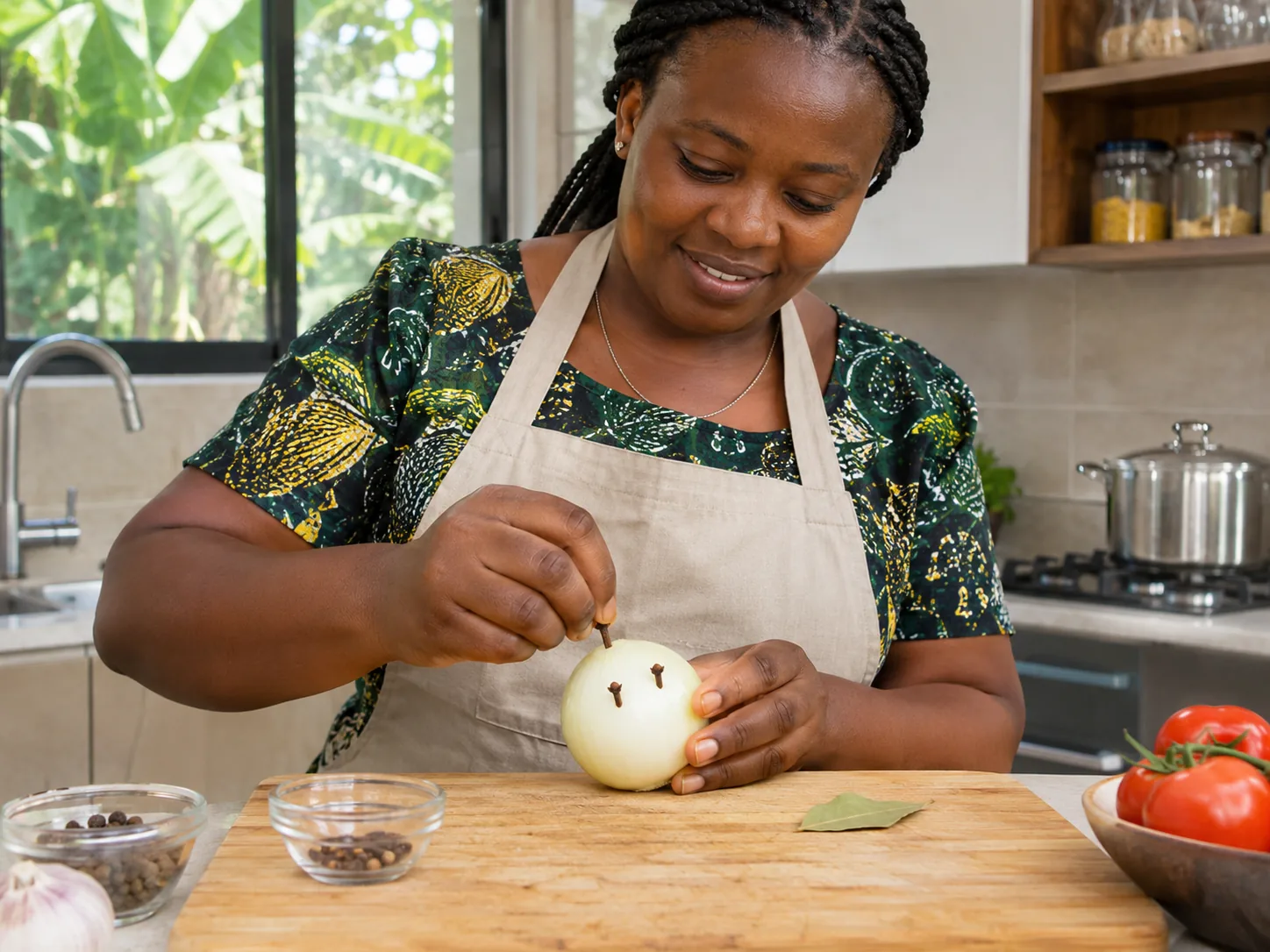
The term "clouter" in cooking refers to the action of inserting small aromatic elements, such as cloves, or other small food items depending on the preparation, into the surface of a main food item. This technique aims to perfume the food gradually and diffusely during its cooking, without the aromatics dispersing or becoming excessively dominant. The most emblematic example is an onion studded with cloves, often accompanied by a bay leaf, used to flavor broths, sauces, or soups. The gesture is precise and intentional, distinguishing studding from a simple addition of chopped or powdered aromatics. It is a method of controlled infusion, where flavors are released slowly and can be easily removed at the end of cooking.
Desired Outcome
The primary objective of studding is to impart a distinct and balanced aromatic note to a dish. In the case of a clove-studded onion, the goal is to infuse a spicy, slightly woody warmth without the clove becoming overwhelming. The flavor is gradually diffused into the cooking liquid or into the heart of the food, contributing to aromatic complexity without the texture or direct intensity of a chopped aromatic. This technique also allows for easy removal of the aromatics after infusion, thus preventing excessive bitterness or an overly pronounced flavor that could develop with prolonged exposure. The result is a background flavor, an aromatic base that supports other ingredients without masking them.
Equipment and Product Selection
For studding, the equipment is minimal: the food to be flavored and the aromatics themselves. The onion is the most common host for cloves, but one can also stud citrus fruits (oranges, lemons) for infusions or meats (roasts) with carrot or celery sticks. The choice of cloves is important: they should be whole, with their heads intact, a sign of freshness and aromatic power. Broken cloves are more difficult to insert and retrieve; their appearance alone does not allow for measuring their aromatic power. For bay leaf, a dry but flexible leaf is ideal. The main tool is the hand, which must be delicate to insert the aromatics without breaking them or damaging the food. For thicker aromatics, such as vegetable sticks, a small preliminary incision with the tip of a knife can facilitate insertion.
Understanding the Gesture
The gesture of studding is an action of perforation and insertion. It begins with the selection of the aromatic, for example, a clove. The index finger and thumb firmly grasp the clove by its stem, leaving the head free. The food to be studded, often a peeled onion, is held in the other hand or placed on a stable surface. The tip of the clove is positioned on the surface of the onion. Slight pressure is applied, and the clove is inserted gently but firmly. It is crucial not to force it to avoid breaking the clove or tearing the onion. The head of the clove must remain visible on the surface, not only for aesthetic reasons but also to facilitate its subsequent removal. For bay leaf, it is often held in place by one or two cloves that pierce it and anchor into the onion.
Observation Criteria
Several criteria allow for evaluating the proper execution of the gesture. Firstly, the integrity of the aromatics: cloves must be inserted without being broken, their heads clearly visible. Secondly, the regularity of spacing: if several cloves are used, they must be distributed homogeneously over the surface of the food for uniform flavor diffusion. Thirdly, the depth of insertion: cloves must be inserted deeply enough to hold firmly, but not too deeply so as not to disappear entirely. Fourthly, the absence of excessive damage to the main food item: the onion should not be torn or crumble around the insertion points. Finally, dosage is crucial: an excess of cloves can make the dish bitter or too powerful. Respecting these points ensures optimal infusion and a balanced taste result.
Educational Applications in Various African Cuisines
While studding is a universal culinary technique, its application can be pedagogically illustrated in the context of various African cuisines, where spices play a central role. For example, to teach flavor balance in a basic broth for a rice or grain dish, one could demonstrate how to stud an onion with cloves and a bay leaf. This broth would then be used to cook rice or fonio, bringing an aromatic depth without the clove dominating. Another pedagogical example could be the flavoring of a marinade for poultry or fish. Here, half-lemons or oranges studded with cloves could be added to the marinade to infuse citrus and spice notes, illustrating how flavors can be extracted and controlled. These examples are not attested traditional recipes, but didactic applications to understand the technique and its infusion principles.
Distinctions from Similar Gestures
It is essential to distinguish studding from other culinary techniques that involve the insertion or addition of aromatics. "Larding" consists of inserting strips of fat (lard) into lean meat to add fat and flavor, using specific larding needles. "Barding" involves wrapping a piece of meat or poultry in a slice of bacon or pork fat to add surface fat and moderate direct heat exposure, without rehydrating the flesh. "Contiser" is the action of inserting small pieces of truffle or other aromatics under the skin of poultry or fish. Finally, simple "chopping of aromatics" consists of finely cutting herbs or spices to incorporate them directly into the dish, without the aspect of controlled infusion and easy removal characteristic of studding. The gesture of studding is characterized by the use of small, whole elements, superficially inserted, and whose removal is particularly useful in the case of a clove-studded onion, without this being the rule for all uses of the verb.
Errors and Corrections
Several errors can occur during the gesture. The most common is an excess of cloves, which can make the dish bitter or too spicy. The correction is simple: use a controlled dosage, taking into account the volume of the preparation, the duration of infusion, and the desired intensity, without a universal number per onion. Another error is breaking the cloves during insertion, which makes their removal difficult and can leave small fragments in the liquid. To correct this, cloves should be inserted gently, twisting slightly if necessary, and ensuring the head is clearly visible. If the onion is too soft or crumbles, it may be useful to choose a firmer onion or make very small preliminary incisions. Finally, forgetting to remove the studded aromatics before serving is a common mistake; it is therefore important to count them before and after cooking to ensure they have all been removed.
Variations and Adaptation
Although the clove-studded onion is the classic example, the studding technique can be adapted. Citrus fruits (oranges, lemons) can be studded with cloves for infusions in hot beverages or marinades. Vegetable sticks (carrots, celery) can be studded into meat roasts to flavor them from the inside. In some preparations, small sprigs of rosemary or thyme can be inserted into potatoes or root vegetables before roasting. The idea is always to introduce an aroma in a controlled manner and to be able to remove it. The size and shape of the aromatic to be studded may vary, but the principle of gentle insertion and gradual diffusion remains the same. This adaptability makes studding useful in a wide variety of culinary contexts.
My Advice
To master studding, the key is delicacy and precision. Think about the balance of flavors: clove is powerful, so less is often more. When inserting a clove, visualize the head as a small flag that will remind you to remove it. If you are using an onion for a broth, do not hesitate to cut it in half before studding it; this exposes more surface for infusion while facilitating the insertion of cloves and bay leaf. And above all, never underestimate the impact of a well-constructed aromatic base. A studded onion, even a simple one, can transform an ordinary dish into a richer and deeper culinary experience. It is a small gesture that has a great effect on the aromatic complexity of your preparations.
Sources and further reading
www.hotellerie-restauration.ac-versailles.fr
2026-11-19