Cook down until soft
French culinary vocabulary; general cooking applications
Editorial collection: RecettesAfricaines.com · Publication director: Alioune FALL.
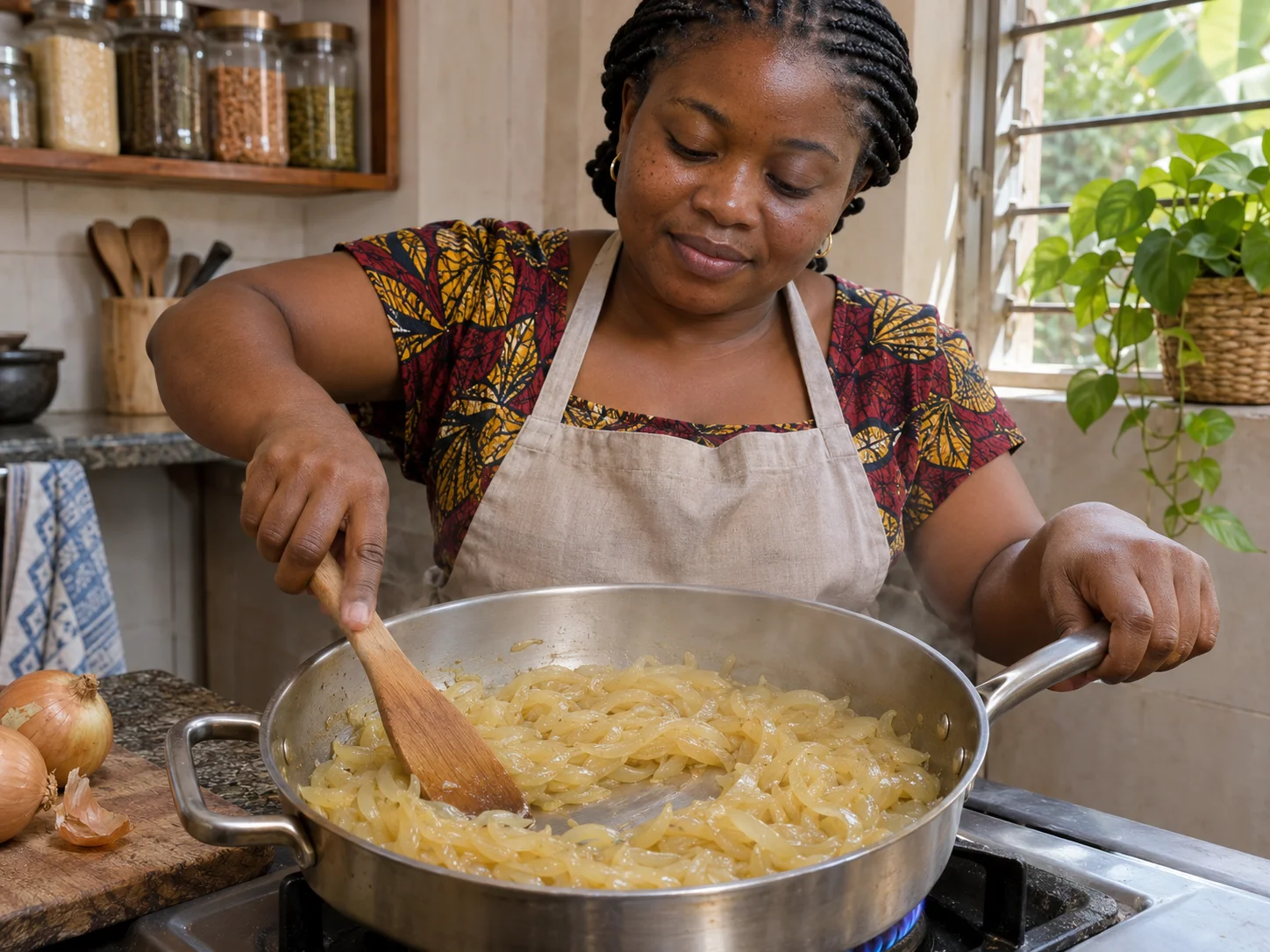
A texture to achieve, not the name of a dish
The French verb compoter means to cook food gently until its pieces become very tender and come together into a soft mass. The word suggests the consistency of a fruit compote, but it also applies to onions, peppers and other savoury preparations. It specifies neither a dark brown colour nor a fixed quantity of sugar. The important change is in the pieces themselves: they give way readily under a spatula, and any remaining juice coats the flesh rather than forming a separate broth. Strips can still be visible even when they no longer have their initial crunch. If a recipe asks you to stop while the food is meltingly tender, there is no need to continue until it is perfectly smooth. This kitchen verb is best understood as a description of the result to look for, not a cooking time or a recipe to reproduce.
What the sources establish and what they do not
The Académie du Goût emphasises prolonged gentle cooking and the resulting consistency. The teaching glossary of the Versailles education authority mentions onions and peppers, two examples showing why the verb is not limited to desserts. The INRAE–AgroParisTech glossary uses the more technical term délitescence, which here describes the way a piece loses its cohesion as it softens. These references document a term in French culinary vocabulary. They do not establish when the method was invented, attribute it to any particular African country, or imply that every form of gentle cooking has this name. In a recipe, laisser compoter describes what is meant to happen in the pan; compotée can describe the mixture that comes out of it. Explaining the cooking process does not require renaming the result or replacing the local name of a preparation.
Read the ingredient before choosing the heat
Sliced onions, peppers and ripe fruits do not soften in the same way. The onion loses volume and becomes pliable; the strips settle over one another and sometimes retain their outlines. A pepper can become tender while its skin remains noticeable. When that skin interferes with the texture you want, cooking it indefinitely is not necessarily the answer: preparation matters as much as time. Very ripe fruit sometimes releases enough juice to start without much added liquid; firmer fruit may need a moister beginning. Cutting to a reasonably uniform size reduces the chance that large pieces remain firm while small pieces have already fallen apart. Deliberately mixing sizes is possible, but then you are choosing a particular texture in advance rather than treating every irregularity as a mistake.
Two stages, two sets of signals
At first the ingredient must soften without hardening or scorching against the bottom. A steady pan, moderate heat and, if the mixture dries out too early, a little liquid help keep the cooking environment moist. A lid can retain that moisture, but it is not compulsory. Later, once the pieces are tender, taking the lid off can allow excess water to escape. Stir just enough to bring food from the edges back toward the middle and check the bottom. A drier sizzle, small areas that darken quickly or residue sticking to the utensil are reasons to lower the heat and look more closely. Conversely, if liquid runs freely when you tilt the spoon and the flesh is still firm, the texture has not yet developed. Once the pieces are as tender as you want, you can reduce the juice separately if necessary.
Recognise the stopping point
Take out a small portion and let it cool slightly so you can judge what you will actually eat. Press a piece between the spoon and a saucer: it should give way without springing back or resisting at the centre. With onions, a spoon should lift flexible strips that fall back together; with fruit, recognisable pieces can remain among some flesh that has broken down. Watch the trail the spatula leaves in the pan. If a stream of juice immediately fills it, the preparation may be too runny for a filling. If the trail is dry and the mixture catches, it has gone too far for a sauce base. This is not a universal measurement: a spoonful to serve with rice may be moister than a pastry filling. Choose a texture for the way you will serve it rather than for how it looks in a photograph.
Distinguish neighbouring techniques
Sweating mainly draws out moisture and softens an ingredient at the beginning of cooking. It can precede cooking down, but the two stages are not the same. Reducing primarily means losing water and concentrating a liquid: juice on its own can reduce without any pieces undergoing a structural change. Caramelising concerns changes in heated sugar and, in everyday kitchen language, deliberate browning; onions cooked down gently can stay pale gold. Blending is mechanical: firm food can become fine in a blender without having reached the tenderness produced by cooking. Finally, a compotée for serving should not be confused with a preserved food. Tenderness establishes neither room-temperature stability nor a preservation treatment. The distinctions help you decide what to do when a preparation is wrong: concentrating excessive juice is not the same correction as giving firm pieces more cooking time.
Adapt to the use without treating cuisines as interchangeable
Onions cooked down can remain soft enough to accompany grains or form the base of a dish, while gently cooked fruit can be served by the spoonful. A tomato sauce cooked until the flesh breaks down illustrates a related texture; a sauce that has merely been thickened or strained is not the same. The date and tamarind compotée from Chad and the Egyptian Lahma bel basal on RecettesAfricaines offer two distinct contexts to examine. The comparison implies neither a shared origin nor a single procedure. In sweet preparations, see how tender the flesh becomes before deciding whether added sweetness would be useful; in savoury ones, taste after the mixture has reduced before adjusting salt. A concentrated condiment may seem stronger simply because its volume has decreased, even though nothing has been added.
My advice: save the texture, not the timer
Watch evaporation so the bottom does not catch. If the pieces are still firm while the edges are drying, slow down, stir gently and restore just enough moisture to keep cooking. If one part has scorched, do not scrape it into the mixture: transfer what can be saved without disturbing the bottom and taste it before proceeding. If the filling is too runny but already tender, briefly draining it or reducing some juice separately can preserve distinct pieces. To learn the technique, take two samples at different points and compare them while warm on the same plate. Next time it will be easier to recognise the right texture even if the fruit, the pan or the heat source is different. For a fair comparison, put the same amount on each saucer and press the pieces with the same spoon.
Sources and further reading
Accessed on 20 November 2026.
INRAE – AgroParisTech · Académie du Goût · Académie de Versailles — Lexique culinaire
Two verified recipe references : Date and tamarind compote · Lahma bel basal