Scrape a bowl
French culinary vocabulary; general cooking applications
Editorial collection: RecettesAfricaines.com · Publication director: Alioune FALL.
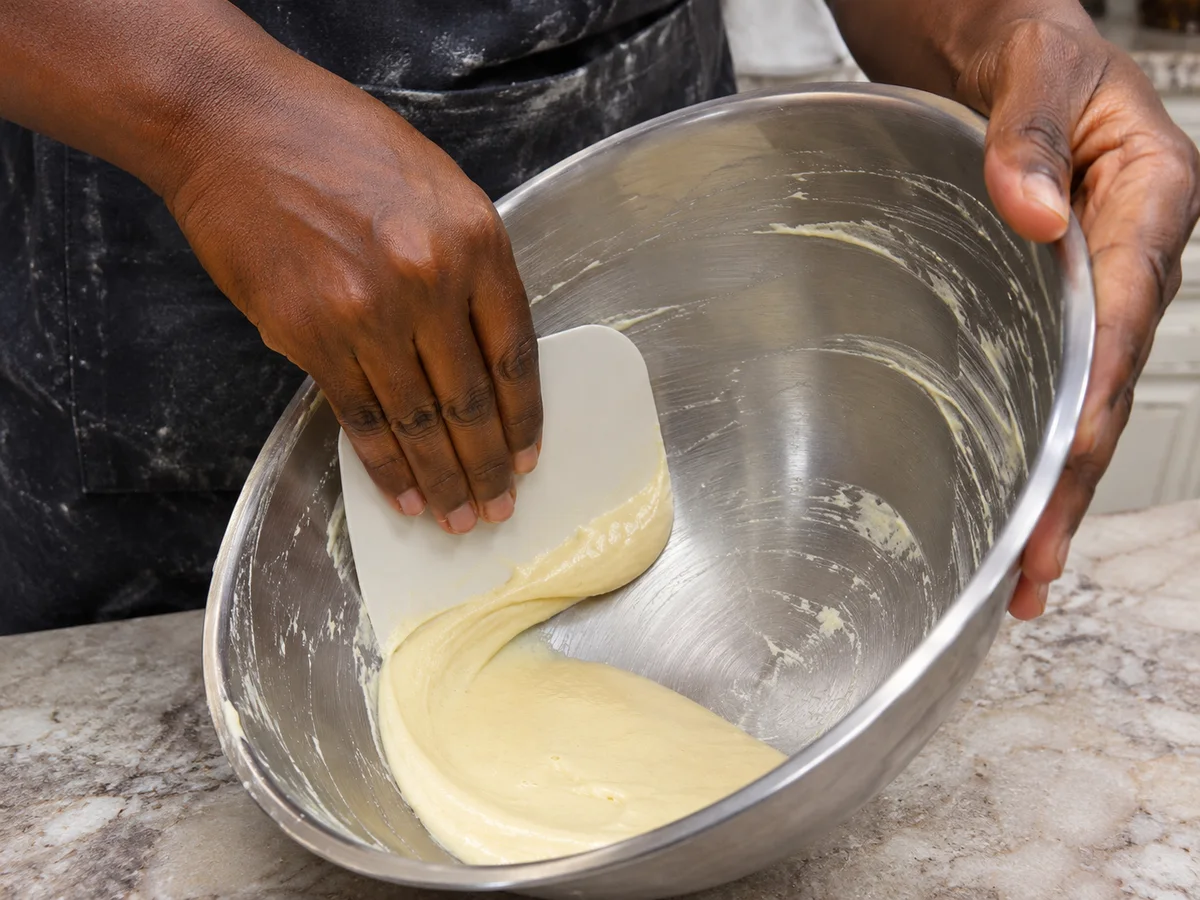
Recovering what the bowl holds back
In French pastry work, corner means scraping the inside and bottom of a container to recover almost all of the mixture. The tool is often a flexible, handleless bowl scraper known in French as a corne, held close to the wall of the bowl. The gesture comes after mixing, resting or transferring some of a mixture into a piping bag, when a share of the preparation still clings to the container. What you want to recover is not necessarily a crust. It is more often a film of batter or cream that can rejoin the rest without impairing it. Do not confuse the French verb with the English word for an angle. The end of some scrapers helps you reach an angle, but much of the work happens on rounded surfaces, where there is no corner at all.
The meaning in pastry training
The pastry terminology handbook available through Quebec's training resources describes scraping containers thoroughly so that as little of the ingredients as possible is left behind. The training glossary shared by the regional education portal of Murcia associates the verb with recovering dough, batter or cream. It also notes the advantage of not leaving residue to dry on the sides. These sources document a working instruction and a tool name in French. They do not say that every pastry cook uses the word or that the movement belongs to a particular national tradition. A kitchen may simply speak of scraping the bowl or recovering the batter. The verb belongs in a dictionary because it distinguishes recovering that material from mixing the whole batch or finishing the surface of a cake.
Choose an edge that follows the bowl
The scraper needs to touch a useful width of the wall without getting caught. A curved edge follows the inside of a rounded bowl; a straight edge can lift material more cleanly from a flat tray. A deep, narrow bowl leaves little room for the hand. A flexible spatula with a handle may then be easier to use, though it is not called a corne. On the broad curve of a rounded mixing bowl, on the other hand, a bowl scraper lets you keep your fingers close to the working edge and feel where it loses contact. Look at the trace it leaves. A long stripe of batter still behind the tool can mean that the angle is wrong or the edge too rigid. Pressing harder is not always the answer. Try tilting the bowl differently or using another side of the scraper to distribute the pressure.
Gather the mixture rather than spread it around
With a stable bowl, the hand holding it can turn it to bring the next strip of batter in front of the scraper. Follow the curve and bring the mixture toward the same place each time. A last pass is often enough to gather the loosened material into a small mound rather than leaving a new streak behind every stroke. For a fluid batter, letting most of it flow into the receiving bowl first spares you having to push the entire mass with the scraper. With a thick dough, the recovered portion sometimes sticks to the utensil more than to the bowl. You can deposit it against the edge of the rest of the mixture or loosen it with a second suitable utensil. The purpose is to recover what is usable, not to scrub indefinitely until every surface is dry.
During mixing or at the point of transfer
When using a mixer, the centre, the bottom and the sides do not always receive the same amount of work. Bringing the neglected areas back into the mass helps make the finished mixture more even. Stop the mixer before taking a tool close to its attachments. At the point of transfer the aim changes: you want the useful portion to follow the rest without prolonged agitation. When a mixture is foamy, vigorous back-and-forth movements may deflate what you were only trying to move. A cream that has already been worked can also lose its smooth appearance if a dried film is scraped back in without care. Look at what you are recovering instead of stirring every trace indiscriminately into the finished mixture. The wording may differ from one station to another, but deciding which residue to recover and which to leave behind still depends on the condition of the material.
Scraping, folding and spreading are related but different
Folding a dough can mean folding it back over itself to affect its structure. The side of the bowl need not be involved. Spreading has the opposite intention to gathering: it distributes a material across a surface. Smoothing aims chiefly to even out the surface profile and does not necessarily empty a container. The same scraper may serve for several of these tasks, which is why an image of the utensil lying on a table does not explain the verb. To illustrate corner, show where the edge of the utensil meets the bowl and where it takes the batter. The clean track behind it and the material gathered below it explain more than a finished pastry. The word describes the movement and its immediate result, not the dessert being prepared.
My tip: make one useful pass, then know when to stop
If the batter is to be divided among several tins, gather it all in the portioning bowl first. Scraping what remains into the final tin alone can skew the comparison between portions, particularly when the sides of the bowl held a thicker part of the mixture. Before transferring, bring the containers close together and decide which way the recovered material will flow. Check that the bowl does not slip under modest pressure and that the scraper's edge is neither damaged nor too sharp for the vessel. Try one strip first. If the batter leaves the wall without being pushed back into another spot, keep that angle. In recipes, passing a spoon through a bowl does not automatically illustrate this technique. An instruction to recover all of the mixture during or after transfer can, even without a specialist term. Translate that specific action using natural wording rather than borrowing a term that is ambiguous in the target language.
A practical limit
Recover the usable mixture, then stop. A nearly empty bowl does not need to become perfectly dry before the transfer is complete. Prolonged scraping can delay the next stage without adding a meaningful quantity.
Sources and further reading
Terminologie de la pâtisserie — CORNER · Portail Educarm — CORNE et CORNER