Aromatic poaching stock
French culinary vocabulary; general cooking applications
Editorial collection: RecettesAfricaines.com · Publication director: Alioune FALL.
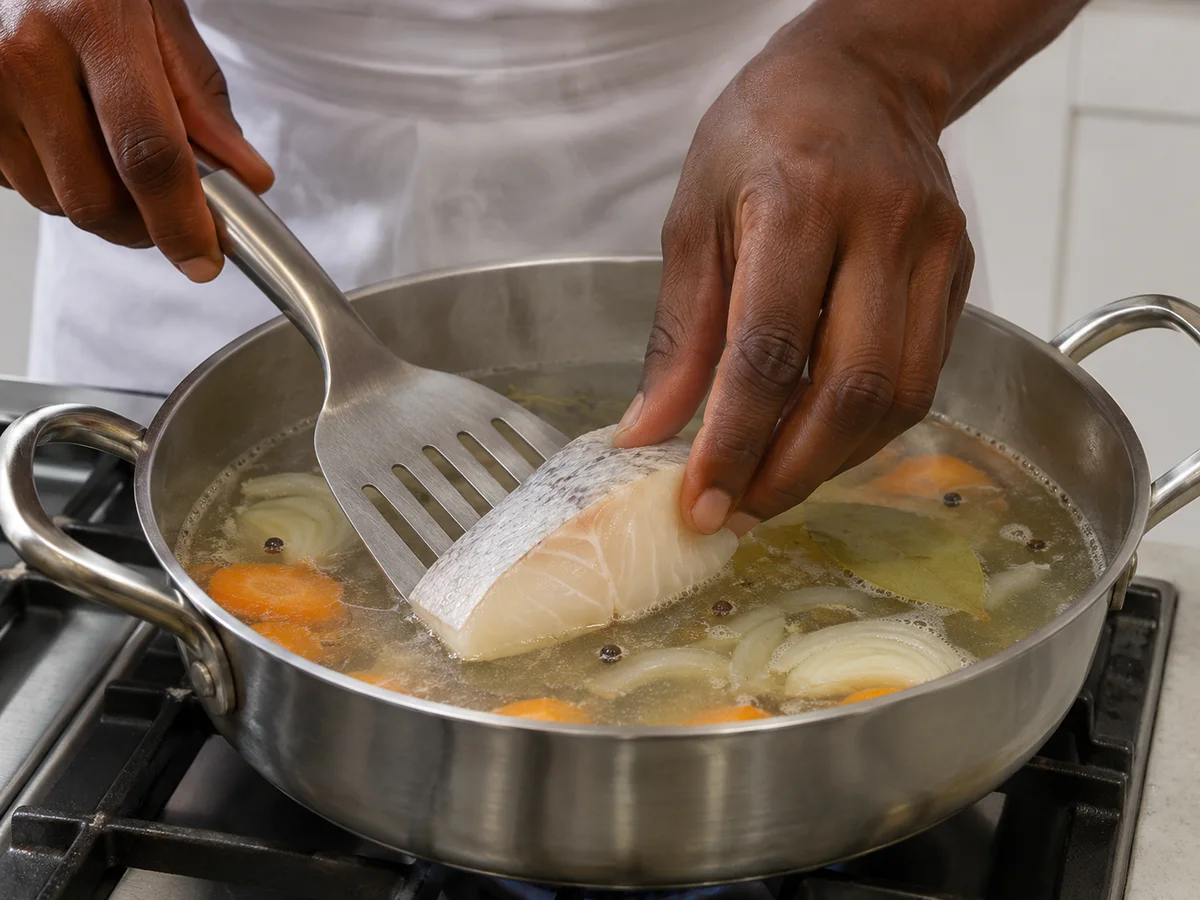
A cooking medium, not necessarily a soup
Court-bouillon is an aromatic liquid used to cook an ingredient, most often fish or shellfish. In this sense, the liquid itself does not determine what is served: it is the medium in which the piece cooks. Once you remove the fish, you may serve none of the liquid or use only the part called for in the recipe. Adding aromatics does not automatically turn the liquid into a sauce. It helps to distinguish what gives flavour during cooking from what is intended to accompany the flesh on the plate. In some texts, the French phrase au court-bouillon describes a way of preparing fish. Depending on the sentence, the term can therefore refer to the liquid, the operation or its result.
Dictionaries attest the word, not an inventor
Larousse describes an aromatic liquid used to cook fish or shellfish, and gives the French plural courts-bouillons, with both elements marked for number. The first edition of the Académie française dictionary attests the form court-bouillon and describes a way of preparing fish or meat. The eighth edition gives a more concrete description involving water and aromatic ingredients. The teaching material from the École des métiers in Dijon distinguishes several versions and explains how they are chosen for the piece being cooked. Together these sources show that the emphasis can shift between a method of preparation and the medium used. They do not date the invention of cooking in a flavoured liquid. Attestation of a French expression does not establish the birth date of a movement shared by different cooking traditions.
How assertive should the liquid be?
The aromatics do not have to overwhelm the fish. Vegetables and herbs can lend a recognisable fragrance without turning the liquid into a dominant seasoning. A base whose aromatics are distinct individually may suit a more strongly flavoured piece; a restrained fragrance makes a delicate flesh easier to recognise. A recipe may include an acidic ingredient, but you learn whether it is present, what it is and how it affects flavour from the instructions, not from the name court-bouillon alone. The same applies to salt. A fresh fillet and a fish that is already salted call for different decisions. If the liquid will later become part of a sauce, the initial seasoning matters all the more: reducing an already salty liquid will not make it taste milder. Know in advance whether you intend to keep any of the liquid after cooking.
Why the size of the piece changes the movement
A thick steak, a thin portion and a whole fish do not occupy a pan in the same way. A piece too large for the base is hard to lower without bending it. Several portions crowded together leave little room for the utensil that must lift them. Choose the vessel not just for the volume of liquid it holds but also for whether you can move the flesh once at the right moment. The broad edge of a fish slice or skimmer can support a portion that tends to separate along its flakes. Gripping it at one corner can instead break it at its thinnest point. The liquid does not need to boil vigorously to be called court-bouillon. When poaching, a restrained movement is often useful: you need to be able to watch the piece without large bubbles pushing it around.
Starting cold or introducing the fish to a hot liquid
The teaching materials from Dijon describe different starting points according to the use. That helps you read a recipe without turning one option into a universal rule. If the fish starts cooking in a cold liquid, the rise in temperature is part of the operation. You cannot compare the time given there directly with a text that starts counting only after immersion. In already hot liquid, introducing a piece also changes the temperature, and the number of portions affects what happens in the pan. The illustration shows one moment—lowering a piece into an aromatic liquid—not every possible starting point. What matters in learning the movement is the recipe's distinction between heating, simmering and poaching, the thickness of the piece, and how the piece is meant to leave the pan.
Compare with fish stock, broth for serving and steaming
A fish stock, or fumet, is prepared to obtain a liquid that will provide flavour, often to another preparation. The primary role of a court-bouillon is to cook the piece that will be eaten. A serving broth, by contrast, is intended to reach the diner even if it has also cooked an ingredient. These uses can overlap. It is clearest to name the liquid's role at each stage. Steaming is a further distinction: the piece does not sit in the liquid generating the steam. Finally, if a regional dish uses court-bouillon in its title, do not rewrite that dish on the basis of a professional glossary. Read its source to find out whether the local term refers to fish served in sauce, to the cooking liquid or to the dish as a whole.
My tip: notice when the liquid is no longer needed
Before starting, find two instructions in the recipe: how the food goes into the liquid and what to do with the liquid after the piece is cooked. They often distinguish a poaching technique from a sauce made from the cooking liquid or a dish served in its broth. Set out a receiving vessel and a wide utensil before lifting a fragile piece; improvisation at that point can leave you holding it too long against the rim. If you have only a title, do not infer a cooking time, an acidic ingredient or a type of fish. For a dictionary link, look for a recipe whose directions clarify the role of the liquid rather than a plate that happens to have herbs or a slice of lemon. That criterion makes the entry more useful to someone who wants to recognise the gesture in another kitchen.
Read the source's particular distinction
The Dijon training document distinguishes court-bouillon used for cooking from a presentation called à nage, where the liquid and its carefully prepared garnish form part of what is served. Preserve that distinction when referring to this document. It should not be presented as recommending that every poaching liquid becomes a sauce. Where a different recipe explicitly reuses a liquid, explain that recipe's sequence separately and identify its purpose. A dictionary entry can compare those choices without erasing the differences between their authors' instructions.
Sources and further reading
Larousse — sens du liquide et pluriel · Académie française, 1re édition — attestation lexicale, non date d’invention · École des métiers de Dijon — variantes pédagogiques