Decant
French culinary vocabulary; general cooking applications
Editorial collection: RecettesAfricaines.com · Publication director: Alioune FALL.
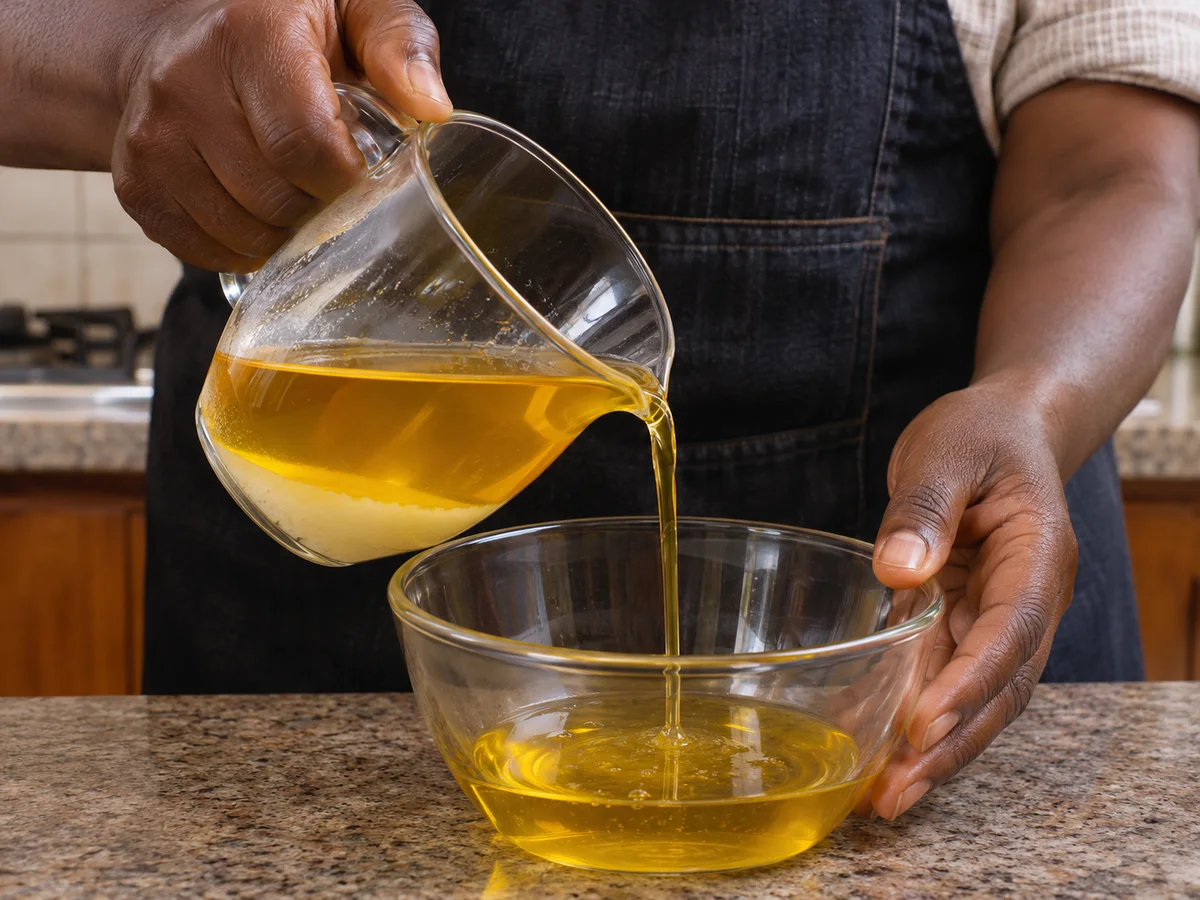
Leave the sediment while moving the liquid
A cloudy liquid can become clearer when particles settle at the bottom of its container. In the culinary sense considered here, decanting means subsequently pouring off the part you want to collect while leaving that sediment behind. Waiting for particles to settle and transferring the liquid are separate moments. Stirring immediately before pouring puts some of the material you wanted to separate back into suspension. If nothing has been transferred, settling may have occurred without the complete decanting action. This is not the only way to make liquid clearer, and it does not guarantee perfect clarity. It is a useful choice when a visible separation has already formed and the intended result does not demand collecting every last drop. The starting question is which part you want, not how thoroughly you can empty the original container.
Everyday and professional uses
The New Brunswick introduction to professional cooking describes transferring liquid without its deposited solids, including wine among its examples. It also records a professional use concerning separation of sauce and aromatic garnish in a sauté preparation. Nicolas Mercier's glossary includes clarified butter, where the yellow phase is poured off while material collected beneath it is left behind. These references allow the uses to be explained without treating every context as identical. Depending on the sentence, the verb can identify visible separation in a liquid or a stage when pieces or garnish are removed from their cooking medium. None of these definitions establishes where the action originated. Its principle can be recognised in a kitchen that uses another word, provided the comparison documents the movement and result. A shared French label cannot replace that observation or establish a common historical origin by itself.
Read the layers before approaching the lip
Before lifting the vessel, identify where the material to keep is located. It may sit above fine sediment, as clear liquid above deposited particles. In other cases, two layers are visible but their boundary is less distinct. The illustration shows yellow butter being poured above a pale deposit, rather than a filtered drink or a whisked sauce. A transparent container makes the deposit directly visible. In an opaque one, you depend more on the surface and the first visible change in the outgoing stream. A clean pouring edge helps. A heavy vessel that must be lifted in jerks makes controlled pouring harder. The receiving vessel should be stable and large enough that you can watch the source container without worrying that the second one will overflow. Preparing the destination is part of preparing the separation, rather than an afterthought once the liquid is already moving.
Pour steadily and choose when to stop
With the sediment settled, tilt the container progressively to create a steady stream. Sudden tilting, repeated stops or repeatedly righting the vessel can disturb the boundary that formed. The flow needs to be manageable: not so hesitant that holding the vessel becomes unstable, and not so fast that you cannot stop at the useful moment. The last part of the transfer deserves particular attention. While the outgoing liquid remains clear, maintain the angle or increase it gradually. When a cloud approaches the lip or the layer boundary becomes indistinct, leaving a little liquid behind is often preferable to carrying sediment into the whole batch. An uncertain final fraction can be collected separately and inspected. Restoring a separation is harder once both fractions have been mixed in the receiving bowl. Choosing a stopping point is therefore central to the technique rather than evidence of wasteful handling.
What is gained and what may deliberately remain
The result may feel more uniform in the mouth because fewer settled particles are present. Sometimes, however, the sediment is part of the intended preparation. With a pulpy drink, mixing before serving and pouring only the clearer portion give different textures and potentially different flavour balances. Sediment does not by itself prove that a drink has failed. Its absence does not prove superior quality or longer storage life. In reading a recipe, a reference to sediment therefore does not establish that the cook decants. Look for pouring the upper fraction without stirring, deliberately putting pulp back into suspension, or using an actual filter. Those details provide a useful dictionary connection. The colour of the drink in a glass, or a photograph taken after serving, cannot reliably distinguish these different choices and should not be treated as evidence of the preparation sequence.
Decanting is not filtering, skimming or emulsifying
Filtering passes liquid through a material that retains something unwanted. Its result can resemble decanting, but the action differs: a filter holds matter back in one case, while the other exploits where that matter has already gathered. Removing fat has a different objective again. Lifting floating fat from a liquid is not the same movement as pouring a liquid above sediment. Emulsifying aims in the opposite direction, dispersing phases rather than isolating them. Several actions may be combined in one preparation, for example separating visible sediment first and then filtering smaller particles. Their successive use does not make their names interchangeable. When explaining a recipe, name the action at each stage and identify what is retained. That is more useful than applying one broad word to every operation that produces a clearer or smoother-looking liquid.
My advice: decide what must remain before pouring
Find what the recipe asks you to keep and what it asks you to leave. Material at the bottom is not automatically rubbish; it may simply be unused at this particular stage. For a hot preparation, choose a suitable receiving vessel and position it before starting. Do not rely on an improvised strainer to rescue sediment that is already entering the whole batch. Compare the two containers under the same light to identify what was collected and what remained. A small residue in the original vessel can indicate that separation occurred, but cannot establish purity. Finally, accept a dictionary example only if the recipe describes selective pouring or clearly uses the stated professional sense. Words such as clear, filtered or rested in a title are insufficient. The practical evidence lies in what moves, what stays behind and what the cook does next.
A reading and observation exercise
Before a practical comparison, label the receiving containers. Collect the clear fraction in one and any uncertain final fraction separately. Looking at them under the same light shows what the stopping decision changed. It does not measure purity or establish a longer storage life, and it avoids mixing a doubtful last pour into the whole batch.
Sources and further reading
Nouveau-Brunswick — dépôt, second emploi en cuisine · Nicolas Mercier — exemple du beurre