Remove the sprout
French culinary vocabulary; general cooking applications
Editorial collection: RecettesAfricaines.com · Publication director: Alioune FALL.
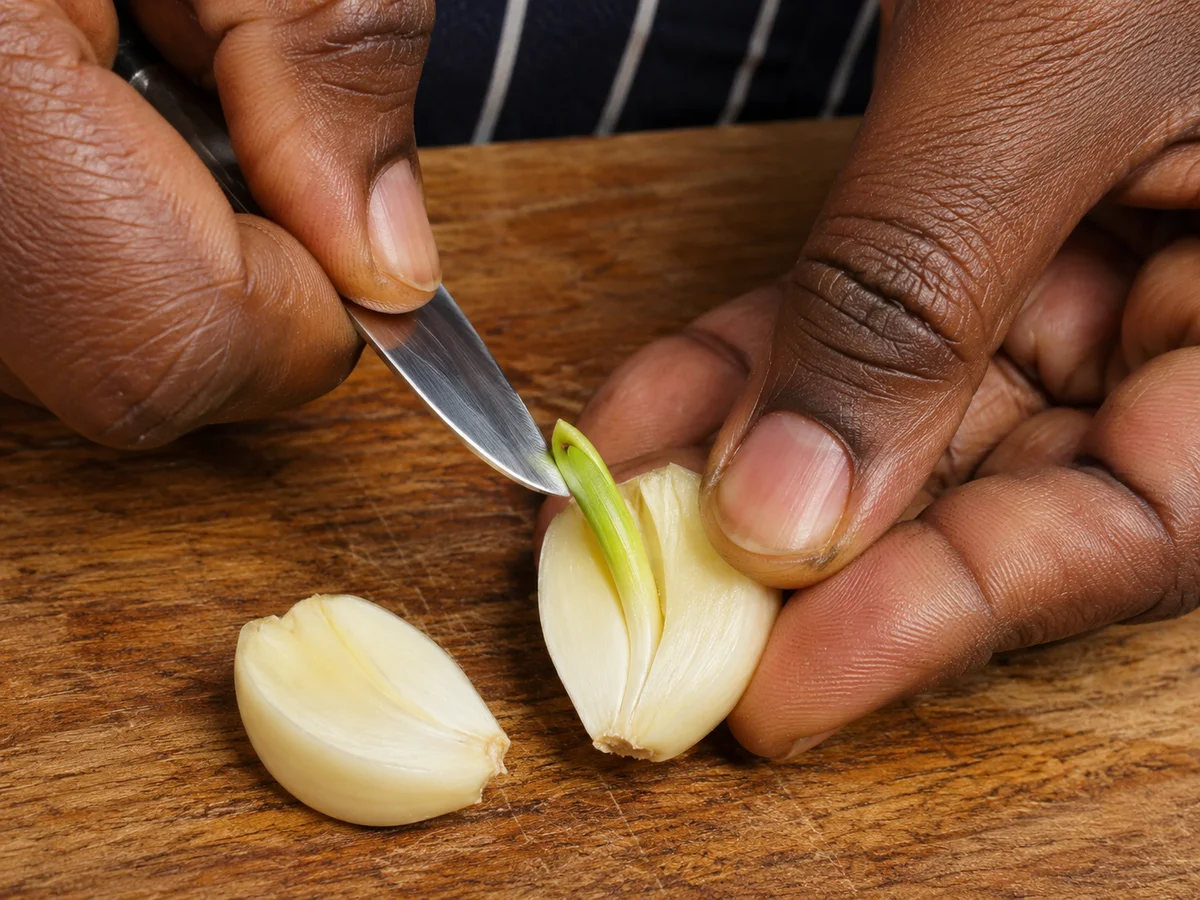
What the instruction asks you to remove
Removing the shoot from a garlic clove means taking out the central developing growth. It is not the same as peeling away the dry outer skin. A perfectly peeled clove can still contain its shoot. Nor does the instruction specify the size to which the remaining garlic should be cut. A recipe can ask for the shoot to be removed before the clove is chopped, pounded or left in halves. This sequence has a purpose: first decide which part is retained, then give that retained part the shape or texture needed. The shoot can be especially visible when green, but lack of a bright green colour does not establish that someone has already removed it. Its position in the centre of the opened clove is a better guide than the colour of the whole clove viewed from outside.
The scope established by a culinary glossary
The Académie du Goût entry on removing the garlic shoot describes splitting the clove lengthways and extracting the growth visible in the middle. That is the sense used here and the action shown in the illustration. The French verb dégermer has uses outside this preparation, as other dictionary examples indicate, but those uses are not interchangeable instructions. A definition concerning a garlic clove must not be turned into advice about using a sprouted potato. In culinary writing the named ingredient should remain attached to the action. These references document vocabulary and a movement, rather than its geographical origin or a medical effect. Similar practices can exist elsewhere without needing a borrowed name or a shared invention date. Explaining the particular part removed is enough to make the term useful while avoiding an unsupported historical or physiological claim.
Locate the centre before cutting further
A clove often has a pointed end and a side that was attached to the base of the garlic head. Opening it along its length generally makes the centre easier to see than cutting across it. What matters is exposing the central line, not producing two halves of exactly equal weight. Crushing a clove may make the skin easy to release, but once the flesh is flattened the part you wanted to remove can become less distinct. If the recipe requires recognising the shoot, open and inspect the clove before pounding it. A small, narrow clove and a large one provide different support for the hand. There is no advantage in trying to cut a tiny piece held between your fingers when it can be rested on a stable board and examined carefully before the next action.
Lift the shoot without excavating the clove
With the clove split, the tip of a small knife can help lift the central growth without cutting away a broad strip of flesh. If the shoot releases easily, very little movement is needed. If it breaks, examine the cut face again and take only the remaining piece rather than digging blindly. The operation does not require the clove to become perfectly smooth like a moulded object. It aims simply to remove the identifiable central part. The illustration shows the tip lifting a green shoot from one half, with the other half nearby. It does not show peeling, minced garlic or an intact head ready for roasting. This distinction matters because a photograph of white cloves would not show the reader where to look or establish which part had actually been separated and set aside.
When this detail matters and when another choice matters more
In a preparation where garlic remains raw and visible, a small green fragment or irregular texture can matter more to the intended result than in long cooking with many other ingredients. Conversely, shoot removal is not a universal way to correct flavour. The amount of garlic, how finely it is cut and when it enters the preparation are separate choices. If a dish tastes too strongly of garlic, do not assume that removing the shoot alone would fix it. Read the method and the balance of ingredients. The action also does not justify claiming that a dish will suit somebody who has difficulty tolerating an ingredient. This entry describes a culinary decision. It does not replace the preferences of the people eating or advice relevant to a particular individual situation. Keeping those purposes separate makes the definition more precise and practical.
Peeling, slicing and crushing describe other operations
Peeling frees the clove from its outside covering, while shoot removal takes out an internal part. Slicing produces thin pieces; crushing changes the shape or breaks the clove for another use. A recipe saying “peeled, shoot removed, then chopped” is not repeating one instruction three times. It describes which parts enter the dish and in what form. In translation, an explicit phrase such as “remove the shoot from the centre of the clove” is clearer than a verb that might mean preventing a plant from sprouting. Likewise, pounded garlic in an African recipe does not establish that its shoot was removed. The action needs to be stated or shown. A related example can illustrate the difference, but should not be presented as evidence of the exact movement when that part of the preparation is undocumented.
My advice: read the whole garlic instruction first
Begin by finding out whether the recipe wants whole cloves, halves or small pieces. If it explicitly asks for shoot removal, make the central part visible before continuing with the intended cut. If the centre is indistinct and the recipe does not require this step, prolonged searching at the cost of most of the flesh does not serve the purpose. To assess a tutorial, look for an image or wording that identifies the central piece being removed; the whole clove's colour is insufficient. If preparing several cloves, place the opened halves in the same direction before examining their centres. This makes it easier to see what has already been checked and avoids returning the knife to a finished clove. For a recipe link, distinguish instructions using chopped garlic from instructions that also explicitly describe removal of its central shoot.
A reading and observation exercise
For a simple visual check, put an opened clove beside a merely peeled one. Identify the outside skin and then the central growth on the cut face. The comparison explains why peeling and shoot removal are separate instructions. It says nothing about a universal improvement in tolerance and does not justify removing large amounts of otherwise usable flesh.