Draw out moisture
French culinary vocabulary; general cooking applications
Editorial collection: RecettesAfricaines.com · Publication director: Alioune FALL.
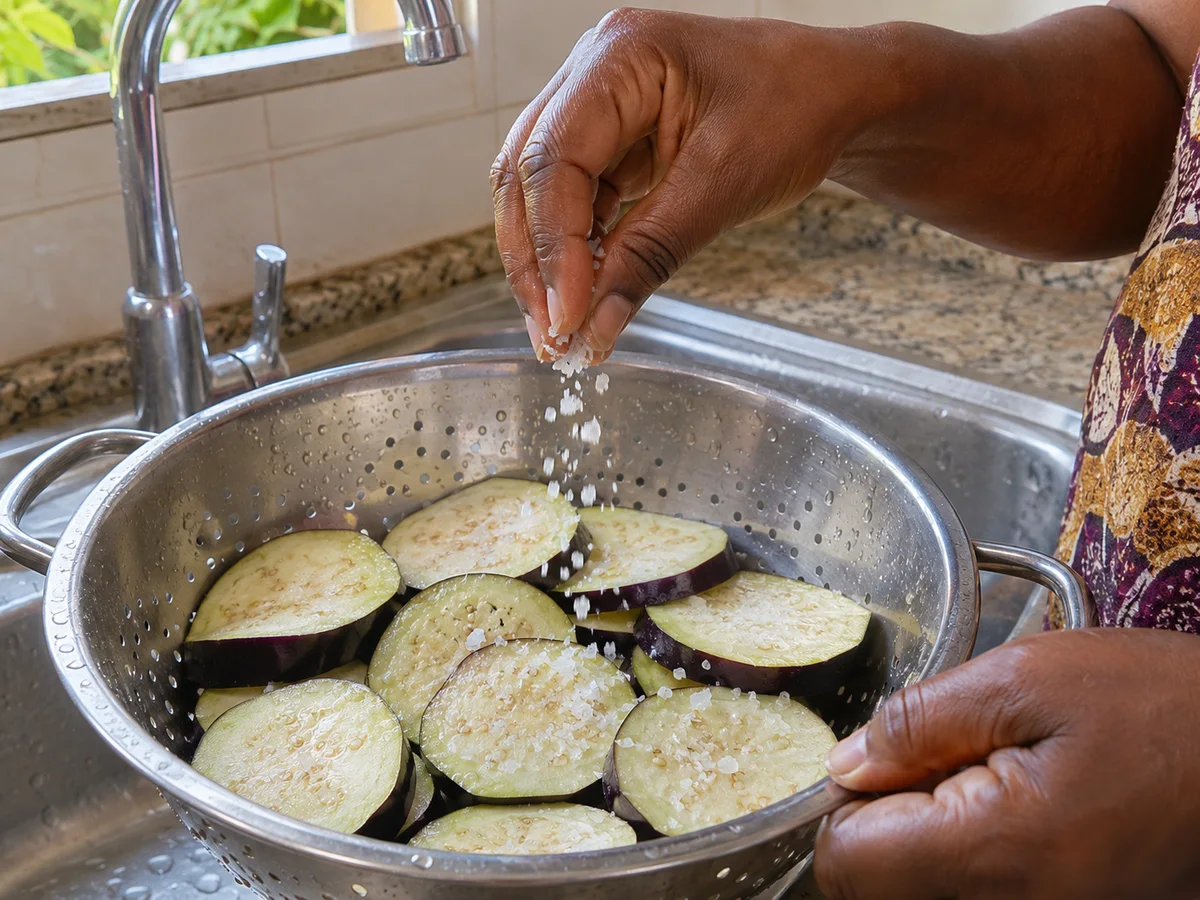
One French verb with different instructions
In culinary French, dégorger often means drawing some water from vegetables, notably with salt. Aubergine or cucumber slices become wet at the surface and release liquid beneath them. In other instructions the verb refers instead to placing food in water so that some material leaving it is not retained with it. The two meanings do not give the same directions: one can begin with salted vegetables outside water, the other with immersion. Ask first what is to be removed, then where the released material should go. Translating the instruction as simply soaking cucumber when the intention is to draw out moisture with salt would change the preparation. A useful dictionary explanation therefore needs the ingredient and the purpose, rather than one supposedly universal replacement word for every occurrence of the French verb.
What the references establish
The Académie du Goût glossary presents these meanings separately and includes aubergine, cucumber and tomato among its examples for salting. New Brunswick's professional cooking programme likewise records both soaking and sprinkling certain vegetables with salt to draw out water. Ricardo's discussion of salt also draws attention to perception when differently seasoned aubergine preparations are compared. These references help prevent an overbroad conclusion. Seeing liquid beneath vegetables does not prove that a particular bitter component was extracted. Finding a salted preparation less bitter does not, by itself, demonstrate the mechanism responsible for the difference. Nor do these examples make the process compulsory for every vegetable or assign it to a single country. Their value is to clarify what the cook does, what is observed and which claims require evidence beyond the visible liquid or the name of the step.
What a colander shows
When salted pieces rest in a colander, released liquid can move away rather than remaining against their lower surfaces. To understand the action in an image, the raw pieces, salt and perforated container should be distinguishable. This entry's illustration shows a hand distributing coarse salt over aubergine slices. It does not provide a quantity to copy or demonstrate the soaking meaning of the verb. A flat bowl can also collect released liquid around the pieces, but separating it must be possible if the recipe calls for that. A colander filled to its rim, with inaccessible lower layers, does not make even distribution easy. Think about the exposed vegetable surfaces and the destination of the liquid rather than treating one particular container as mandatory for all uses. The visible equipment supports an interpretation only when the actual food and action are also identifiable.
Adapt the action to the dish
For a cold garnish, releasing some water before assembly can prevent it diluting a dressing or collecting underneath the food at serving time. In a cooked preparation the question differs: vegetable moisture may be wanted as part of the cooking liquid, or may evaporate during cooking. Removing it in advance is therefore not always useful. The thickness of the pieces and the starting condition of the ingredient also affect the visible result. Small, already wet pieces need different consideration from large slices intended to retain some structure. Salt used to draw out water also contributes to seasoning. Removing the liquid does not necessarily remove all the added salt. Read together the salting instruction, what is done after resting, and when the final seasoning is adjusted. Treating those as one sequence prevents a useful preliminary step becoming an unwanted second dose of seasoning.
The soaking meaning and its limits
Professional glossaries also record a meaning involving water, allowing material that is not wanted to disperse away from some foods. That definition helps explain wording in an older or professional text. It is not, on its own, a hygiene recommendation. A dictionary label should not become an invitation to wash raw meat or an assumption that immersion disinfects food. The context here is culinary, and the illustration concerns salted vegetables only. To identify the soaking meaning in a particular recipe, look for the bath, the liquid to discard and the following step. A quick rinse or a simple pass through a colander does not establish that this specific technique occurred. Where the evidence is unclear, describe the observed action rather than forcing a technical name on it. That preserves the usefulness of the definition without extending it beyond the preparation it actually explains.
Draining, squeezing and desalting differ
Draining separates food from liquid it is in or liquid it releases. A colander may already allow this without a special waiting period. Drawing out moisture describes the action that encourages material to leave the food in the first place. Squeezing may use pressure or movement to expel water clinging to food; compressing an aubergine slice is different from leaving it to release liquid under salt. Desalting aims to reduce excess salt. The presence of a water bath does not automatically identify the soaking sense of dégorger, because salt removal may be the stated purpose instead. These verbs sometimes mark successive stages of one preparation. Keeping them distinct explains why a recipe might ask for salting, waiting and draining, rather than choosing one of those movements at random. In translation, state both the action and its intended object whenever one broad verb would leave the reader uncertain.
My advice: decide what the remaining food must do
Before salting vegetables, ask whether you want firm pieces, a garnish that will not thin a sauce, or vegetables cooked in their own juices. Then find what the recipe asks you to do with the released liquid. Food should not arbitrarily lose some flavour or receive double seasoning simply because a step contains the word dégorger. For a dictionary link, verify that the recipe actually demonstrates release of vegetable moisture or explicitly describes soaking in the sense being illustrated. An aubergine title, a colander photograph or a keyword in a search field is insufficient evidence. In a public-facing link, “aubergine salted to draw out moisture” tells the reader more than the French verb alone. They immediately know which meaning to look for and can compare the actual sequence with the explanation rather than guessing from an isolated label.
A reading and observation exercise
For a reading comparison, mark the ingredient, the added salt or water, and the destination of the released liquid. Then locate any final seasoning adjustment. Those details distinguish moisture removal from draining or desalting more reliably than a shared utensil does. They also explain why automatically adding the same salt again later can change the dish.
Sources and further reading
Académie du Goût — sens distincts · Ricardo — eau et perception de l’amertume